
Our best WooCommerce plugins to be visible in ChatGPT and the AI search engines
Three plugins so the machines finally know what you sell.
WordPress is readable to the models. WooCommerce is not: prices, variations and availability disappear into JavaScript. An assistant reading your page does not know what you sell — so it does not cite you.
Sound familiar?
A catalogue that vanishes into JavaScript
Prices, variations, availability: WooCommerce loads them on click. The model sees a title and an image.
Invisible to the assistants
ChatGPT recommends your competitor. Not because they are better — because they are legible and you are not.
Visibility nobody measures
Do you appear in Perplexity? On which questions? You do not know — so you optimise blind.
A search that only understands letters
Your customer describes what they want. Your search only understands the exact word — and finds nothing.
Our selection, ranked
Every module below is built, maintained and supported by our team. The ranking reflects what we would install first on a client store.
-
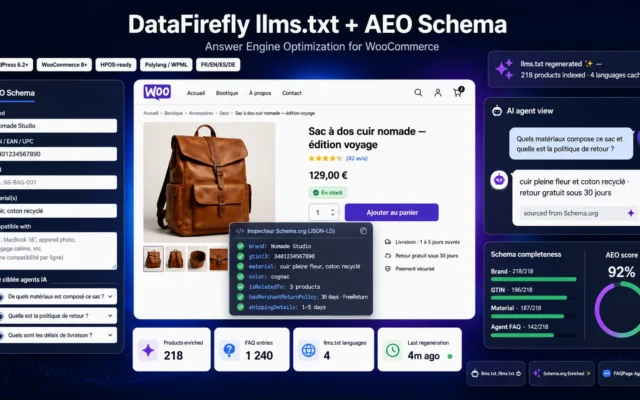
llms.txt and AEO schema. They bring back into the light what WooCommerce hides in JavaScript. Lowest cost, biggest effect.
Serve a dynamic llms.txt and enrich your WooCommerce product schema with the anti-hallucination data AI agents look for: brand, GTIN, materials, compatibility, agent-targeted FAQ,…
€19.00 View the module -
AEO Monitor & Optimizer — LLM Visibility (ChatGPT, Perplexity, Claude, Gemini, Mistral)
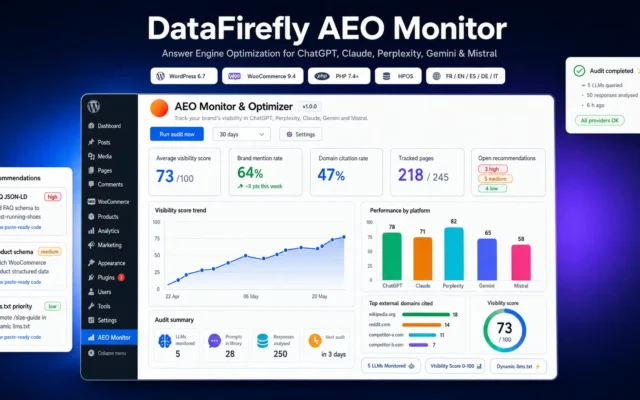
Measure whether you are namedChatGPT, Perplexity, Claude, Gemini, Mistral. And above all: which competitor stands beside you.
Track your brand in ChatGPT, Perplexity, Claude, Gemini and Mistral. Measure citation rate, identify pages poorly indexed by LLMs and generate ready-to-paste fixes: FAQ…
€59.00 View the module -
Vector Search Native — AI Semantic Search for WooCommerce
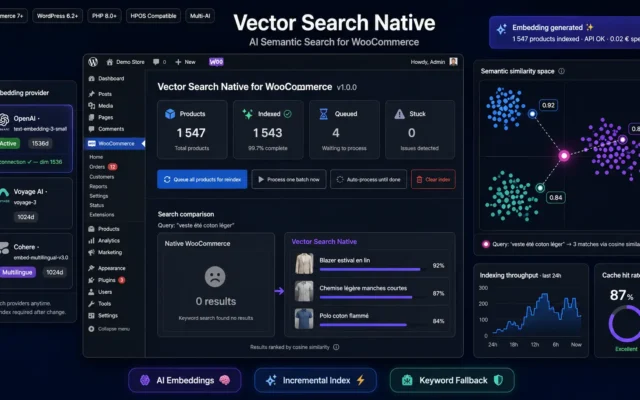
Meaning, not lettersSemantic search: your customer describes what they want instead of guessing the exact word. The same mechanism as the assistants.
Turn the WooCommerce search bar into a semantic engine. Customers who can't remember the exact product name still find it, thanks to meaning-based similarity…
€59.00 View the module
Side-by-side comparison
| Module | Best for | Price | Rating | Link |
|---|---|---|---|---|
| llms.txt + AEO Schema WooCommerce — AI SEO & Agent FAQ | Start here | €19.00 | — | |
| AEO Monitor & Optimizer — LLM Visibility (ChatGPT, Perplexity, Claude, Gemini, Mistral) | Measure whether you are named | €59.00 | — | |
| Vector Search Native — AI Semantic Search for WooCommerce | Meaning, not letters | €59.00 | — |
WordPress is readable — WooCommerce is not
Here is the paradox: WordPress produces clean, semantic HTML that models read effortlessly. But the moment WooCommerce is added, the essentials disappear into JavaScript, into variations, and into prices that only appear on click.
A language model reading your product page then sees a title, an image — and little else. It cannot cite you, because it does not know what you sell.
Citability is not a ranking question
An assistant does not rank. It selects, summarises and attributes to one source. To be selected, your data must be unambiguously structured — not pretty, but machine-readable.
And you cannot optimise what you do not measure
Do you appear in ChatGPT? In Perplexity? On which questions — and with which competitor beside you? Without an answer to those three questions, you are optimising blind.
Further reading
Two in-depth guides from the blog complete this selection: understanding AEO and topic clusters and topical authority.
How to choose
The WooCommerce problem WordPress does not have
WordPress produces clean, semantic HTML — models read it effortlessly. WooCommerce, by contrast, often hides prices, variations and availability in JavaScript. A model reading your product page sees a title and an image — little else. It cannot cite you, because it does not know what you sell.
Become readable first
llms.txt and the AEO schema. It is the cheapest building block, the fastest — and the one whose absence costs the most. Without it, the models have to guess your store from your HTML, and they guess badly.
Then measure — in that order
Do you appear in ChatGPT? In Perplexity? On which questions? And above all: which competitor stands beside you? That is the real information. Measure only after you have become readable — otherwise you measure the zero state and optimise against nothing.
The side effect nobody mentions
What an assistant finds citable — clear structure, clean data, factual answers — is exactly what Google has rewarded for years. AEO is not a break with SEO: it is its continuation with different recipients. The investment pays twice.
What you gain
Read by the assistants
llms.txt and AEO schema describe your store in a format models read natively.
What WooCommerce hides
WooCommerce hides the essentials in JavaScript. Structured data brings them back into the light.
Measure whether you are cited
Finally know whether you appear in ChatGPT, Perplexity, Claude, Gemini and Mistral — and on which questions.
See who else gets cited
Not just whether you are cited: which competitor stands beside you. That is the real information.
A search that understands meaning
Semantic search: your customer describes what they want instead of guessing the exact word.
AEO and SEO at once
What an assistant finds citable is what Google has rewarded for years. The investment pays twice.
From install to results
-
Understand what the model actually sees
Prices, variations, availability: WooCommerce loads them on click. The model never sees them.
-
Become readable first
llms.txt and AEO schema. The cheapest building block and the one whose absence costs the most.
-
Then measure, in that order
Only after you have become readable — otherwise you measure the zero state and optimise against nothing.
-
See who stands beside you
Not just whether you are cited: who else is. That is the real information.
-
AEO is not a break with SEO
What an assistant finds citable is what Google has rewarded for years. The investment pays twice.
“We thought we were well optimised: Yoast green, clean sitemap. Then we measured what ChatGPT actually sees on our page. It saw a title and an image. Our prices, our variations — none of it existed as far as the machine was concerned.”
Frequently asked questions
Why is WooCommerce hard for AI to read?
Because WordPress and WooCommerce do not have the same problem. WordPress produces clean, semantic HTML — models read it effortlessly. WooCommerce, by contrast, often hides prices, variations and availability in JavaScript that loads only on click. A model reading your page sees a title and an image — little else.
What exactly is llms.txt?
It is a file at the root that describes to models what you sell and how your catalogue is organised. Like robots.txt, but for understanding rather than crawling. It is the cheapest first step — and the one whose absence costs you the most.
How do I know whether ChatGPT cites me?
Without measurement you do not know — and you optimise blind. The AEO monitor puts to the assistants the questions your customers would ask, and shows you whether you get cited. And above all: who else gets cited. That is the real information.
Is a classic SEO plugin not enough?
Yes, and it is a common misconception. Yoast and Rank Math optimise your ranking: titles, meta descriptions, sitemap. AEO optimises your citability: can a machine understand what you sell? They are two distinct disciplines that overlap but do not replace each other.
Does AEO conflict with my classic SEO?
Barely, and that is the good news. What an assistant finds citable — clear structure, clean data, factual answers — is exactly what Google has rewarded for years. AEO is not a break with SEO, it is its continuation with different recipients.
What does semantic search bring here?
It understands meaning rather than letters. Your customer describes what they want without guessing the exact word — and still finds it. It is the same mechanism that drives the assistants: meaning rather than character string. Your store becomes readable to humans for the same reason it becomes readable to machines.
Where do I start?
Start with llms.txt and the AEO schema: low cost, immediate effect, no prerequisite. Measure afterwards, with the monitor. In that order — otherwise you measure the zero state and optimise against nothing.
Which metric should I track?
Your citation rate on the questions your customers actually ask — not your traffic. An assistant passes no classic referrer; you will never see that traffic cleanly in Analytics. What you can measure is whether you get named. And that is the number that counts.
This need on other platforms
Not sure which one fits your store?
Tell us your context — we answer with a straight recommendation, not a sales pitch.