
Our best PrestaShop modules to be visible in ChatGPT and the AI search engines
Six modules to appear in the AI answers — and to sell there tomorrow.
Your future customers are not asking Google any more — they are asking ChatGPT. And an assistant gives back one name, not ten links. These modules decide whether that name is yours.
Sound familiar?
Invisible to the assistants
ChatGPT recommends your competitor. Not because they are better — because they are legible and you are not.
Bots you cannot see
GPTBot, ClaudeBot, PerplexityBot are walking through your store. You do not know when, how often, or what they take.
A decision with no basis
Block to protect your content? Allow to get cited? With no data, you decide blind.
A store that says nothing to agents
The assistant buys on the user's behalf. Your store does not answer — so it buys elsewhere.
Our selection, ranked
Every module below is built, maintained and supported by our team. The ranking reflects what we would install first on a client store.
-
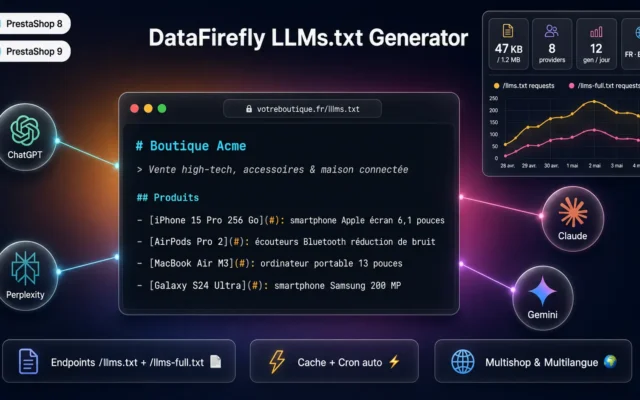
llms.txt describes your store in a format the models read natively. Lowest cost, biggest effect, no prerequisite.
Expose your PrestaShop catalogue to LLMs (ChatGPT, Claude, Perplexity, Gemini) via the standard llms.txt and llms-full.txt files. Automatic generation, smart cache, multistore & multilingual.
€59.00 View the module -
AI Crawler Manager — PrestaShop 8 & 9
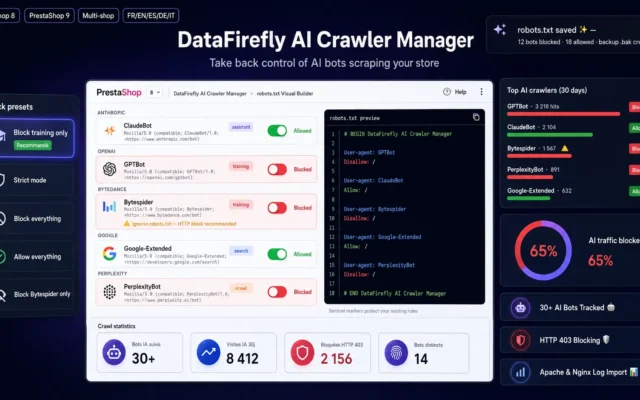
Control and visibility30+ AI bots detected, visual robots.txt builder, block or allow per bot and per page. The decision is finally yours.
Fine-grained AI bot management (GPTBot, ClaudeBot, PerplexityBot, Google-Extended, Bytespider and 25+ more) with visual robots.txt builder, HTTP 403 blocking and crawl statistics. PrestaShop 8…
€59.00 View the module -
Traffic Radar — Real-time traffic & AI crawlers for PrestaShop 8 & 9
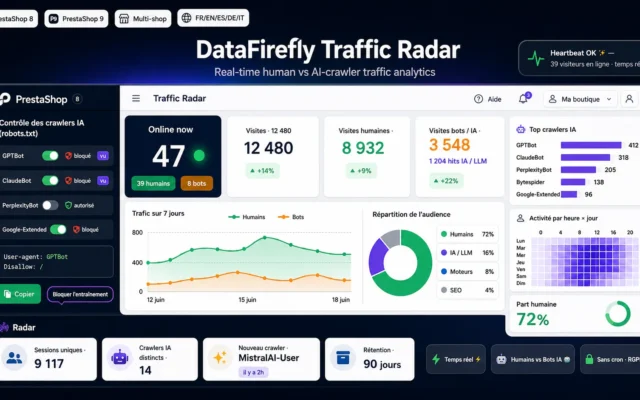
Measure before optimisingSee in real time which AI bot visits you, when and where. Without that baseline you optimise blind.
Turn your back office into a traffic control tower: live visitors, a clean humans / bots / AI crawlers split, charts, heatmap and AI…
€49.00 View the module -
AI People Also Ask (PAA) & Rich Snippets for PrestaShop
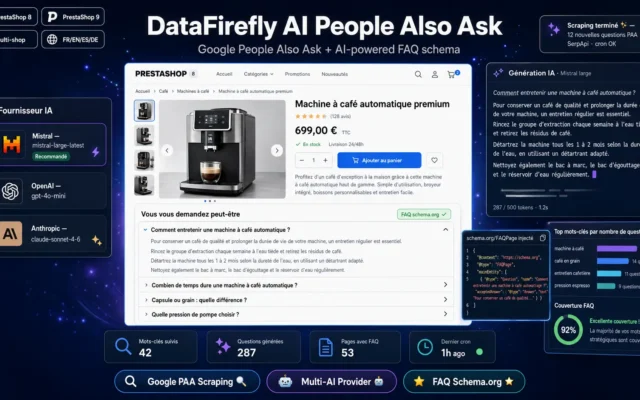
Best for getting citedPAA questions answer users' exact phrasings, with clean markup. The most citable content there is.
Scrape Google's "People Also Ask" on your target keywords, generate answers with Mistral, OpenAI or Anthropic, and publish a schema.org FAQ on your product…
€99.00 View the module -
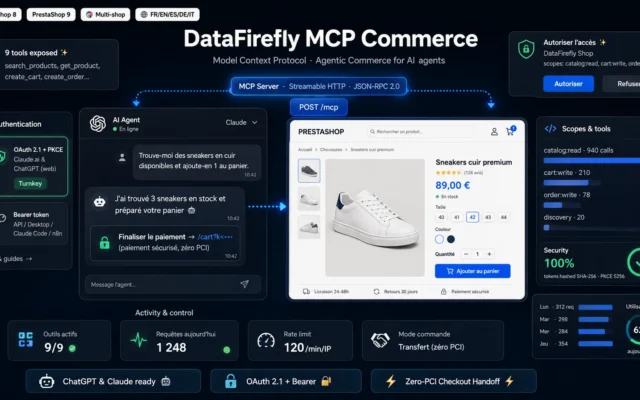
DataFirefly MCP Commerce — PrestaShop MCP Server / Agentic Commerce
The edge nobody hasMCP server: your catalogue becomes queryable by agents. You are no longer merely citable, you are addressable.
Expose your PrestaShop store to AI agents (ChatGPT, Claude) through an MCP server. Catalogue, cart and order driven by AI, with OAuth 2.1 and…
€89.00 View the module -
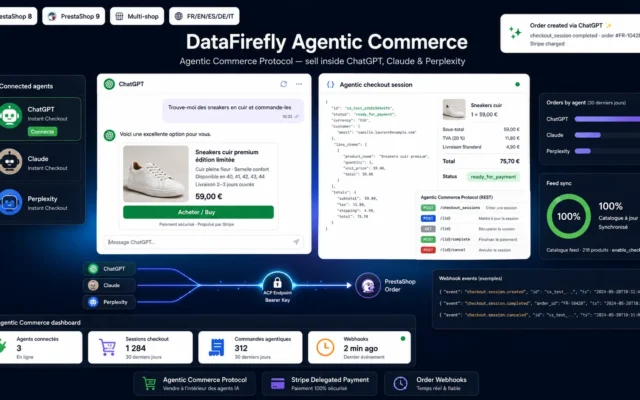
ChatGPT Checkout Module for PrestaShop 8 & 9 – Agentic Commerce Protocol (ACP)
Purchase in the chatAgentic Commerce Protocol: the assistant completes the purchase inside the conversation. An edge today, table stakes tomorrow.
Expose your catalogue and checkout to AI agents (ChatGPT, Claude, Perplexity) through the Agentic Commerce Protocol. 5 conformant REST endpoints, real PrestaShop order, Stripe…
€99.00 View the module
Side-by-side comparison
| Module | Best for | Price | Rating | Link |
|---|---|---|---|---|
| LLMs.txt PrestaShop — AI Visibility for ChatGPT, Claude & Perplexity | Start here | €59.00 | — | |
| AI Crawler Manager — PrestaShop 8 & 9 | Control and visibility | €59.00 | — | |
| Traffic Radar — Real-time traffic & AI crawlers for PrestaShop 8 & 9 | Measure before optimising | €49.00 | — | |
| AI People Also Ask (PAA) & Rich Snippets for PrestaShop | Best for getting cited | €99.00 | — | |
| DataFirefly MCP Commerce — PrestaShop MCP Server / Agentic Commerce | The edge nobody has | €89.00 | — | |
| ChatGPT Checkout Module for PrestaShop 8 & 9 – Agentic Commerce Protocol (ACP) | Purchase in the chat | €99.00 | — |
Search no longer happens only on Google
A growing share of your future customers will never discover your products through a classic list of results. They will ask ChatGPT, Perplexity or Claude — and get a name in reply, not ten blue links. That name is either yours or your competitor’s.
This is not speculation about the future: those assistants are crawling your store right now, with their own bots, their own rules and their own idea of what counts as a citable source. Most merchants do not even know they come by.
AEO is not SEO under a new name
Classic SEO optimises for ranking. AEO (Answer Engine Optimisation) optimises for citability. An assistant does not rank — it selects, summarises and attributes to a source. To be selected, your content must be machine-readable: unambiguously structured, factual, directly answering.
Concretely that means: an llms.txt file describing your store to the models; a clean question-and-answer format; structured data that leaves nothing to guess; and control over which bots you let through.
The step almost nobody has taken
Agentic commerce. The assistant does not merely discover your product — it buys it, on the user’s behalf. An MCP server and support for the Agentic Commerce Protocol make your store connectable by agents. Today that is an edge. In eighteen months it will be table stakes.
Further reading
Three in-depth guides from the blog complete this selection: understanding AEO, AEO applied to PrestaShop 8 and topic clusters and topical authority.
How to choose
Order matters more here than anywhere else
Start with llms.txt. It is the cheapest building block, the fastest, and the one whose absence costs the most. Without it, the models have to guess your store from your HTML — and they guess badly.
Then measure before optimising
Install the AI Crawler Manager and Traffic Radar before doing anything else. You will discover which bots already visit — the numbers almost always surprise — and you will get a baseline. Without that baseline you will never know whether anything worked.
The strategic call nobody can make for you
Block or allow? Blocking protects your content — and removes you from the answers, while competitors who allow get cited there instead. Allowing makes you citable — and exposes your catalogue. Our position: open the product pages (that is where you want to be cited), protect the editorial content if it is your capital, and throttle the rate in every case.
The edge that will close
Agentic commerce is empty today. An MCP server and ACP support put your store in a field almost nobody occupies. That edge will not last forever — but while it does, an agent choosing between you and a store that does not answer will choose you.
What you gain
Read by the assistants
llms.txt describes your store in a format the models read natively. The first building block of AI visibility.
AI crawlers under control
You decide which bots get through, at what rate and on which pages. Visibility without losing control.
Citable content
PAA questions answer the exact phrasings users put to assistants — with clean schema.org markup.
Finally measure who reads you
Traffic Radar shows in real time which AI bot visits you, when and where. You cannot optimise what you do not measure.
A store open to agents
MCP server: your catalogue becomes queryable by agents. You are no longer merely citable, you are addressable.
Purchase inside the chat
ACP support: the assistant can buy right inside the conversation. The step almost nobody has taken.
From install to results
-
Install llms.txt first
The cheapest building block and the one whose absence costs the most. Without it, the models guess your store — and guess badly.
-
Measure before optimising anything
Crawler Manager and Traffic Radar. You will discover who already visits — the numbers almost always surprise.
-
Decide: block or allow
Open the product pages (that is where you want to be cited), protect the editorial content if it is your capital.
-
Make your content citable
PAA questions with clean markup. You do not get cited for being optimised, you get cited for answering clearly.
-
Open the store to agents
MCP server and ACP. A field almost nobody occupies — and an agent picks the store that answers.
“We installed Traffic Radar to see whether AI bots were visiting. We expected almost nothing. Within a month they had crawled more pages than Googlebot.”
Frequently asked questions
What separates AEO from classic SEO?
SEO optimises for ranking, AEO for citability. An assistant does not rank — it selects, summarises and attributes to one source. It does not cite the "best optimised" page, it cites the one that gives a clear, factual, machine-readable answer. Two distinct disciplines that overlap but do not replace each other.
What exactly does llms.txt do?
It is a file at the root of your store that describes to language models what you sell, how your catalogue is organised, and which pages carry the authority. Like robots.txt, but for understanding rather than crawling. It is the cheapest first step, and the one whose absence costs you the most.
Do AI crawlers really visit my store?
They already do — most merchants simply do not know it. GPTBot, ClaudeBot, PerplexityBot and a dozen others have been crawling European stores for over a year. Traffic Radar shows you precisely who comes, when, and on which pages. The numbers almost always surprise.
Should I allow or block the AI bots?
It is a strategic decision, not a technical one. Blocking protects your content but removes you from the answers — alongside your competitors who do let them through. Allowing makes you citable but exposes your catalogue. The AI Crawler Manager lets you be granular: open the product pages, block the blog, throttle the rate.
Is agentic commerce worth it already?
The competitive advantage is at its maximum precisely because almost nobody does it. An MCP server makes your catalogue queryable by agents; ACP lets the assistant complete the purchase inside the conversation. In eighteen months it will be table stakes — like responsive design in 2015. Those who arrive early get chosen.
Does AEO conflict with my classic SEO?
Barely, and that is the good news: what an assistant finds citable — clear structure, factual answers, clean structured data — is exactly what Google has rewarded for years. AEO is not a break with SEO, it is its continuation with different recipients. The investment pays twice.
How do you measure traffic coming from assistants?
Not with the usual tools: an assistant passes no classic referrer. What is measurable is crawler activity (who reads you, how often) and the direct visits that follow a conversation. That is why Traffic Radar sits in this selection — without measurement you optimise blind.
Do I need to install everything at once?
No. Start with llms.txt and the Crawler Manager: low cost, immediate effect, no prerequisite. The rest follows your priorities. Agentic commerce only makes sense once the rest is in place — letting an agent into a store no model can understand achieves nothing.
This need on other platforms
Not sure which one fits your store?
Tell us your context — we answer with a straight recommendation, not a sales pitch.