
Our best WooCommerce plugins to sell internationally
Four plugins — and an order of operations where language doesn't come first.
Translating isn't selling. VAT first — because it applies retroactively, then language, then returns. Do it the other way round and you get a pretty store and a tax bill.
Sound familiar?
A tax that hits backwards
The EU threshold applies from the sale that breaks it. Not from the day you noticed.
A half-translated page
Title translated, attributes not. The customer sees it instantly — so does Google.
A return from abroad
It often costs more than the order brought in. And nobody does the arithmetic.
Revenue per country as an illusion
A market can sell a lot and still cost you money. Revenue hides it.
Our selection, ranked
Every module below is built, maintained and supported by our team. The ranking reflects what we would install first on a client store.
-
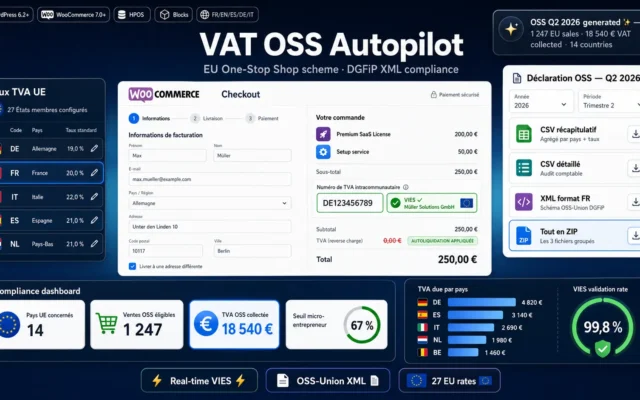
VAT OSS Autopilot — Real-time EU VAT & OSS return
First — it applies retroactivelyThe EU threshold in sight, the destination rate applied automatically. The one item you pay rather than correct.
Automate your WooCommerce store intra-EU VAT end-to-end: correct rate per delivery country, real-time VIES validation of B2B numbers, and one-click quarterly OSS return generation…
€49.00 View the module -
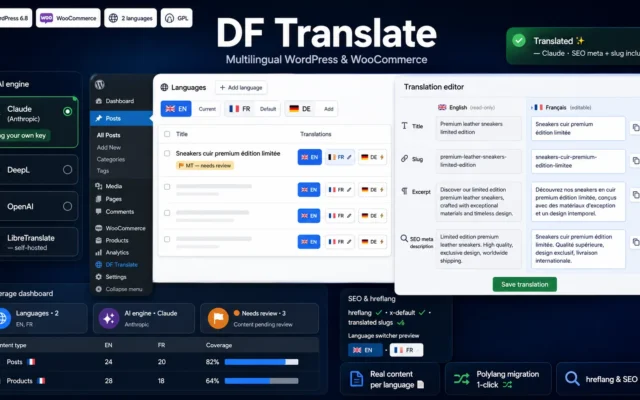
DF Translate — AI Multilingual Translation for WordPress & WooCommerce (free)
Test before you payFree. One market, one language. If it doesn't answer, you've only lost time.
Make your WordPress site and WooCommerce store truly multilingual: real content per language, AI translation with your own key (Claude, DeepL, OpenAI, LibreTranslate), hreflang,…
€0.00 View the module -
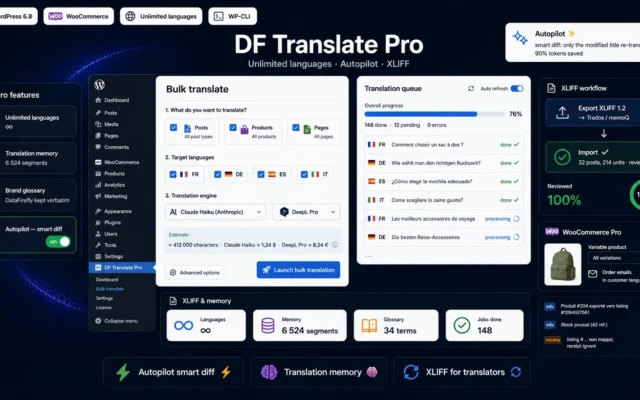
DF Translate Pro — Multilingual Translation at Scale for WordPress & WooCommerce
When the market answersLarge catalogues, workflows, quality control. Not before — after.
The Pro add-on for DF Translate: unlimited languages, bulk translation with cost estimation, autopilot with smart diff, translation memory, glossary, WooCommerce variable products, order…
€99.00 View the module -
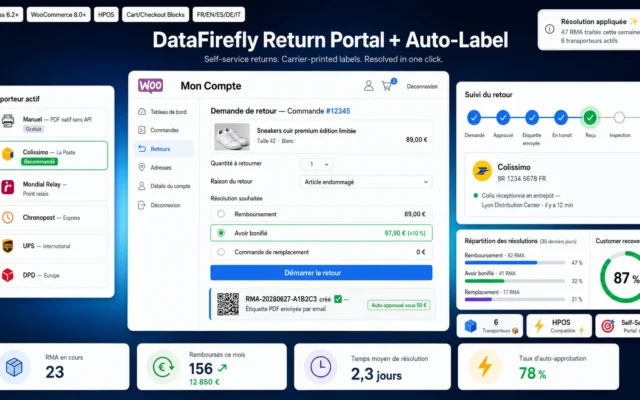
Return Portal + Auto-Label for WooCommerce
The quiet cost centreA cross-border return often costs more than the order's margin. Plan for it.
Self-service customer return portal with automatic multi-carrier label generation (Colissimo, Mondial Relay, Chronopost, UPS, DPD), admin inspection workflow, and resolution engine (refund, bonus store…
€79.00 View the module
Side-by-side comparison
| Module | Best for | Price | Rating | Link |
|---|---|---|---|---|
| VAT OSS Autopilot — Real-time EU VAT & OSS return | First — it applies retroactively | €49.00 | — | |
| DF Translate — AI Multilingual Translation for WordPress & WooCommerce (free) | Test before you pay | €0.00 | — | |
| DF Translate Pro — Multilingual Translation at Scale for WordPress & WooCommerce | When the market answers | €99.00 | — | |
| Return Portal + Auto-Label for WooCommerce | The quiet cost centre | €79.00 | — |
Translating isn’t selling
A store that’s translated but not tax-compliant, and not prepared for cross-border returns, sells once — and loses money afterwards. Language is the visible part. The expensive parts are invisible.
Machine translation isn’t your problem
Google doesn’t penalise machine translation as such; it penalises content with no value. What actually hurts you is something else: the half-translation. An English product page with German attributes, a checkout that switches language halfway — the inconsistency costs more than any accent.
And the order isn’t the one you’d expect
VAT first — because it applies retroactively. Then language. Then returns. Do it the other way around and you get a pretty store and a tax bill.
How to choose
Tax first — because it applies backwards
It sounds unromantic, but it's the only item you pay afterwards rather than correct. The EU threshold for cross-border consumer sales applies from the sale that crosses it — and WooCommerce isn't counting for you.
Then language — but all of it
Machine translation isn't what hurts you. The half-translation is. Title translated, attributes not. Product page translated, checkout not. The customer sees that inconsistency instantly — and it costs more than any accent.
Test before you pay
Start with the free plugin and one market. If it doesn't answer, you've lost nothing. If it does, scale — and the professional version pays for itself.
And budget for the return before it arrives
A return from abroad often costs more than the order brought in. It's the quietest way to lose money in export: revenue rises, margin falls, and nobody does the arithmetic.
What you gain
First, what costs you backwards
The EU threshold applies retroactively. It's the first step, not the last.
Fully translated, not half
Products, categories, SEO fields. Including what the customer doesn't read but Google does.
Test before you pay
A free plugin to check whether the market responds at all — before you invest.
Scale when it's worth it
When the market answers: large catalogues, workflows, quality control.
Returns that were budgeted for
A cross-border return costs more than the order's contribution. It belongs in the plan.
The right rate, in the right country
The destination country's rate, automatically. No end-of-quarter calendar roulette.
From install to results
-
Check the EU threshold
It applies from the sale that breaks it. Not from the day you noticed.
-
Test one language, not five
Free, one market. If it doesn't answer, you've lost nothing.
-
Translate completely
Titles, attributes, checkout, SEO. The half-translation hurts more than the accent.
-
Budget for the return
It often costs more than the order's margin.
-
Measure margin per country
Not revenue per country. A market can sell a lot and cost you money.
“We translated into four languages over a year. We sold in two. And in one of those we lost money — the returns cost more than the margin. Had we tested first, we'd have known.”
Frequently asked questions
Does Google penalise machine translation?
No. Google penalises content with no value — not the technique used to produce it. What actually hurts you is the half-translation: a page in one language, its attributes in another, a checkout that switches halfway through.
Where do I start when selling abroad?
With VAT, unromantic as that sounds. Language can be fixed tomorrow; a tax rate charged wrongly for six months can only be paid. The EU threshold applies from the sale that crosses it.
How do I test a market without investing much?
With the free plugin and a single market. If nobody buys, you've lost nothing but time. If it works, you scale — and then the professional version pays for itself.
Why take returns so seriously?
Because it costs more than the order brought in. Cross-border returns are the quietest way to lose money abroad: revenue rises, contribution falls, and nobody does the arithmetic.
Which metric shows a market is working?
Margin per country, not revenue per country. A market can sell a lot and still cost you money — through tax rate, shipping and return rate. Revenue alone is especially misleading in export.
Does a multilingual store dilute my SEO?
Only if you translate it half-heartedly. One extra language, fully maintained, is a gain; five languages half-maintained are five bad stores. Fewer markets, done properly.
Is a market where I sell nothing worth it?
Yes — and that's the whole point of the order of operations. Check whether the market answers, then invest. Most stores do the opposite and fund a perfect translation for a country that was never going to buy.
This need on other platforms
Not sure which one fits your store?
Tell us your context — we answer with a straight recommendation, not a sales pitch.