
Everything you'd want to know before you install.
A detailed look at how LLMs.txt PrestaShop — AI Visibility for ChatGPT, Claude & Perplexity works, why we built it the way we did, and the thinking behind the features above.
§ 01
Why an llms.txt file?
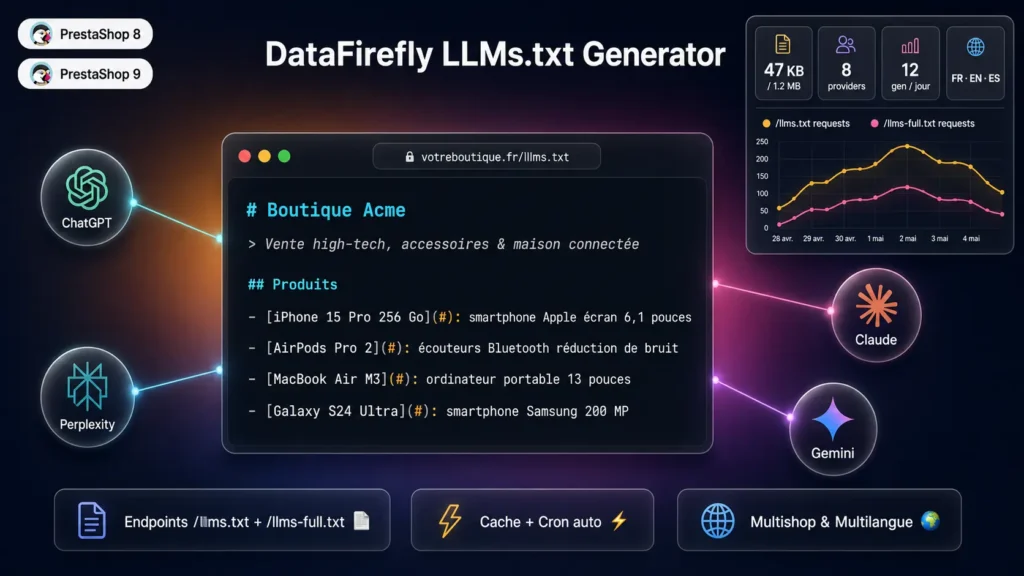
The llms.txt standard established itself in 2025 as the reference for exposing a website to Large Language Models (ChatGPT, Claude, Perplexity, Gemini). Unlike sitemap.xml which targets classic search engines, llms.txt offers a structured, readable and synthetic index specifically designed for generative AI. Without this file, your catalogue remains invisible — or poorly interpreted — by AI agents, which are becoming an increasingly important acquisition channel. With it, your products are correctly understood, cited and recommended by LLMs.
§ 02
Two files, two complementary uses
The module exposes llms.txt (condensed index: title + URL + summary for each catalogue entry) and llms-full.txt (full cleaned content, ideal for LLMs that want to deep-index without crawling each page individually). Both files are published automatically at your store root, accessible at yoursite.tld/llms.txt and yoursite.tld/llms-full.txt, with appropriate HTTP headers.
§ 03
Smart cache and performance
Generation is cached with a configurable TTL. Files served to AI crawlers always come from cache — zero impact on front-end performance. Catalogue hooks (create, edit, delete product, category, CMS, manufacturer, supplier) automatically invalidate the cache. For large catalogues, a token-secured cron pre-generates everything off-peak in a single call for all stores and all active languages.
§ 04
Custom multilingual sections
Beyond the raw catalogue, you can add free content: return policy, brand values, FAQ, delivery conditions or even LLM-specific instructions. Each section is multilingual, multistore, with configurable placement (before sources, after, or in the file footer) and drag-and-drop ordering.
§ 05
Extensible architecture for developers
The module exposes a Content Providers system that other modules can enrich via the actionDfLlmsTxtRegisterProviders hook. If you have a blog module, a product FAQ module, testimonials or customer cases, it can publish its content in the llms.txt without modifying dfllmstxt. Three generation hooks allow filtering or enriching content just before it is served.
§ 06
Exclusions and privacy
You keep full control over what is exposed. Exclusion lists by IDs (B2B products, internal categories, service CMS pages), out-of-stock filter, description field choice (short / long / both), and global entry count limit. The X-Robots-Tag: noindex header also guarantees the file will not pollute the Google index — it targets AI crawlers exclusively. Your classic SEO is unaffected.



There are no reviews yet.