
Our best PrestaShop modules to produce SEO content at volume
Five modules to make two hundred pages speak, without producing two hundred pages of rubbish.
The problem is not writing well — it is making two hundred pages speak. AI solves the volume problem, not the quality problem. These modules generate at volume; you keep the final word.
Sound familiar?
Two hundred empty meta descriptions
Two hundred pages, two hundred default titles. Google shows them — and nobody clicks.
A blog dead for eight months
The last post is from March. Not out of laziness — because nobody ever finds the time.
Questions no page answers
Your customers ask them every day. None of your pages answers a single one — and Google notices.
Pages that do not know each other
With no internal linking, every page is an island. Authority does not circulate, it dilutes.
Our selection, ranked
Every module below is built, maintained and supported by our team. The ranking reflects what we would install first on a client store.
-
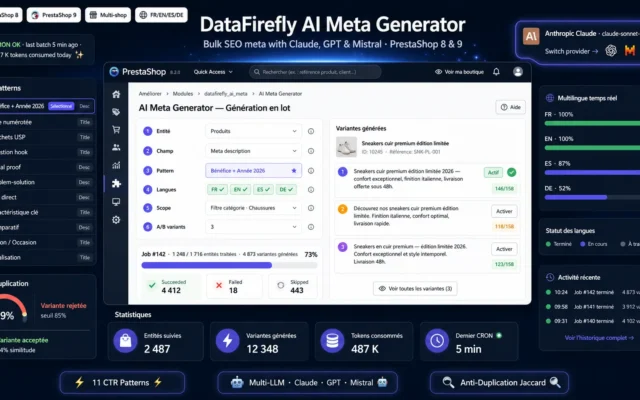
AI Generator for Meta Titles, Descriptions & ALT — PrestaShop
Install this firstMeta titles, descriptions and ALT in batch. Existing pages are already indexed — repairing them works in days, not months.
Bulk-generate meta titles, meta descriptions and ALT tags with AI (Claude, GPT, Mistral) using proven CTR patterns, A/B variants, multilingual support, SERP length control…
€149.00 View the module -
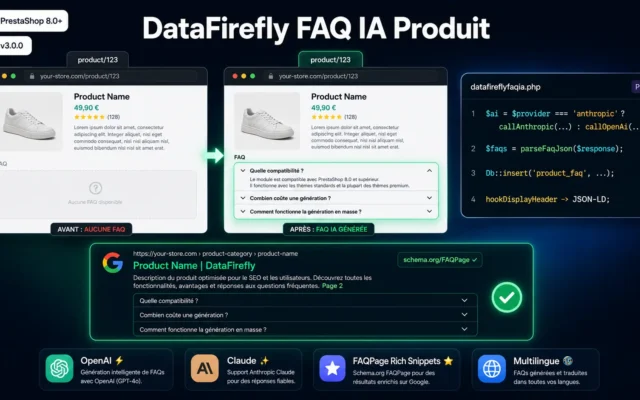
DataFirefly Product FAQ AI — Auto-generated product FAQ with Google rich snippets and OpenAI/Claude for PrestaShop 8
The best content leverAutomatic FAQ with QAPage markup. Qualified long-tail traffic on a page where a buy button is already waiting.
PrestaShop 8 module that auto-generates product FAQs with AI (OpenAI or Anthropic Claude). Google FAQPage rich snippets, multilingual, multi-shop, per-product FAQ editor, bulk generation,…
€79.00 View the module -
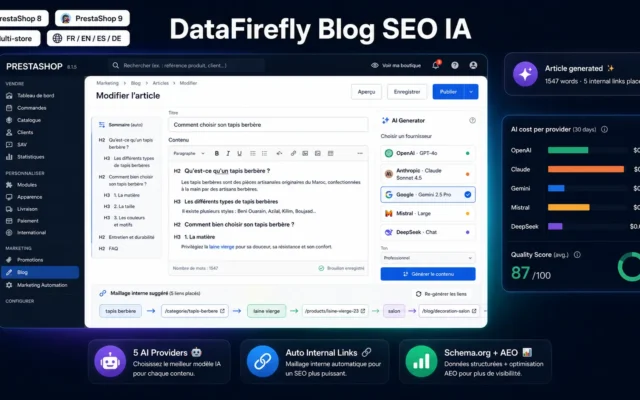
DataFirefly SEO AI Blog Pro — 1-click blog setup, bulk article suggestions and “1 article every N days” scheduling for PrestaShop 8 & 9 (OpenAI, Claude, Gemini, Mistral, DeepSeek)
The blog that does not dieOne-click setup, batch suggestions, "one article every N days" scheduling. Blogs die of friction, not ambition.
All-in-one fully-automated SEO AI blog for PrestaShop 8 & 9. An "Analyse my shop" button that builds your whole blog structure (categories, tags, authors,…
€149.00 View the module -
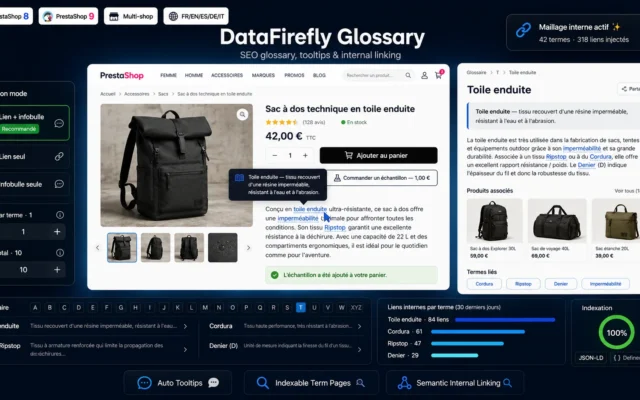
DataFirefly SEO Glossary — Industry term lexicon, automatic tooltips in your descriptions and internal linking to your products for PrestaShop 8 & 9
The under-rated leverTooltips on your specialist terms and automatic linking to products. Semantics and internal linking in one move.
Build a glossary of your industry terms: every occurrence in your product, category and CMS descriptions becomes a link with a tooltip pointing to…
-
External Blog Carousel for PrestaShop
Bring in external contentBlog carousel from an external source. Useful when your editorial content lives somewhere other than the store.
Display your external blog articles as a carousel on the PrestaShop homepage. Titles, descriptions, images and links entered manually from the back-office. Swiper.js, customisable…
€19.00 View the module

Side-by-side comparison
| Module | Best for | Price | Rating | Link |
|---|---|---|---|---|
| AI Generator for Meta Titles, Descriptions & ALT — PrestaShop | Install this first | €149.00 | — | |
| DataFirefly Product FAQ AI — Auto-generated product FAQ with Google rich snippets and OpenAI/Claude for PrestaShop 8 | The best content lever | €79.00 | — | |
| DataFirefly SEO AI Blog Pro — 1-click blog setup, bulk article suggestions and “1 article every N days” scheduling for PrestaShop 8 & 9 (OpenAI, Claude, Gemini, Mistral, DeepSeek) | The blog that does not die | €149.00 | — | |
| DataFirefly SEO Glossary — Industry term lexicon, automatic tooltips in your descriptions and internal linking to your products for PrestaShop 8 & 9 | The under-rated lever | €69.00 | 5.0 | |
| External Blog Carousel for PrestaShop | Bring in external content | €19.00 | — |
The real problem is not writing — it is volume
Anyone can write one good article. Nobody can hand-write unique meta tags, a FAQ and a real description for two hundred product pages. That is exactly where content SEO fails in e-commerce — not on quality, but on the sheer mass of pages that have something to say and say nothing.
A two-hundred-product catalogue is a catalogue with two hundred empty meta descriptions, two hundred unanswered questions, and a blog nobody has touched for eight months. That does not cost you a ranking — it costs you existence on hundreds of queries.
AI solves the volume problem, not the quality problem
A language model does not write a better article than you. It writes two hundred of them while you write one. That is the whole point, and it is also the limit: AI content nobody checks is content nobody reads.
The right split: the machine produces the draft at volume, the human reviews and nudges. Cut that second half and you produce exactly the thin content Google has been penalising for years.
Start with what already exists
Before writing a single new article: fill in the meta tags on your existing pages. Those pages are already indexed, they already carry authority, they already collect impressions. Giving them a good title works within days — a new article works within months.
Further reading
Two in-depth guides from the blog complete this selection: topic clusters and topical authority and the complete e-commerce SEO guide.
How to choose
The order that makes the difference
Start with what already exists, not with what is new. Your product pages are already indexed, already carry authority, already collect impressions. Giving them a good title and description works within days. A new blog post works within months.
Then the FAQ, before the blog
The product FAQ is the best content lever in e-commerce, and almost nobody uses it. It answers customers' exact phrasings, it carries QAPage markup, generative assistants quote it — and it sits on a page where a buy button is already waiting. A blog post brings traffic; a FAQ brings qualified traffic.
The rule that decides everything
Everything is generated as a draft, and you proofread. Reviewing two hundred meta tags takes an hour; writing them takes a week. That hour is exactly what separates your content from the thin content Google has been penalising for years. Skip it and you save an hour and lose a year.
The blog nobody maintains
If your blog has been dead for eight months, another manual push will change nothing. What works is scheduling: "one article every N days", auto-generated as a draft, which you review and publish in twenty minutes. Blogs do not die of ambition, they die of friction.
What you gain
The volume problem solved
Two hundred product pages with unique meta tags in one batch. By hand: impossible. That is precisely what AI is for.
A FAQ on every page
Automatically generated FAQs with clean schema.org markup: long-tail content that generative assistants also quote.
A blog that runs itself
One-click blog setup, batch topic suggestions, "one article every N days" scheduling. The blog stops dying.
Internal linking that builds itself
The glossary creates tooltips inside your descriptions and links automatically to your products. Semantics and internal linking at once.
The provider of your choice
You pick the provider: OpenAI, Claude, Gemini, Mistral, DeepSeek. No lock-in, you control cost and quality.
The human stays in the loop
Everything is generated as a draft. You keep the final word — and that is exactly what separates this content from thin content.
From install to results
-
Repair the meta tags first
Your pages are already indexed and collecting impressions. Giving them a good title works in days — not months.
-
Switch on the product FAQ
The best content lever in e-commerce, and almost nobody uses it. Qualified traffic on a page with a buy button.
-
Schedule the blog instead of wishing for it
Blogs die of friction. "One article every N days", auto-drafted: you review in twenty minutes.
-
Let internal linking build itself
Tooltips on specialist terms, automatic linking to products. Semantics and internal linking in one move.
-
Proofread — always
Reviewing two hundred meta tags: one hour. Writing them: one week. That hour separates your content from thin content.
“We started with the blog because it felt like the noble task. Six months later we discovered our two hundred product pages were getting impressions and no clicks — because not one had a decent title.”
Frequently asked questions
Does Google penalise AI-generated content?
No. Google penalises thin content, not AI content. The distinction is decisive: a text generated by AI, reviewed by a human, factually accurate and genuinely useful ranks just as well as a hand-written one. An empty, generic, unchecked text gets penalised — whether a machine or a tired human wrote it, Google does not care.
Where do you start?
With the meta tags on your existing pages. They are already indexed, already carry authority, already collect impressions — giving them a good title works within days. A new article works within months. Optimise what is already alive, then generate new material.
Do I have to proofread everything the AI generates?
Yes, and it is the most productive rule in this whole selection: everything is generated as a draft. Reviewing a batch of two hundred meta tags takes an hour — writing them by hand takes a week. You keep control, but you stop writing.
Blog posts or product FAQ — which first?
The product FAQ, without hesitation. It answers the exact phrasings customers type, it carries clean QAPage markup, and it is the format generative assistants quote most. A blog post brings traffic; a FAQ brings qualified traffic — on a page where a buy button is already waiting.
How much do the AI calls cost?
You control it entirely: you pick the provider (OpenAI, Claude, Gemini, Mistral, DeepSeek) and use your own API key. No markup, no subscription to us. Across two hundred product pages the cost runs to a few euros depending on the model — a fraction of what a copywriter would charge.
What stops me producing a thousand pages of rubbish?
Nothing — as long as you generate without checking. That is why all these modules produce drafts and prioritise: the pages with impressions but no clicks first. Publish everything at once without reading, and you build the exact thin-content problem you thought you were solving.
What is the SEO glossary for?
It detects your specialist terms in the descriptions, generates tooltips with the definition, and links to the matching products. Double effect: the customer understands (conversion) and internal linking builds itself (SEO). On technical catalogues it is the most under-rated lever there is.
How quickly do results show?
On the blog: allow three to six months, that is the nature of content SEO. On the meta tags: sometimes days — because you are not building something new, you are repairing pages that already collect impressions and simply fail to earn the click.
Not sure which one fits your store?
Tell us your context — we answer with a straight recommendation, not a sales pitch.