
Our best PrestaShop modules for Google Shopping and social ads
Three modules for channels that do not play the same role.
Google Shopping captures an intent. Meta creates a desire. Not the same role, not the same budget — and treating both with the same feed loses on both sides.
Sound familiar?
Products Merchant Center rejects
A rejected product is invisible. No bid in the world brings it back — and the rejection comes from a missing attribute.
One catalogue for every channel
You publish the same catalogue everywhere and hope. Google and Meta do not sell the same thing.
A Meta budget flying blind
The Meta pixel gets blocked. You switch off a campaign that was in fact selling.
An organic channel dead after three weeks
The last post is from March. Not from strategy — because nobody found the time.
Our selection, ranked
Every module below is built, maintained and supported by our team. The ranking reflects what we would install first on a client store.
-
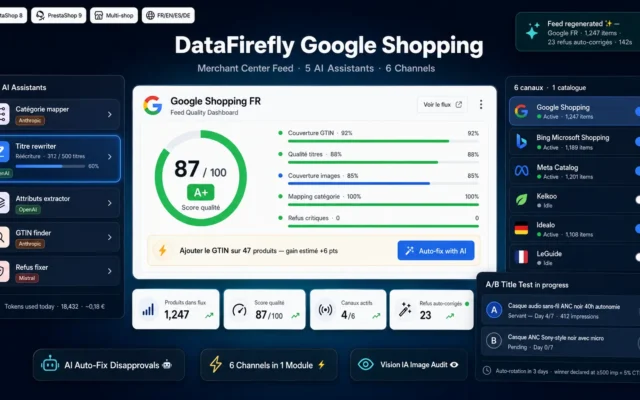
Google Shopping PrestaShop Module — Merchant Center Feed, AI & Multi-Channel
Almost always firstGoogle Shopping captures an existing intent. And the feed decides: a rejected product is invisible.
Premium PrestaShop module for next-generation Google Shopping export. Merchant Center feed compliant with latest 2025 rules, 5 AI assistants to rewrite titles, map categories…
Original price was: €219.00.€149.00Current price is: €149.00. View the module -
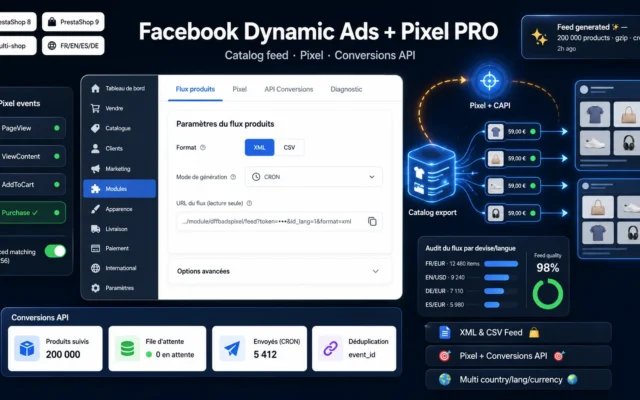
Facebook Dynamic Ads + Pixel PRO — Product Feed, Pixel & Conversions API (PrestaShop 8 & 9)
Meta with no blind spotsPixel AND Conversions API. Without a server-side event you switch off the campaign that sells.
Export your catalog to Facebook & Instagram (XML & CSV feeds), track conversions with the pixel and the Conversions API, and retarget your visitors.…
€89.00 View the module -
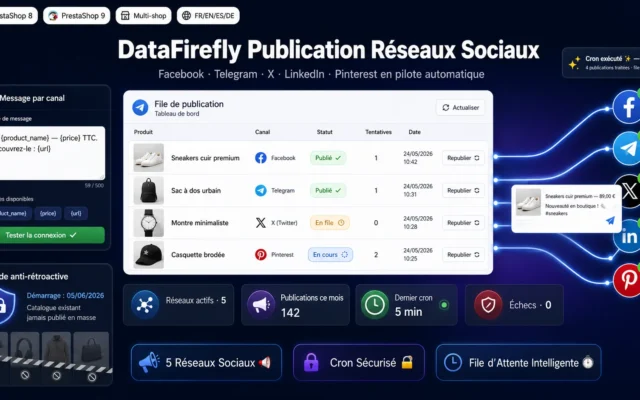
DataFirefly Social Autopost
The channel that dies of frictionAutomated publishing. Does not solve creativity — only the one problem that kills the channel.
Automatically post every new PrestaShop 8 or 9 product to Facebook, Telegram, X, LinkedIn and Pinterest: queue, secure cron, per-network customisable messages and an…
€149.00 View the module
Side-by-side comparison
| Module | Best for | Price | Rating | Link |
|---|---|---|---|---|
| Google Shopping PrestaShop Module — Merchant Center Feed, AI & Multi-Channel | Almost always first | Original price was: €219.00.€149.00Current price is: €149.00. | — | |
| Facebook Dynamic Ads + Pixel PRO — Product Feed, Pixel & Conversions API (PrestaShop 8 & 9) | Meta with no blind spots | €89.00 | — | |
| DataFirefly Social Autopost | The channel that dies of friction | €149.00 | — |
A channel is not an audience — it is a format
The commonest mistake is to publish the same catalogue everywhere and hope. But Google Shopping, Meta and social media do not sell the same things, nor in the same way.
Google Shopping captures an intent: the user is already searching. Meta creates a desire: the user is searching for nothing. Those are not the same role in the funnel — and treating both with the same feed and the same budget loses on both sides.
What decides success is the feed — not the campaign
People argue for hours about bids and audiences. But a product rejected by Merchant Center is an invisible product: no bid in the world brings it back. And rejections almost always come from missing attributes, not from strategy.
And tracking decides whether you even notice
Without server-side tracking you do not see part of your sales — and you switch off the campaign that actually works. This selection is therefore useless unless you measure properly first.
How to choose
Install what is not on this page first
Tracking. Without clean server-side tracking you do not see part of your sales — and you cut the budget of the campaign that actually works. Opening channels without being able to measure is the most expensive way to spend money. Everything on this page assumes it is done.
Then Google Shopping — almost always first
Because it captures an existing intent: the user is already looking for your product. You do not have to convince them they want it. Meta creates desire — harder, more expensive, and only effective on products that convince visually.
The feed decides, not the campaign
People argue for hours about bids while the real problem sits in the attributes. Missing GTIN, missing brand, a title with “-50%” in it: rejected. And a rejected product is invisible, however high your bid. Fix the feed before touching the campaign.
Meta without the Conversions API is Meta flying blind
The pixel gets blocked like any other. Without a server-side event you will never discover that the campaign you were about to switch off was in fact selling.
And organic posting?
It costs time rather than money — and time is exactly what is missing. An organic social channel almost always dies after three weeks, not from strategy but from friction. Automation does not solve creativity; it only solves the one problem that kills it.
What you gain
A feed that gets accepted
A rejected product is an invisible product. No bid in the world brings it back.
The right channel for the right role
Google captures intent, Meta creates desire. Not the same role, not the same budget.
Meta with no blind spots
Pixel AND Conversions API. Without server-side you do not see part of your sales.
The attributes that count
Title, GTIN, brand, condition: the attributes that decide rejection are built correctly.
An organic channel that survives
Social publishing automated. The organic channel stops dying after three weeks.
No channel without measurement
You cannot optimise what you do not measure — and a channel with no clean tracking is budget spent blind.
From install to results
-
Tracking first (not on this page)
Opening channels without being able to measure is the most expensive way to spend money. Everything here assumes it.
-
Start with Google Shopping
It captures an existing intent. The user is already searching — you do not have to convince them.
-
Fix the feed before bidding
Missing GTIN, a title with “-50%”: rejected. And a rejected product is invisible, however high your bid.
-
Meta only with the Conversions API
The pixel gets blocked like any other. Without a server-side event you are flying blind.
-
Automate the organic channel
It dies of friction, not strategy. Automation solves that one problem — and only that one.
“We spent two months optimising bids. Then we discovered 40% of our catalogue was being rejected by Merchant Center — for missing GTINs. No bid in the world would have fixed that.”
Frequently asked questions
Google Shopping or Meta — which first?
With Google Shopping, in almost every case — because it captures an existing intent. The user is already looking for your product; you do not have to convince them they want it. Meta creates desire: that is harder, more expensive, and only works on products that convince visually.
Why does the feed matter more than the campaign?
Because people argue about bids when the real problem is in the attributes. A product with no GTIN, no brand, or a title that breaks the rules gets rejected — and a rejected product is invisible, however high your bid. Fix the feed before touching the campaign.
Do I really need the Meta Conversions API?
Yes, and it is one of the most expensive blind spots in e-commerce. The Meta pixel gets blocked like any other. The Conversions API fires the event server-side — and you discover that the campaign you were about to switch off was in fact selling. Without it you steer Meta blind.
Is organic posting still worth it?
Because it costs time rather than money — and time is exactly what is missing. An organic social channel almost always dies after three weeks, not from strategy but from friction. Automating publication does not solve creativity, but it solves the one problem that kills it: nobody ever finds the time.
What causes most Merchant Center rejections?
Almost always the attributes: missing GTIN, missing brand, condition not stated, titles containing promotional words (“SALE”, “-50%”), images with watermarks. Almost never the strategy. That is why a module that builds the feed correctly costs less than a week spent chasing rejections by hand.
Do paid channels replace my SEO?
No — and anyone claiming otherwise is selling you advertising. Google Shopping and Meta work on the same principle as SEO: a badly described product sells nowhere. The difference is that advertising makes you pay for visibility, while SEO lets you keep it.
What do I install before the channels?
Tracking. Without clean server-side tracking you do not see part of your conversions — and you cut the budget of the campaign that sells. Opening channels without measuring properly is the most expensive way to spend money.
Paid advertising or SEO — must I choose?
Yes, and it should be said plainly: paid advertising stops the moment you stop paying. It is an accelerator, not an asset. Putting your whole budget into ads and nothing into SEO means renting your traffic — and the lease ends the day the cash runs out.
Not sure which one fits your store?
Tell us your context — we answer with a straight recommendation, not a sales pitch.