
Everything you'd want to know before you install.
A detailed look at how DataFirefly Accounting Export — FEC, Sage, EBP, Ciel, Pennylane works, why we built it the way we did, and the thinking behind the features above.
§ 01
Why a multi-format accounting export for PrestaShop?
Every PrestaShop shop produces hundreds, sometimes thousands of orders and credit notes every month that need to be integrated into accounting. Without a dedicated tool, the operation is done manually, line by line, or through clumsy Excel exports that the accountant has to clean up. This module eliminates that repetitive work: it generates, in a few clicks from your back office, a file in the exact format expected by your accounting software or accountant. No more manual entry, no more decimal comma errors, no more missed accounts.
§ 02
FEC compliance: ready for a tax audit
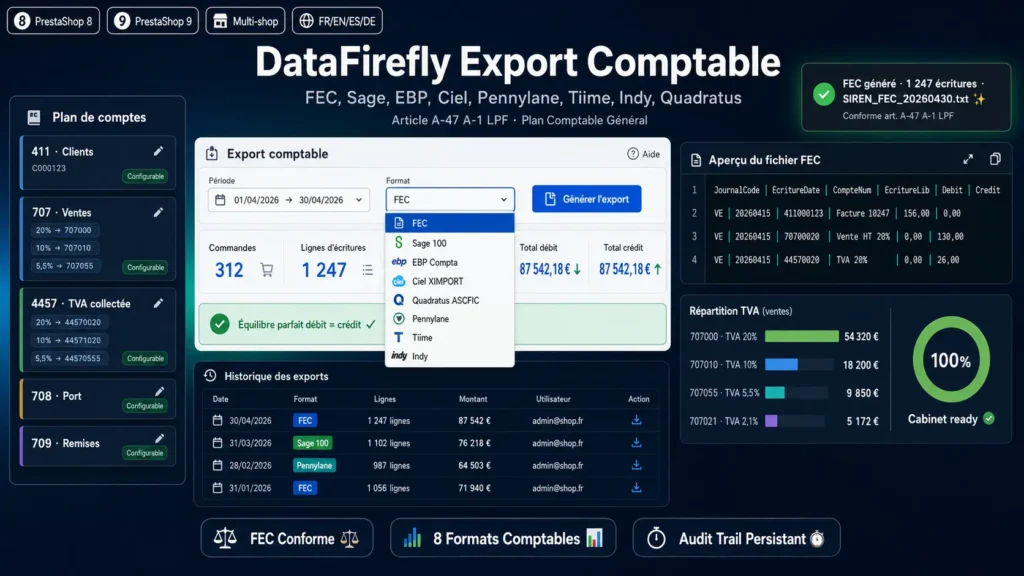
The FEC (Fichier des Écritures Comptables) is a French legal requirement defined by article A-47 A-1 of the French Tax Procedures Code. Any company that keeps its accounting electronically must be able to produce this file during a tax audit. Our FEC exporter strictly follows the official format: 18 pipe-separated columns, dates in YYYYMMDD format, absolute amounts with a direction column, file name made of SIREN + FEC + closing date, UTF-8 encoding without BOM. Fill in your SIREN in the configuration and the file is compliant.
§ 03
Compatible with your accountant or accounting software
Eight formats are supported: Sage 100 (semicolon-separated CSV), EBP Compta (tab-separated), Ciel XIMPORT (81-character fixed width), Quadratus ASCFIC (fixed width), Pennylane (modern CSV with decimal point), Tiime (semicolon-separated CSV), Indy (simplified CSV for freelancers), and the FEC. The format is chosen at export time — you can produce several formats in a row without reconfiguring the module.
§ 04
Smart accounting breakdown
Orders are not exported as a single block on account 707. The module automatically splits sales by VAT rate: account 707000 for 20 percent, 707010 for 10 percent, 707055 for 5.5 percent, 707021 for 2.1 percent, 707000 for exempt sales. Collected VAT follows the same logic on account 4457. Shipping charges land on 708 and discounts on 709, with their own VAT. Alternate mode: breakdown by product category if your analytical chart calls for it.
§ 05
Fully configurable chart of accounts
Default account numbers follow the French General Chart of Accounts (411 for customers, 707 for sales, 4457 for collected VAT, 708 for shipping, 709 for discounts, 512 for bank, 530 for cash). You can change them all from the configuration: if your accountant uses 4111 instead of 411 or 70710 instead of 707, two clicks are enough. A separate panel even lets you force an exact account number per VAT rate, for example 707100 for sales at 20 percent and 445720 for the matching VAT, instead of the automatic suffix. No line of code to touch.
§ 06
Customer accounts: collective account or one account per customer
Three modes are available. The recommended one groups every customer entry on a single collective account (411000 by default) and puts the per-customer detail in the auxiliary columns CompAuxNum and CompAuxLib, in the form C000123: one customer account on the balance sheet, with payment reconciliation and unpaid invoice follow-up still possible. The second mode uses the collective account alone, with no auxiliary column, for accounting teams that want no customer detail in the file. The third creates a distinct general account per customer (411001, 411002 and so on) when your accountant works with an individualised customer chart. In collective mode the general account label stays constant: in an FEC, one account number must not carry different labels from one line to the next.
§ 07
Pre-export preview: check the balance
Before generating the file, run the preview: the module computes the number of orders, the number of journal lines, the total debit and the total credit. If the balance is not perfect, an alert banner highlights the gap. An automatic rounding adjustment mechanism compensates for residual VAT cents (under 0.10 euro) on the matching VAT account — your accountant will thank you.
§ 08
Export history and traceability
Every export is recorded in the database: chosen format, period, order count, journal line count, debit and credit totals, generated file name, operator who launched the export, timestamp. If your accountant asks you to regenerate an export from last year or prove that a file was sent, the history is there.
§ 09
Compatible with PrestaShop 8 and 9
The module is built with a sober architecture — ModuleAdminController, Smarty, ObjectModel — that works identically on PrestaShop 8.0, 8.1, 8.2, and 9.0. No specific Symfony dependency, no painful migration when you upgrade to PrestaShop 9.

There are no reviews yet.