
Our best PrestaShop modules to manage product returns
Three modules to remove the cause — instead of punishing the customer.
A return is not an incident — it is the most honest signal your catalogue produces. It tells you exactly where your product page lied. And at a 30% margin, it wipes out the profit of three orders.
Sound familiar?
A return that wipes out three sales
Outbound shipping, return shipping, handling, restocking. At a 30% margin, one return wipes out three orders.
Reasons nobody captures
You accumulate the costs but not the reasons. So you never fix the product page that lied.
A process that drives customers away
You make returning hard to avoid it. The customer returns anyway — and never comes back.
An exclusion nobody read
Personalised goods with no visible notice: the customer feels cheated, and the dispute is lost before it starts.
Our selection, ranked
Every module below is built, maintained and supported by our team. The ranking reflects what we would install first on a client store.
-
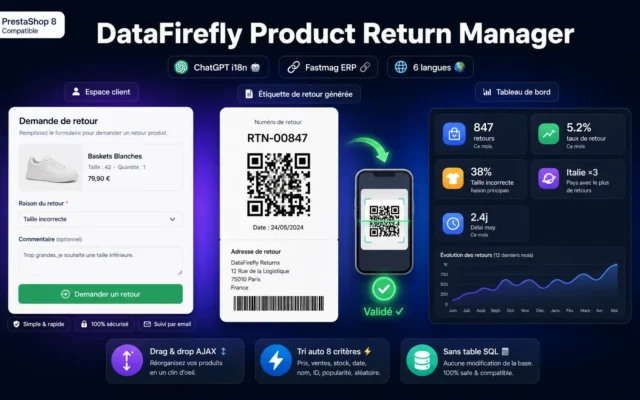
DataFirefly Product Return Manager — Product returns with QR scan, analytics and ChatGPT translation for PrestaShop 8
Install this firstQR portal with structured reasons. What matters is not the convenience — it is that the reasons finally get captured.
Complete product return management system for PrestaShop 8: customer self-service request, PDF label with QR code, QR scan for receipt validation, 13-axis analytics dashboard,…
Original price was: €129.00.€89.00Current price is: €89.00. View the module -
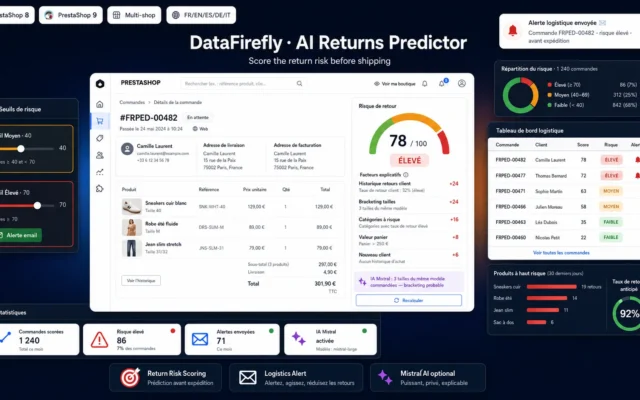
AI Returns Predictor
Act before dispatchFlags the high-return-risk orders before the parcel leaves. The last moment when something can still be done.
AI Returns Predictor scores every order the moment it is validated, computes a 0–100 return-risk score and alerts your logistics team before shipping. Transparent…
€79.00 View the module -
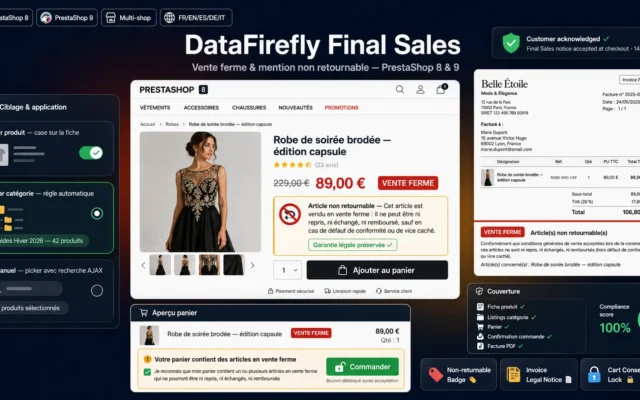
DataFirefly Final Sales — Non-Returnable Badge & Invoice Notice for PrestaShop 8 & 9
Clarity before the purchaseFinal sale and non-returnable notices, visible BEFORE the purchase. Stated afterwards, the notice is unenforceable.
Mark items as Final Sales and print the non-returnable mention on the invoice in one click — multilingual, multi-shop, compliant.
€29.00 View the module
Side-by-side comparison
| Module | Best for | Price | Rating | Link |
|---|---|---|---|---|
| DataFirefly Product Return Manager — Product returns with QR scan, analytics and ChatGPT translation for PrestaShop 8 | Install this first | Original price was: €129.00.€89.00Current price is: €89.00. | — | |
| AI Returns Predictor | Act before dispatch | €79.00 | — | |
| DataFirefly Final Sales — Non-Returnable Badge & Invoice Notice for PrestaShop 8 & 9 | Clarity before the purchase | €29.00 | — |
A return is not an incident, it is a metric
Most stores treat returns as friction to be endured. They are in fact the most honest signal your catalogue produces: they tell you exactly where your product page lied.
A garment returned over size is a missing size chart. A device returned as “not what I expected” is a photo that misleads. A return with no stated reason is a form that never asked.
The bill nobody opens
A return costs you the outbound shipping, the return shipping, the handling, the restocking — and frequently a loss of value on the goods. At a 30% margin, one return wipes out the profit of three orders. That is why the return rate is not a service metric you polish: it is a margin lever.
And yet: making returns harder is a mistake
A difficult returns process does not reduce returns — it reduces repeat purchases. The customer returns anyway, resents you for it, and never comes back. What works is not slowing the return down, it is removing the cause before the order exists.
How to choose
The mistake almost everyone makes
Making the return difficult, hoping to avoid it. It does not work: the customer returns anyway — they are entitled to — and never comes back. You paid for the return and lost the customer. The only way to cut returns runs before the order, not after it.
Start with the portal — but not for the convenience
A returns portal is useful because it makes returning easy. It is decisive because it captures the reasons. Without structured reasons you accumulate costs only. With them you accumulate a priority list: which product page to fix first, which photo lies, which description is too vague.
Then act before dispatch
AI prediction flags the high-return-risk orders before the parcel leaves. What you do with that is your call — but it is the last moment when something can still be done.
And be honest about what cannot come back
Personalised goods, sealed hygiene items: the law permits exclusion. But the notice must be visible before the purchase. Stated afterwards it is unenforceable — and it turns a routine matter into a dispute you will lose.
What you gain
A return with no friction
QR scanning and an automated portal: the customer files it themselves, you track it with no email chain.
The reason becomes a metric
Return reasons are data. They tell you exactly which product page lied — and which to fix first.
The return spotted before dispatch
Prediction flags the high-return-risk orders before they ship.
Clarity on what cannot come back
Personalised goods, hygiene items, final sale: a visible label prevents the return — and the dispute.
Margin you take back
At a 30% margin, one return wipes out the profit of three orders. It is not a service issue, it is a margin lever.
A customer who comes back
You do not cut returns by making them hard — you only cut repeat purchases.
From install to results
-
Install the returns portal
Not for the convenience — for the reasons. Without structured reasons you accumulate costs only.
-
Read the reasons as a priority list
“Too small” = missing size chart. “Not like the photo” = misleading image. Fix the page, not the process.
-
Act before dispatch
Prediction flags the risky orders before dispatch. The last moment when something can still be done.
-
Be clear about what cannot come back
The notice must be visible before the purchase. Afterwards it is unenforceable — and the dispute is lost.
-
Do NOT make returning hard
A difficult process does not cut returns. It cuts repeat purchases. Compute both.
“We made the returns process harder to cut returns. The return rate did not move. The repeat-purchase rate fell by a third.”
Frequently asked questions
Does a difficult returns process reduce returns?
The opposite — and it is the most expensive misconception on this page. A difficult process does not reduce returns; it reduces repeat purchases. The customer returns anyway (they are entitled to), resents you, and never buys again. You paid for the return and lost the customer.
Why do return reasons matter so much?
Because they tell you where your product page lied. “Too small” = missing size chart. “Not like the photo” = misleading image. “Not as described” = vague description. Without structured reasons you accumulate costs; with them you accumulate a priority list for your product pages.
Does AI prediction prevent returns?
No — it shows you the high-risk orders before they ship. What you do with that is a decision: send a confirmation email, prompt a size check, inspect the packing. It does not prevent, it warns — and the warning is precisely the last moment when something can still be done.
What does a return really cost?
At a 30% margin, one return wipes out the profit of three orders: outbound shipping, return shipping, handling, restocking, and often a loss of value on the goods. Do the arithmetic once, and the return rate stops being a service number.
Can I exclude returns on some products?
Yes, in the cases the law provides for: personalised goods, sealed hygiene items, perishables, unsealed media. But the notice must be visible before the purchase — stated afterwards it is unenforceable, and it turns a routine matter into a dispute.
How do I cut returns on clothing?
In fashion, size is the leading cause of returns — by a wide margin. That is why the size chart is the only lever that both sells more and returns less. It does not really belong in this selection: it belongs on the product page, before the order exists.
Is a returns portal really worth it?
The QR portal replaces the email chain: the customer files the return themselves, prints the label, you track the status. At twenty returns a month it is a convenience. At two hundred it is half a headcount — and above all, the reasons finally get captured.
Do easy returns and a low return rate contradict each other?
No, and that is the whole craft of it. You want the customer to know returning is easy — that is a buying argument. You want to know why they return — that is an improvement argument. The two are compatible: make the return easy and the cause visible.
Not sure which one fits your store?
Tell us your context — we answer with a straight recommendation, not a sales pitch.