
Our best PrestaShop modules to audit and steer your SEO
Eight modules to see what is broken — and above all, what is missing.
Most stores run SEO blind — they write, they fix, they wait, and they never know whether it worked. These modules bring the data to where you act: your back office.
Sound familiar?
SEO with no baseline
You fixed titles, added content. Did it improve? You do not know — you have no baseline.
Pages weakening each other
Two of your pages fight for the same query. Both at position 8, where one alone would sit at 3.
Pages that say nothing
Dozens of pages say nothing. They produce no error — they drag down the rating of the whole section.
Holes you cannot see
You never covered an entire zone of demand. A missing page does not raise its hand.
Our selection, ranked
Every module below is built, maintained and supported by our team. The ranking reflects what we would install first on a client store.
-
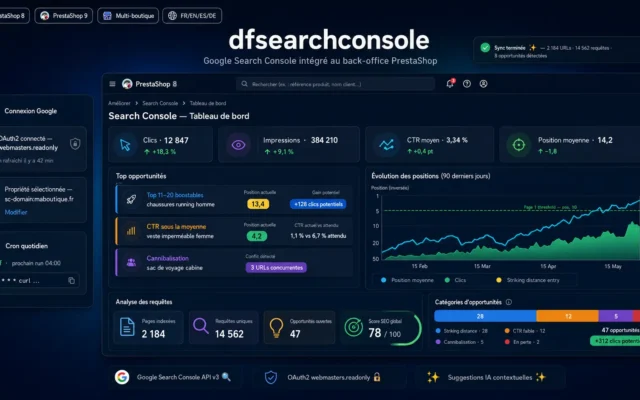
Google Search Console Integration for PrestaShop 8 & 9
Install this firstYour real data, free, in the back office — next to the products. Without this baseline, nothing else is worth doing.
Sync Google Search Console directly into your PrestaShop back office. Top queries per URL, CTR per page, average position, automatically detected SEO opportunities and…
€99.00 View the module -
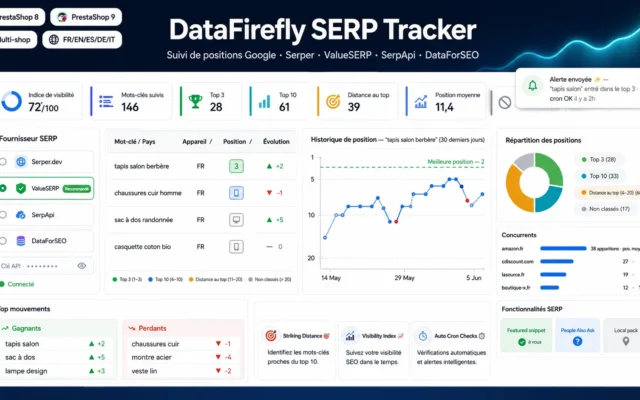
SERP Rank Tracker (Google Positions) for PrestaShop
Watch the positionsRank tracker with alerts on drops and deindexing. You find out the same day, not a quarter later.
Track your Google positions on PrestaShop: keywords by country and device, history and charts, striking distance, visibility index, competitors, SERP features and drop alerts.…
€49.00 View the module -
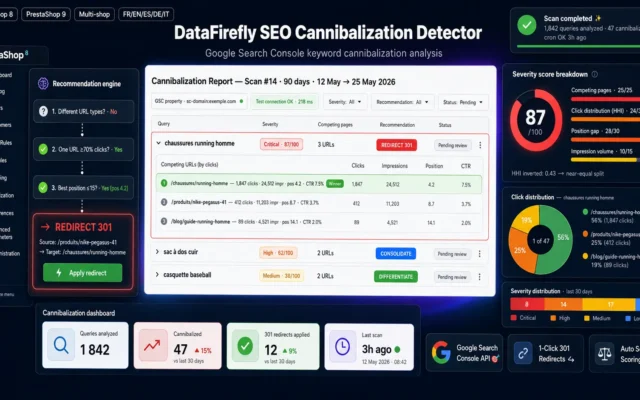
SEO Cannibalization Detector — PrestaShop 8 & 9
The most invisible diseaseTwo pages fighting for the same query cap each other. It produces no error — only a ceiling.
Detect and resolve SEO cannibalization in your store through Google Search Console: severity score 0-100, automatic recommendations, integrated 301 redirects.
€39.00 View the module -
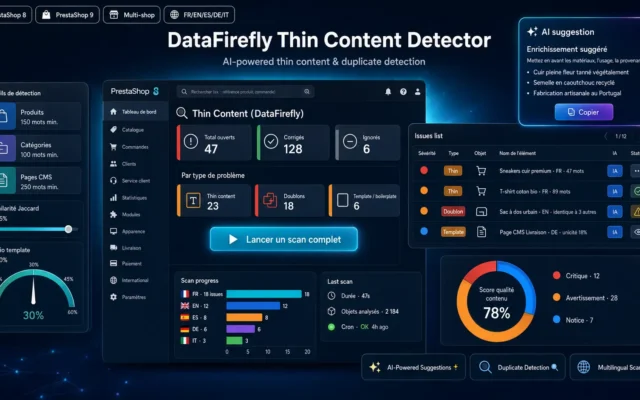
Thin Content Detector — AI Thin Content Detection for PrestaShop 8/9
Prioritises what to rewriteThin content is a page that says nothing — not a short page. The detector scores substance, not character count.
Automatically scan your products, categories and CMS pages across all active languages. Detect thin pages (words below threshold), duplicate descriptions between products, and pages…
€39.00 View the module -
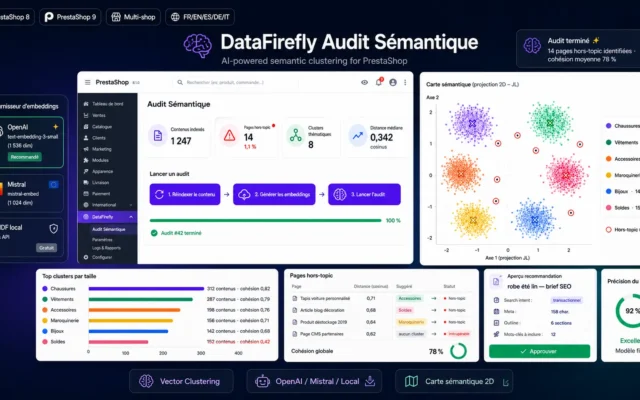
AI Semantic Audit — Vector clustering for PrestaShop 8 & 9
Best for seeing the holesVector clustering: you discover the subjects you should have covered and did not. A missing page does not raise its hand.
Detect "off-topic" pages that dilute your store's thematic authority. The module turns each product, category and CMS page into a semantic vector, groups them…
€29.00 View the module -
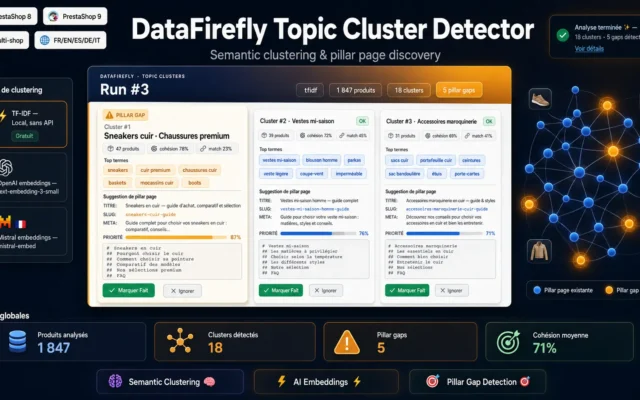
Topic Cluster Detector
Structure by meaningGroups your pages by meaning, not by category. And the two rarely match.
Automatically detect the relevant topic clusters in your catalog and identify missing pillar pages — with a complete SEO draft generated for each opportunity.
€29.00 View the module -
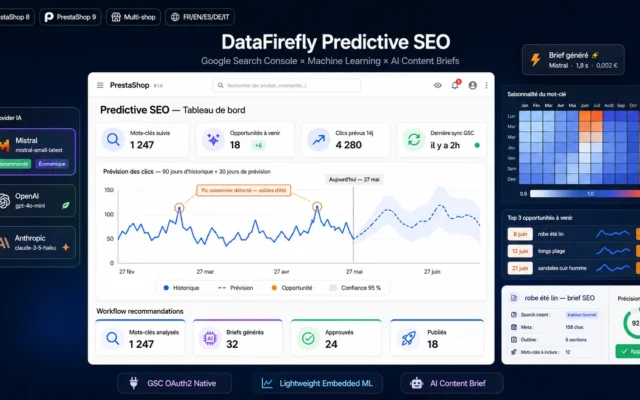
Predictive SEO — Traffic & Keyword Forecasting for PrestaShop
Useful but speculativeTraffic forecasting. For prioritising, never for promising. The one speculative part of this selection.
Anticipate your seasonal SEO peaks. The module syncs Google Search Console, applies a lightweight regression model with seasonal decomposition, and automatically surfaces 14-day-ahead opportunities…
€35.00 View the module -
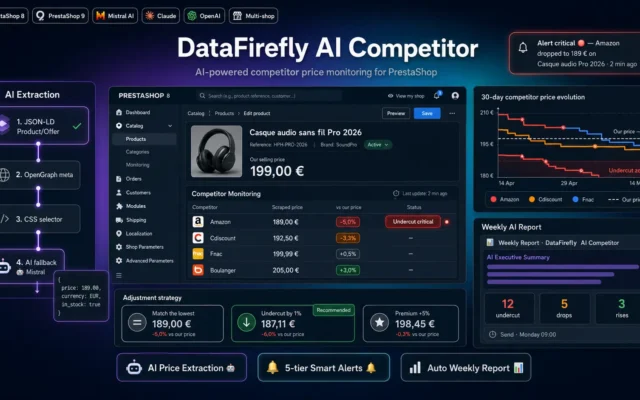
AI Competitor — Competitor Price Monitoring with AI
Competitors as a signalA competitor rising tells you where the demand is — not that you should copy them.
Track competitor prices continuously and adjust your own. Crawl a competitor's entire catalogue, reuse competitor profiles across shops with import/export, AI extraction, alerts, analytics…
€169.00 View the module
Side-by-side comparison
| Module | Best for | Price | Rating | Link |
|---|---|---|---|---|
| Google Search Console Integration for PrestaShop 8 & 9 | Install this first | €99.00 | — | |
| SERP Rank Tracker (Google Positions) for PrestaShop | Watch the positions | €49.00 | — | |
| SEO Cannibalization Detector — PrestaShop 8 & 9 | The most invisible disease | €39.00 | — | |
| Thin Content Detector — AI Thin Content Detection for PrestaShop 8/9 | Prioritises what to rewrite | €39.00 | — | |
| AI Semantic Audit — Vector clustering for PrestaShop 8 & 9 | Best for seeing the holes | €29.00 | — | |
| Topic Cluster Detector | Structure by meaning | €29.00 | — | |
| Predictive SEO — Traffic & Keyword Forecasting for PrestaShop | Useful but speculative | €35.00 | — | |
| AI Competitor — Competitor Price Monitoring with AI | Competitors as a signal | €169.00 | — |
You cannot optimise what you do not measure
Most stores run SEO blind. They write content, fix meta tags, wait — and never know whether any of it worked. Not out of laziness: because the data sits in Search Console, in a rank tracker, in a spreadsheet, and nobody joins it up.
This selection brings it into your back office, next to the products it concerns. That is the real difference: not more data, but data where you act.
The four questions that matter
Where do I stand? Positions, impressions, clicks. With no baseline there is no progress — only a feeling.
What is broken? Cannibalisation (two pages fighting for the same query), thin content (pages that say nothing). Two diseases nobody sees, because they produce no symptom — they produce only absence.
What is missing? Semantic audit and topic clusters reveal the holes in your coverage: the subjects you should have spoken about and did not.
Where am I going? Forecasting and competitor monitoring. The one part that stays speculative — and should be treated as such.
The dashboard trap
A tool that measures and changes nothing is a tool that reassures you while you stagnate. Every metric here must lead to a decision: rewrite this page, merge those, redirect that one. If a number leads nowhere, do not look at it.
Further reading
Three in-depth guides from the blog complete this selection: Indexing API, IndexNow and AI bots, 301 redirects and 404 monitoring and the complete e-commerce SEO guide.
How to choose
The baseline first
Search Console in the back office. It is your real data, free, and without it you will never know whether a change worked or whether Google simply rolled out an update. Everything else builds on this.
Then the two invisible diseases
Cannibalisation and thin content. Neither produces an error — they produce a ceiling. Two pages fighting for the same query both land at position 8, where one alone would sit at 3. A page that says nothing drags down the rating of the whole section. You only find them with a tool, because they do not complain.
Only then, what is missing
Semantic audit and topic clusters reveal the holes: the subjects you should have covered and did not. That is harder to see than a bad page — a missing page does not raise its hand. And it is often the biggest opportunity.
Forecasting: useful, not sacred
SEO forecasting tells you which subjects are likely to bring traffic. It does not tell you exactly how much you will get. Use it to prioritise, never to promise — to your boss or to yourself. It is the one speculative part of this selection, and it should be treated that way.
What you gain
The data where you act
Positions, impressions and clicks straight in the back office — next to the products they concern.
Cannibalisation finally visible
Two of your pages are fighting for the same query and weakening each other. With no tool, nobody sees it.
Thin content flushed out
Pages that say nothing drag the rest down. The detector prioritises which ones to rewrite first.
The gaps in coverage
The semantic audit reveals the holes in your coverage: the subjects you should have covered and did not.
A structure that makes sense
Topic clusters group your pages by meaning, not by category. The structure Google actually reads.
The alarm before the fall
Alerts on position drops and deindexing. You find out the same day, not a quarter later.
From install to results
-
Bring Search Console into the back office
Your real data, free, next to the products. Without this baseline you will never know whether a change worked.
-
Flush out the cannibalisation
Two pages fighting for the same query cap each other. It produces no error — only a ceiling.
-
Hunt down the thin content
Prioritises what to rewrite first. Thin content is a page that says nothing, not a short page.
-
Find the holes in your coverage
The subjects you should have covered and did not. A missing page does not raise its hand — and it is the biggest opportunity.
-
Only measure what leads to a decision
Every metric must lead to an action. A number that leads nowhere is a number that reassures you while you stagnate.
“We had three category pages all fighting for the same query. For two years. We merged them, and the survivor went from position 9 to position 2 in six weeks.”
Frequently asked questions
Which tool do you start with?
With Search Console, no debate — and inside the back office. It is your real data, free, and you need it as a baseline. Everything else in this selection builds on it: with no baseline you will never know whether a change worked or whether Google simply rolled out an update.
What exactly is cannibalisation?
Two of your pages rank for the same query and split the authority instead of concentrating it. Both land at position 8, where one alone would sit at 3. It is one of the most common SEO diseases in e-commerce — and one of the most invisible, because it produces no error, only a ceiling.
Is thin content just a page that is too short?
Not necessarily. Thin content is a page that says nothing, not a short page. A precise product page with four useful lines is not thin content; a page with six hundred generic words is. The detector scores substance, not character count — and prioritises what to rewrite first.
What is a semantic audit for?
It groups your pages by meaning, not by your category structure. And regularly the two do not match: you discover five pages covering the same subject while an entire zone of demand is not covered at all. It is the only way to see the holes — missing pages are harder to find than bad ones.
How seriously should you take SEO forecasting?
Treat it as a hypothesis, not a truth. It is based on your history and search volumes — it tells you which subjects are likely to bring traffic, not exactly how much you will get. Useful for prioritising, dangerous for promising. The one speculative part of this selection.
Is competitor monitoring genuinely useful?
Yes, provided you read it as a signal, not a model. A competitor rising on a query tells you there is demand there — not that you should copy them. The commonest mistake is rebuilding their strategy instead of understanding their effect.
Why is Search Console not enough?
Because it sits in four different tools, none of which knows your products. Bringing it into the back office does not change the data — it changes the odds that you do something with it. A metric you see next to the product it concerns becomes a decision. The same metric in a spreadsheet stays a number.
What is the biggest danger with an SEO dashboard?
Filling it with metrics that lead nowhere. Every number in this selection must lead to an action: rewrite this page, merge those, redirect that one. A dashboard that measures and changes nothing is a tool that reassures you while you stagnate.
Not sure which one fits your store?
Tell us your context — we answer with a straight recommendation, not a sales pitch.