
Our best Shopware plugins for electronic invoicing
Three plugins — and one sentence that catches most stores off guard.
A PDF is not an electronic invoice. The standard means a structured, machine-readable format — XRechnung or ZUGFeRD. And you already have to be able to receive one.
Sound familiar?
An invoice that isn't an e-invoice
A PDF by email is a digital document. The standard means XML.
Shopware doesn't do this on its own
The store knows the order, not the format. Without an extension, the wrong thing goes out.
A customer who can't process it
Your customer's accounting can't read your PDF — and eventually won't be allowed to accept it.
The same data typed three times
Store, ERP, accounting. Every re-entry is an error waiting for its moment.
Our selection, ranked
Every module below is built, maintained and supported by our team. The ranking reflects what we would install first on a client store.
-
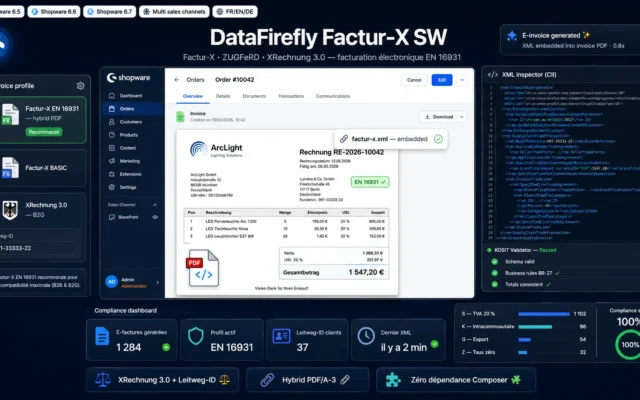
DataFirefly Factur-X SW — E-Invoicing for Shopware 6: ZUGFeRD & XRechnung 3.0
The format the standard meansZUGFeRD and XRechnung following EN 16931. Not a PDF under another name — structured XML, machine-readable.
EN 16931 electronic invoices for Shopware 6: Factur-X / ZUGFeRD embedded in the invoice PDF, XRechnung 3.0 with Leitweg-ID for B2G, automatic generation, e-mail…
€89.00 View the module -
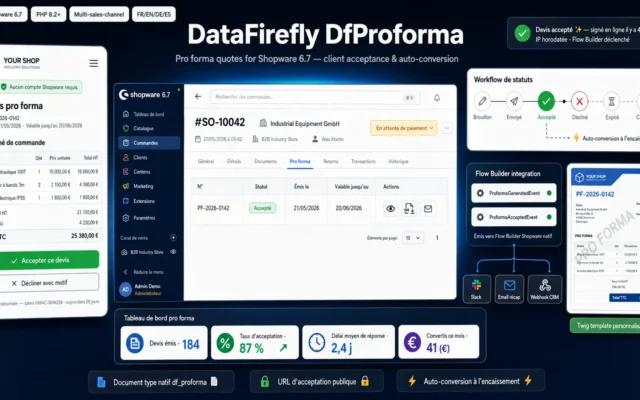
DfProforma Shopware — Pro forma quotes for Shopware 6.7 with client acceptance and auto-conversion
Before the invoice, not instead of itThe proforma lets the client approve internally before delivery. It doesn't replace the invoice.
Issue real pro forma quotes from any Shopware 6.7 order, send them by email with a public acceptance URL, and convert them to orders…
€129.00 View the module -
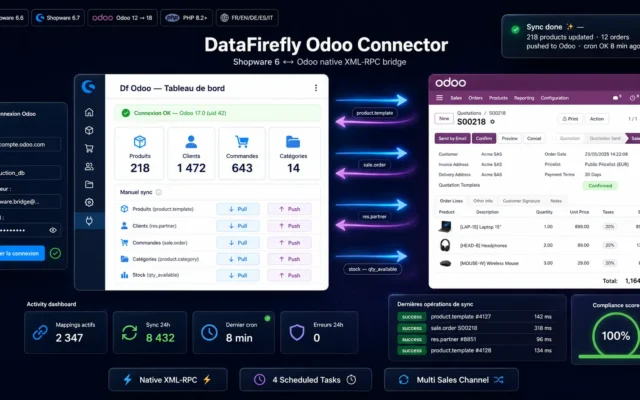
DataFirefly Odoo Connector — Shopware ↔ Odoo
The chain, all the way to the ERPInvoice, customer and payment in the ERP without anyone retyping. A structured format exposes every typo.
Two-way Shopware 6.6 / 6.7 ↔ Odoo sync via native XML-RPC. Products, real-time stock, customers, orders, categories. Compatible with Odoo 12 to 18, Community…
€119.00 View the module
Side-by-side comparison
| Module | Best for | Price | Rating | Link |
|---|---|---|---|---|
| DataFirefly Factur-X SW — E-Invoicing for Shopware 6: ZUGFeRD & XRechnung 3.0 | The format the standard means | €89.00 | — | |
| DfProforma Shopware — Pro forma quotes for Shopware 6.7 with client acceptance and auto-conversion | Before the invoice, not instead of it | €129.00 | — | |
| DataFirefly Odoo Connector — Shopware ↔ Odoo | The chain, all the way to the ERP | €119.00 | — |
A PDF is not an electronic invoice
That’s the sentence that catches most stores off guard. A PDF invoice emailed to a customer is a digital document — not an electronic invoice in the sense of the standard. An e-invoice is structured: XML, machine-readable, following EN 16931. XRechnung or ZUGFeRD.
And in Germany you already have to be able to receive one
The obligation to receive structured domestic B2B invoices is already in force. The obligation to issue them arrives in stages over the following years — and whoever starts then, starts under time pressure.
Shopware doesn’t produce this on its own
The store knows the order, not the format. Without an extension, your B2B customers get a PDF their accounting system cannot read — and will eventually not be allowed to accept.
How to choose
First, clear up the misunderstanding
A PDF is not an e-invoice. A PDF sent by email is a digital document. An e-invoice is structured — XML, machine-readable, following EN 16931. Not knowing that difference is how stores believe they're already compliant.
Then choose the format by recipient
XRechnung is pure XML — the route for public sector buyers. ZUGFeRD is a PDF with embedded XML: same standard, but human-readable. In practice B2B stores need both.
The order is receiving, then issuing
The receiving obligation already applies; issuing arrives in stages. Set the chain up properly now and the later stages happen without time pressure — and time pressure is the real cost item in this subject.
And the chain doesn't stop at the store
An e-invoice is created in the store, booked in the ERP, archived in accounting. Every re-entry is an error waiting for its moment — except this time a structured format makes it visible.
What you gain
The format the standard actually means
XRechnung or ZUGFeRD, following EN 16931. Not a PDF under a different name.
One document, two readers
ZUGFeRD is a PDF with embedded XML: readable by humans, processable by machines.
Both routes covered
XRechnung for public sector buyers, ZUGFeRD for private companies. B2B stores need both.
Proforma and invoice, cleanly separated
The proforma allows internal approval before delivery. It doesn't replace the invoice — it precedes it.
No third data entry
Invoice, customer and payment land in the ERP without anyone retyping them.
Prepared, not surprised
Get the receiving side right now and the issuing side later is done without drama.
From install to results
-
Check what you send today
A PDF sent by email is not an e-invoice. The standard means structured XML.
-
Choose the format by recipient
XRechnung for public sector buyers, ZUGFeRD for private companies.
-
Fix the receiving side
It already applies. Issuing arrives in stages afterwards.
-
Add the proforma if you sell B2B
It allows internal approval — it replaces nothing.
-
Connect the chain to the ERP
A structured format makes every re-entry visible.
“We thought we were done: our invoices had gone out as PDFs for years. Then a large client asked for XRechnung. That's when we realised our PDF had never legally been an e-invoice.”
Frequently asked questions
Is my PDF invoice an e-invoice?
No. A PDF sent by email is a digital document, not an electronic invoice in the sense of the standard. An e-invoice is structured and machine-readable — XRechnung or ZUGFeRD, following EN 16931. That distinction is what surprises most people.
XRechnung or ZUGFeRD — what's the difference?
XRechnung is pure XML — the route for public sector buyers. ZUGFeRD is a hybrid: a PDF with embedded XML, readable by humans and processable by machines. Both satisfy the same standard; the choice depends on the recipient.
When does this become mandatory for me?
In Germany, receiving structured domestic B2B invoices is already mandatory. The obligation to issue them arrives in stages over the following years, depending on company size. Check your own deadline — they aren't the same for everyone.
Doesn't Shopware generate this natively?
No. Shopware knows the order, not the format. Without an extension, a PDF goes out that your customer's accounting cannot read — and will eventually not be allowed to accept.
Why a proforma if I already issue e-invoices?
The proforma announces; the invoice taxes. The proforma lets your client raise an internal purchase order before you ship; the invoice is the fiscal document afterwards. Book a proforma as an invoice and it comes back to you.
Why connect the ERP?
Because an e-invoice is a chain, not a document. It's created in the store, booked in the ERP, archived in accounting. Every re-entry is an error waiting for its moment — and a structured format is precisely what makes that error visible.
Where do I start?
With the receiving side and the format. Get XRechnung and ZUGFeRD right today and the later stages are done calmly. Wait, and you start under time pressure — which is what actually costs money here.
This need on other platforms
Not sure which one fits your store?
Tell us your context — we answer with a straight recommendation, not a sales pitch.