
Our best PrestaShop modules for compliant invoicing
Eight modules for the whole chain, from tax rule to customs, not just up to the invoice.
E-invoicing is becoming mandatory across Europe in stages — not a PDF by email, but an invoice a machine can read. And the invoice is only the end of the chain.
Sound familiar?
Invoices no machine can read
You send PDFs. The reform requires structured data a machine can read — and the deadlines are approaching.
An export everyone reworks by hand
Every month your accountant corrects the export by hand. That is a day you cost yourself.
A forgotten tax rule
A product with no tax rule goes live, sells — and you discover it at the VAT return.
Customs that surprise the customer
The non-EU customer pays customs at the door. They refuse the parcel, leave a bad review, never return.
Our selection, ranked
Every module below is built, maintained and supported by our team. The ranking reflects what we would install first on a client store.
-
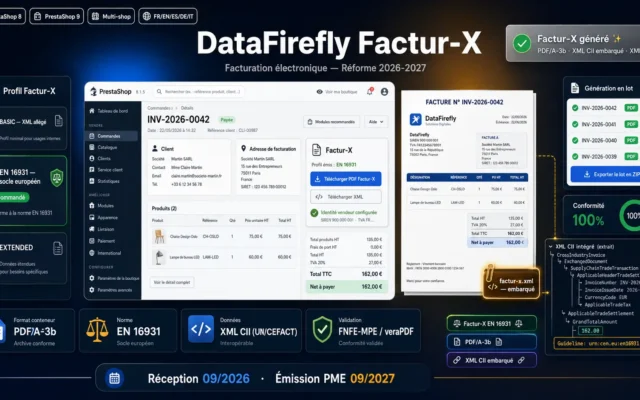
DataFirefly Factur-X — E-invoicing PDF/A-3 + XML
The reform, nowPDF/A-3 with embedded XML. Factur-X, ZUGFeRD, XRechnung: your accountant, your customer and the tax authority read the same file.
Turn every PrestaShop order into a hybrid Factur-X electronic invoice: a printable PDF/A-3b containing the structured CII XML data (EN 16931 standard). Ready for…
€89.00 View the module -
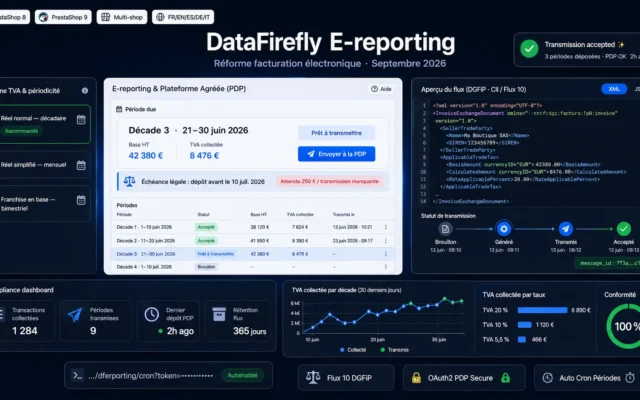
E-reporting French E-invoicing 2026 (PDP)
The other half of the reformTransmission of B2C and international sales data to the approved platform (PDP), required by the French e-invoicing reform. The e-invoice itself only covers domestic B2B.
French e-invoicing reform: transmit your B2C transaction data and invoice statuses to your certified platform (PDP) or the public concentrator. DGFiP flux 10 in…
€89.00 View the module -
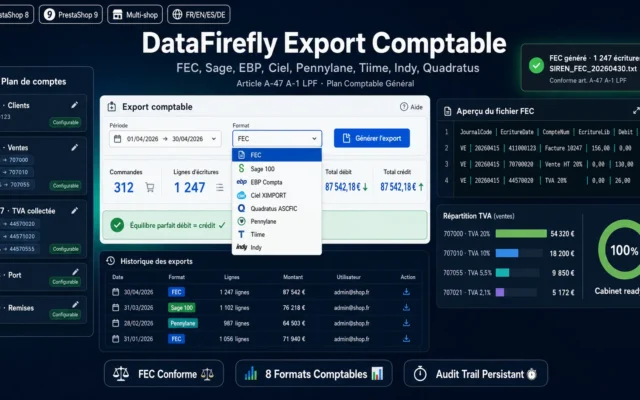
DataFirefly Accounting Export — FEC, Sage, EBP, Ciel, Pennylane
A day saved every monthFEC, Sage, EBP, Ciel, Pennylane. An export accepted without rework is a day saved, every month.
Export your PrestaShop accounting to FEC, Sage 100, EBP, Ciel, Quadratus, Pennylane, Tiime or Indy. Automatic VAT breakdown, configurable chart of accounts, pre-export debit/credit…
€99.00 View the module -
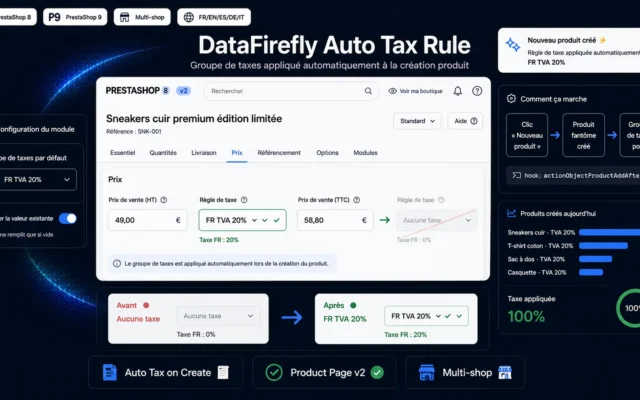
Automatic Default Tax Rule on Product Creation — PrestaShop 8 & 9
The cheapest, the quietestAutomatic default tax rule. Costs almost nothing and prevents the quietest failure in the selection.
Automatically apply your tax rules group to every new PrestaShop product, instead of "No tax". Compatible with the v2 product page, multistore, with an…
€49.00 View the module -
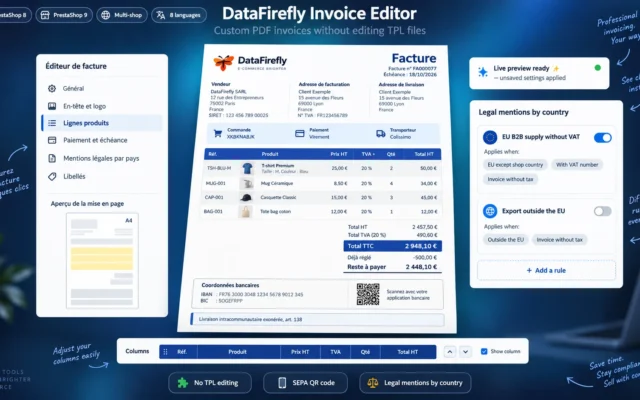
Customize PrestaShop PDF Invoices for PrestaShop 8 & 9 Without Editing TPL Files
The invoice people readLogo, legal notices per country, due date, bank details and SEPA QR code, without touching .tpl files. The PDF your customer receives, complete and up to date.
PDF invoice editor for PrestaShop 8 and 9: logo, colors, product line columns, custom fields, legal mentions by country, due date, bank details with…
€99.00 View the module -
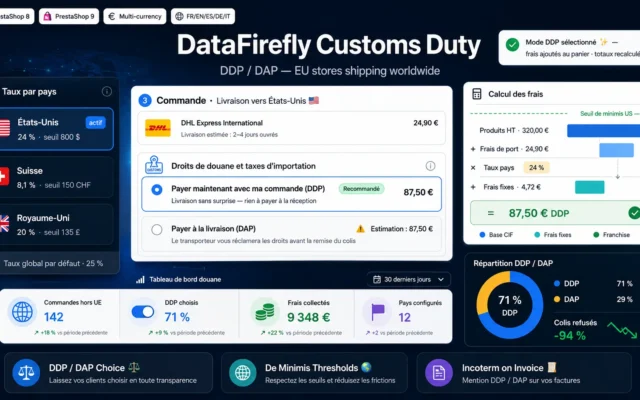
Customs Duty DDP / DAP PrestaShop — Import Taxes Outside the EU for European Stores
If you sell outside the EUDDP costs you upfront what DAP costs you afterwards, at a higher price. Work out your return rate.
Built for European stores shipping outside the EU: at checkout, your customers choose to pay customs duties and import taxes directly on your store…
€89.00 View the module -
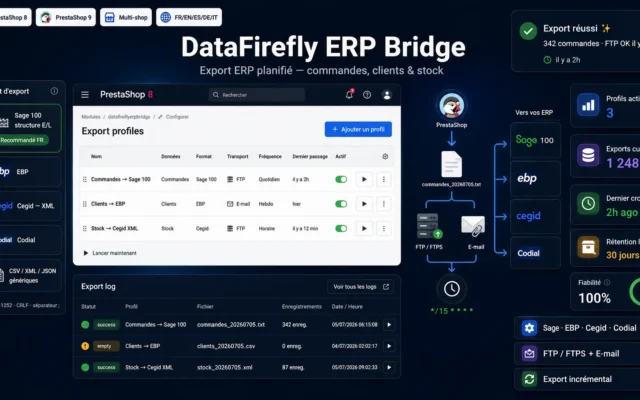
PrestaShop 8/9 ERP Export Module — Sage 100, EBP, Cegid, Codial
If you have an ERPDirect sync to Sage 100, EBP, Cegid, Codial. A continuous flow instead of a monthly operation.
Scheduled export of PrestaShop orders, customers and stock to Sage 100, EBP, Cegid, Codial or a generic CSV / XML / JSON format —…
€129.00 View the module -
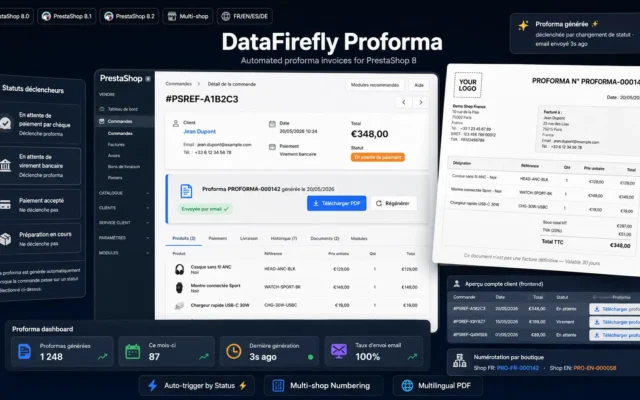
Proforma Invoice Generator — Automatic Proforma Invoice Generation
The B2B documentPro forma invoice: the document that unlocks the order before the goods exist. Essential for export.
Automatically generate proforma invoices as PDF files based on order statuses, with email attachment, customer download, and full back-office management for PrestaShop 8.
€59.00 View the module
Side-by-side comparison
| Module | Best for | Price | Rating | Link |
|---|---|---|---|---|
| DataFirefly Factur-X — E-invoicing PDF/A-3 + XML | The reform, now | €89.00 | — | |
| E-reporting French E-invoicing 2026 (PDP) | The other half of the reform | €89.00 | — | |
| DataFirefly Accounting Export — FEC, Sage, EBP, Ciel, Pennylane | A day saved every month | €99.00 | — | |
| Automatic Default Tax Rule on Product Creation — PrestaShop 8 & 9 | The cheapest, the quietest | €49.00 | — | |
| Customize PrestaShop PDF Invoices for PrestaShop 8 & 9 Without Editing TPL Files | The invoice people read | €99.00 | — | |
| Customs Duty DDP / DAP PrestaShop — Import Taxes Outside the EU for European Stores | If you sell outside the EU | €89.00 | — | |
| PrestaShop 8/9 ERP Export Module — Sage 100, EBP, Cegid, Codial | If you have an ERP | €129.00 | — | |
| Proforma Invoice Generator — Automatic Proforma Invoice Generation | The B2B document | €59.00 | — |
E-invoicing is no longer optional
In France, Germany, Italy, Spain: electronic invoicing is becoming mandatory in stages. Not a PDF sent by email — a structured invoice a machine can read, in Factur-X, ZUGFeRD or XRechnung format.
The difference is not cosmetic. A PDF invoice is a picture of an invoice. A Factur-X invoice is that picture plus the data inside it, machine-readable, verifiable two years later. Your accountant, your customer and the tax authority read the same file — and nobody retypes it.
What most stores overlook
The invoice is only the end of the chain. Before it: the tax rule forgotten when the product was created; the customs duty billed to the customer after delivery; the accounting export reworked by hand every month. Each of these gaps is small — and each costs you more than the invoice itself.
The charge that turns a customer into an enemy
A parcel outside the EU arriving with surprise customs duty is not a minor inconvenience. It is a return, a bad review, and a customer who never comes back. DDP costs you up front what DAP costs you afterwards — only more expensively.
How to choose
Start with the invoice, but not for the reason you think
Not because of the deadline — because of the chain. A structured invoice feeds your accounting export, which feeds your ERP bridge. Start with the export and leave the invoice for later, and you will build twice.
Then the quiet failure
The default tax rule at product creation. PrestaShop sets none if you do not. A product goes live with no rule, sells, and you discover it at the VAT return — with a correction per order, retroactively. The module costs almost nothing and prevents the most irritating failure in this selection.
Customs: the decision nobody makes
If you sell outside the EU, DDP versus DAP is not a technical question. DAP: the customer pays on receipt, is surprised, refuses, leaves a bad review, never returns. DDP: you collect up front, the parcel arrives, nobody is surprised. Compute your non-EU return rate — and you will see what DAP really costs you.
What these modules do NOT do
They compute, they do not decide. Your VAT rates, your intra-community rules, your margin scheme are decisions you and your advisor make. A module produces a compliant document from what you tell it — it does not tell you what to tell it.
What you gain
An invoice a machine can read
PDF/A-3 with embedded XML: your accountant, your customer and the tax authority read the same file.
The right formats, per country
Factur-X, ZUGFeRD, XRechnung: formats differ by country. The module knows them — you do not have to.
An export your accountant accepts
FEC, Sage, EBP, Ciel, Pennylane: the export is produced, not reworked. Every month you gain a day.
No more forgotten tax rule
The tax rule is set automatically at product creation. Forgetting it costs a correction — per order.
No customs surprise at the door
DDP: customs collected up front. The customer receives the parcel without an invoice at the door.
The document that unlocks the order
Pro forma invoice for B2B and export: the document that unlocks the order before the goods exist.
From install to results
-
The structured invoice first
It feeds the accounting export, which feeds the ERP bridge. Start with the export and you will build twice.
-
Set the default tax rule
PrestaShop sets none if you do not. The quietest failure in the selection, and the cheapest to prevent.
-
Align the accounting export
An export accepted with no rework is a day gained every month. An export you correct is a tax you levy on yourself.
-
Decide between DDP and DAP
Compute your non-EU return rate. You will see what DAP really costs you.
-
Connect the ERP if you have one
If you run an ERP, you want a continuous flow, not a monthly operation.
“We shipped DAP because it seemed simpler. Our non-EU return rate was 22% — almost all parcels refused at customs. On DDP it fell below 4%.”
Frequently asked questions
What is the difference between Factur-X and a PDF invoice?
A PDF invoice is a picture of an invoice. A Factur-X invoice is that same picture plus the structured data inside it (PDF/A-3 with embedded XML). The human reads the picture, the machine reads the XML — and nobody retypes it. That is exactly what the reform requires.
Which format do I need in my country?
France: Factur-X. Germany: ZUGFeRD and XRechnung. Italy: FatturaPA. The formats are related but not identical, and the deadlines differ by country and company size. A module that handles the profiles spares you exactly that research.
DDP or DAP — do I really have to choose?
If you sell outside the EU, yes — and it is one of the most expensive decisions people ignore. DAP: the customer pays customs on receipt, is surprised, refuses the parcel. DDP: you collect up front, the parcel arrives, nobody is surprised. DDP costs you up front what DAP costs you afterwards — only more expensively.
Why an automatic default tax rule?
Because PrestaShop sets none if you do not. A product with no tax rule goes live, sells — and you discover the error at the VAT return. The correction then happens per order, retroactively. It is the quietest failure in this whole selection.
What is a pro forma invoice for?
It is not an accounting document: it triggers neither payment nor commitment. It is the document the customer needs before the goods exist — to release an internal purchase order, open a credit line, declare an import. In B2B and export it is the document that unlocks the order.
Is the accounting export really worth it?
Yes, and it is where you gain the most time. An export accepted by your accountant with no rework is a day gained — every month. An export corrected by hand every time is a tax you levy on yourself.
ERP bridge and accounting export — the same thing?
Yes — but the direction of the connection differs. The accounting export produces a file your accountant imports. The ERP bridge synchronises movements directly into your Sage, EBP, Cegid or Codial. One is a monthly operation, the other a continuous flow. If you already run an ERP, you want the bridge.
Do these modules make me tax-compliant?
No, and this must be said. They produce compliant documents and exports. They do not make your tax decisions, do not validate your VAT rates, and do not replace your accountant. On a complex setup (intra-community, OSS, margin scheme) ask your advisor — a module computes, it does not decide.
This need on other platforms
Not sure which one fits your store?
Tell us your context — we answer with a straight recommendation, not a sales pitch.