
Everything you'd want to know before you install.
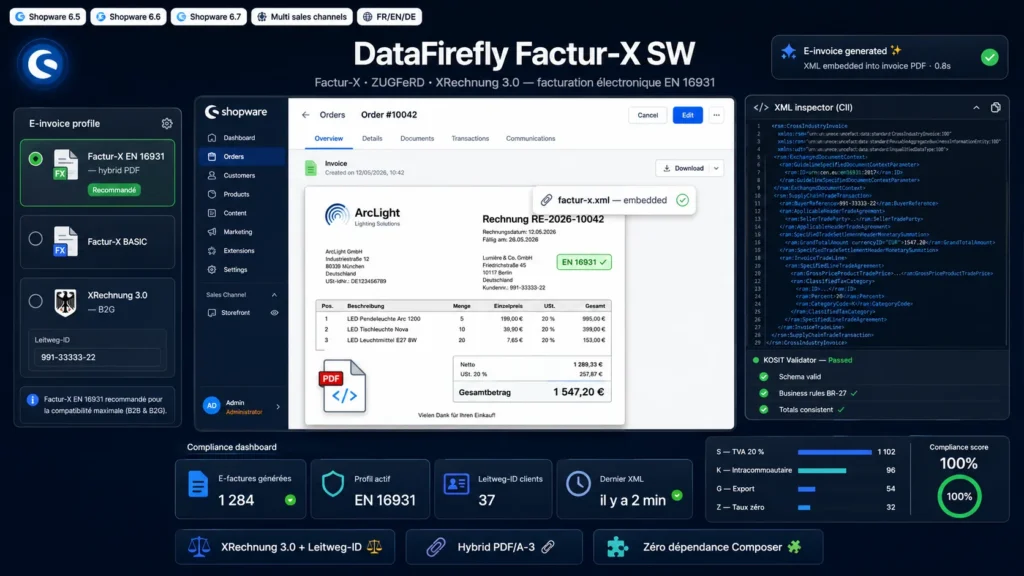
A detailed look at how DataFirefly Factur-X SW — E-Invoicing for Shopware 6: ZUGFeRD & XRechnung 3.0 works, why we built it the way we did, and the thinking behind the features above.
§ 01
Electronic invoicing is no longer optional
In Germany, every business has had to be able to receive B2B e-invoices since January 2025, and the issuance obligation rolls out in stages until 2028. B2G already requires XRechnung with a Leitweg-ID. In France, the Factur-X mandate imposes reception from September 2026 and issuance in 2026-2027 depending on company size. If your Shopware shop sells B2B or invoices public authorities, EN 16931 compliant e-invoices are becoming a condition for getting paid.
§ 02
What native Shopware does not cover
Shopware offers basic ZUGFeRD output since version 6.6.10, but it does not produce XRechnung 3.0, does not handle the Leitweg-ID, does not exist on earlier 6.5 and 6.6 versions, and its seller data is limited to the document settings. DfFacturX is a complete compliance suite: multiple profiles, rich seller data per sales channel, SEPA payment instructions, automatic VAT categories, e-mail attachment and regeneration tooling.
§ 03
XRechnung 3.0 and Leitweg-ID, no workarounds
Invoicing a German public authority requires an XRechnung XML with a BT-10 buyer reference — the Leitweg-ID — which Shopware has nowhere to store. On activation the plugin installs a dedicated custom field on the customer profile and on the order: enter the Leitweg-ID once on the customer and it is reused on all their invoices, with per-order overrides and a configurable fallback. The generated XML includes the Peppol business process, the BG-6 seller contact and the electronic addresses required by the KOSIT validator.
§ 04
A hybrid PDF, not yet another document
For the Factur-X and ZUGFeRD profiles, the XML is embedded directly into the invoice PDF generated by Shopware via incremental update: attached factur-x.xml file, AF relationship of type Data, PDF A-3 XMP metadata with the complete Factur-X extension schema. The document media is replaced in place — the PDF your customer downloads from their account or receives by e-mail is the hybrid e-invoice. If an exotic PDF structure prevents embedding, the plugin degrades gracefully: the XML remains available as an e-mail attachment and via console, and a warning is logged.
§ 05
An accounting model that passes validators
EN 16931 is demanding: net amounts, no negative lines, VAT breakdown per category, totals consistent to the cent. DfFacturX converts gross orders to the net model using Shopware's calculated taxes, turns promotions into document-level allowances with their per-rate breakdown, declares shipping as document charges, and uses the RoundingAmount BT-114 field to absorb any rounding drift: the XML GrandTotal always strictly equals the Shopware order total. Zero rates automatically receive the right category — K intra-community, G export, Z — with an exemption reason.
§ 06
Automatic, and never blocking
Generation triggers when the invoice document is created, whatever the channel: admin, Flow Builder or API. B2B-only mode restricts generation to business orders. The XML is automatically attached to order e-mails. And by design, an e-invoice error never blocks the creation of the invoice itself: the incident is logged and the df:facturx:generate console command lets you regenerate after fixing, with on-the-fly profile override and XML export to a file.
§ 07
Validate before going live
The documentation includes a complete validation checklist: gross and net orders, promotion, shipping, intra-community sale with VAT number, export outside the EU. Export the XML with one command and submit it to the KOSIT validator for XRechnung or the Mustang validator for Factur-X and ZUGFeRD. You go live knowing exactly what your customers and their accounting tools will receive.
There are no reviews yet.