A B2B store that accepts bank transfer with payment on receipt or at 30 days builds up receivables. As long as the amount stays small, a spreadsheet is enough. Past thirty or so invoices open at the same time, manual follow-up comes apart: you chase the large accounts, you forget the small ones, and it is often the small ones that end up written off.
PrestaShop does not handle this at all. The order moves to “Awaiting bank wire payment”, and nothing else happens. No due date counter, no reminder, no penalty calculation. Here is how to structure the process.
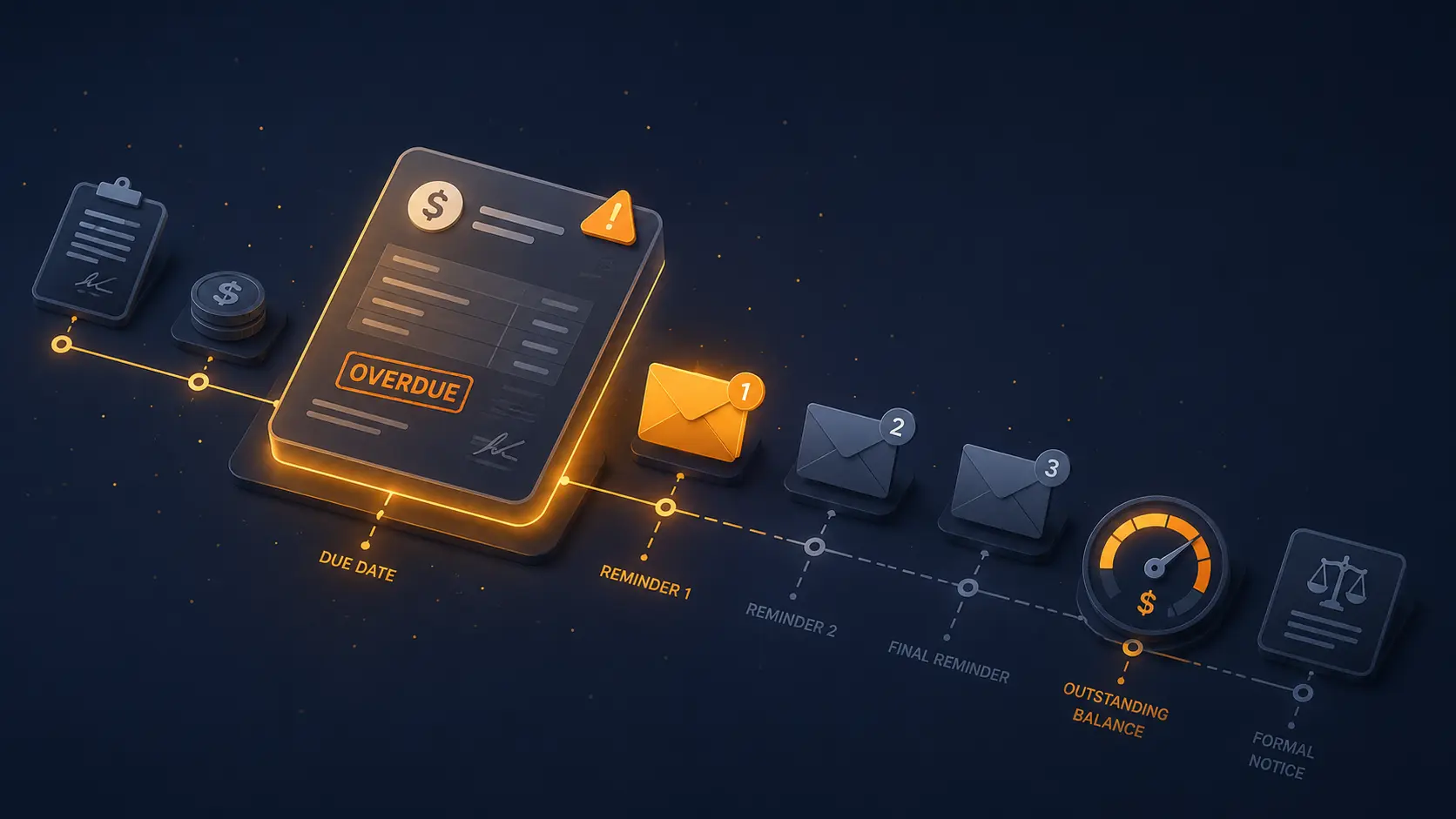
The four-step sequence
The most counter-intuitive fact about collections is this one: the recovery rate depends more on how quickly the first reminder goes out than on how firm the tone is. An invoice chased the day after it falls due turns out, in the vast majority of cases, to be a simple oversight corrected on the spot. The same invoice chased at thirty days enters a negotiation.
D+1: the neutral reminder
Informative tone, not threatening. The goal is to handle the majority case, the invoice lost somewhere in an accounts payable inbox. Restate the invoice number, the amount, the due date now passed, and attach the document again. Offer a direct contact in case of a dispute over the work delivered, which is the best way to surface a substantive problem early.
D+8: the firm reminder
The tone changes. You note that payment has not been received and you set an explicit deadline, generally seven days. This is also the moment to announce, without yet applying them, the consequences set out in your terms of sale: late payment interest and suspension of deliveries in progress.
D+15: the reminder with quantified penalties
You apply and you quantify. Two amounts must appear separately:
- late payment interest, calculated at the rate set in your terms of sale, with the floor set by the EU late payment directive at the European Central Bank reference rate plus eight percentage points, subject to whatever national transposition applies to you;
- the fixed compensation for recovery costs, set at a minimum of 40 euros per invoice.
A point often misunderstood: both amounts are owed by operation of law from the day after the due date, with no prior reminder needed. You choose whether to claim them, but you do not have to have announced them to be entitled to them.
D+30: the formal notice
Registered letter with acknowledgement of receipt, restating the history of reminders, the principal, the interest, the fixed compensation, and a final deadline. This is the document that makes any later proceeding possible. It also marks the exit from the automated process: beyond that point, the case calls for individual handling.
 B2B Dunning & Late Payment Penalties – PrestaShop 8 & 9 ModuleChase your B2B overdue invoices and automatically quantify the legal late-payment penalties.€89.00
What the tracking has to expose
An email sequence is not enough. You need a view per customer, not only per invoice, with four pieces of information:
- total outstanding balance, across all invoices;
- age of the oldest unpaid invoice;
- the dunning stage reached for each one;
- the interest accrued to date.
That view serves two concrete decisions: whether or not to block new orders from this customer, and whether to stay on amicable reminders or move to litigation. Without it, you keep shipping to a customer who has not paid for two months, which happens more often than anyone admits.
The statements your invoice must carry
The dunning process relies on statements that have to be on the original invoice already. Three are mandatory in B2B across the EU:
- the due date or the agreed payment term;
- the applicable late payment interest rate;
- a mention of the fixed compensation of 40 euros for recovery costs.
Their absence does not cancel your right to collect them, but it weakens your position in a discussion and exposes you to a separate administrative penalty in several member states. Check the PrestaShop invoice template before launching any dunning sequence: the native model does not include them.
The tipping point
Three signs indicate that manual handling has reached its limit: you can no longer say off the top of your head which customer owes how much, you discover invoices more than sixty days overdue at closing time, and you chase in waves rather than continuously. At that stage, every week of delay in chasing costs you recovery rate mechanically.
The B2B Unpaid Invoice Dunning module handles this chain on PrestaShop 8 and 9: due dates per order, configurable dunning sequence, automatic calculation of interest and fixed compensation, and a receivables dashboard per customer.