
Our best Shopware plugins for email collection
Three plugins — and a question of timing, not aggression.
A popup that appears instantly doesn't collect emails — it trains a close-it reflex. The right question isn't "how", it's "when". And your own list is the only channel nobody can switch off.
Sound familiar?
A popup that fires too early
It asks for the email before the visitor has a reason to give it.
A bought audience
As long as you pay, they come. You stop, they vanish. That's rent, not an audience.
The offer before the moment
A good discount at the wrong time still gets dismissed. Timing decides.
A list nobody opens
Ten thousand addresses that never open are an expensive vanity number.
Our selection, ranked
Every module below is built, maintained and supported by our team. The ranking reflects what we would install first on a client store.
-
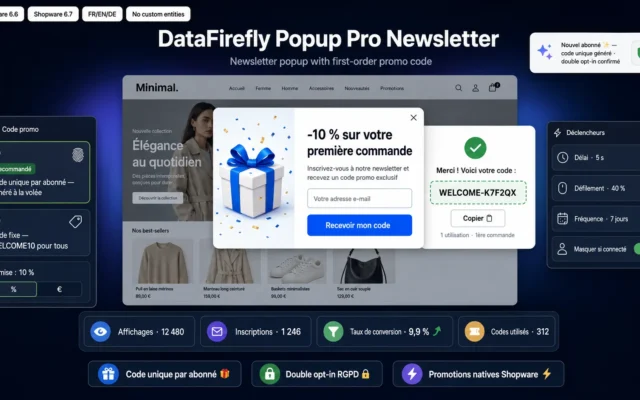
Popup Pro Newsletter — Shopware 6
First — timing makes everythingExit-intent, scroll depth, time on page. Appear after a signal, not in the first second.
High-converting newsletter popup for Shopware 6: visitors subscribe and instantly receive a promo code for their first order — unique code per subscriber or…
€49.00 View the module -
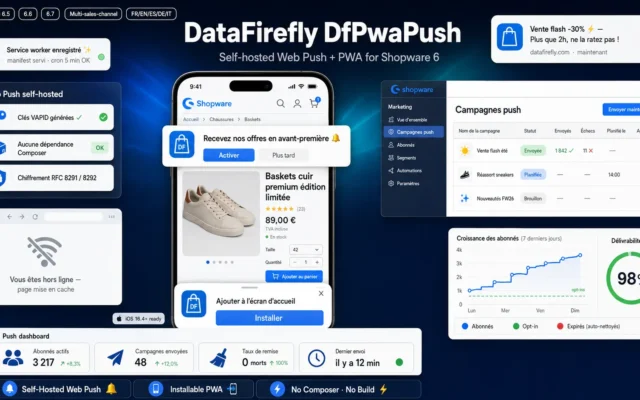
Shopware 6 PWA & Push Notifications Plugin — DfPwaPush: Self-Hosted VAPID Web Push, Manifest + Service Worker, Campaigns, Zero Dependency
A channel alongside emailWeb push reaches those who'd never give an address. One click, no inbox — and it's yours.
Turn your Shopware 6.5, 6.6 and 6.7 storefront into an installable PWA (dynamic manifest and service worker, offline page, install banner) and send fully…
€99.00 View the module -
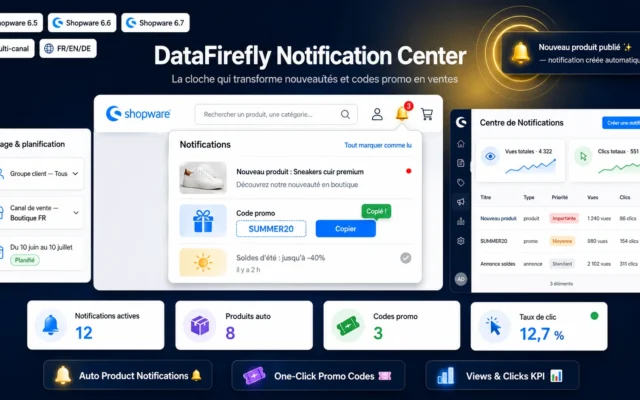
Shopware Notification Center
Collect while doing something elseSomeone signing up for a notification gives you intent with a timestamp. A better opt-in than any discount popup.
A notification bell next to the cart: new products added automatically, promo codes copied in one click, red badge on unread items. For Shopware…
€79.00 View the module
Side-by-side comparison
| Module | Best for | Price | Rating | Link |
|---|---|---|---|---|
| Popup Pro Newsletter — Shopware 6 | First — timing makes everything | €49.00 | — | |
| Shopware 6 PWA & Push Notifications Plugin — DfPwaPush: Self-Hosted VAPID Web Push, Manifest + Service Worker, Campaigns, Zero Dependency | A channel alongside email | €99.00 | — | |
| Shopware Notification Center | Collect while doing something else | €79.00 | — |
A popup that appears instantly isn’t a channel — it’s a door you slam
That’s the most common mistake. A newsletter box that pops up in the first second asks someone for their email before they have a reason to give it. You’re not collecting an address — you’re training a close-it reflex.
And a bought email isn’t an audience
It’s a rental. As long as you run ads, the visitors come; the moment you stop, they vanish. Your own list is the only thing you own — the only channel no algorithm can switch off.
The right question isn’t “how do I collect”, it’s “when”
After the first look at a product. On exit with a full cart. When something is out of stock. The moment decides more than the offer.
How to choose
Timing first — not the offer
A popup that appears in the first second doesn't collect emails, it trains a close-it reflex. Move it behind a signal: a product view, an exit-intent with a full cart, a scroll depth. Same mechanism, different result.
Then understand why the list matters
A bought email is a rental; a collected one is yours. Your own audience is the only channel no algorithm can switch off. Everything else you borrow — and borrowed things get reclaimed.
A second channel for those who won't give an email
Web push isn't a replacement for email, it's a complement: one click, no inbox. It catches the visitors who refuse an address but accept a notification.
And measure opens, not addresses
Ten thousand contacts that never open are a vanity number. The address that opens and buys is the only one that counts. Collect for quality, not volume.
What you gain
A popup with timing, not aggression
Appears after a signal, not in the first second. Collect intent, not a close-it reflex.
The right trigger, not the earliest
Exit-intent, scroll depth, time on page. The moment makes the conversion, not the box.
The waitlist as a collection point
Someone signing up for a back-in-stock alert gives you intent with a timestamp — for free.
A channel alongside email
Web push reaches people who'd never give an email. A second owned channel, no inbox required.
An audience you own
Your own list survives when the ads stop. It isn't a channel you rent.
The right metric
Not the number of addresses. The address that opens and buys is the only one that counts.
From install to results
-
Move the popup behind a signal
In the first second you collect a close-it reflex, not an email.
-
Choose the moment, not the offer
Exit-intent with a full cart, second product view, scroll depth.
-
Open a second channel
Web push catches those who won't give an address. One click, no inbox.
-
Collect through the waitlist
Someone waiting for a product gives you intent with context.
-
Measure opens, not addresses
Not list size. The address that opens and buys is the only one that counts.
“Our popup fired instantly and collected almost nothing. We moved it to exit-intent with a full cart — same mechanism, same offer. The opt-in rate quadrupled.”
Frequently asked questions
Why isn't my newsletter popup working?
Because it appears too early. A popup in the first second asks for an email before the visitor has a reason to give it. Move it behind a signal — a product view, an exit-intent — and the same mechanism collects intent instead of rejection.
When should the popup appear?
After a signal, not after a second. On exit with a full cart, after the second product, past a certain scroll depth. The moment matters more than the offer — a good discount at the wrong time still gets dismissed.
Why build a list when I can run ads?
A bought email is a rental: you pay, the visit comes; you stop, it vanishes. A collected email is yours. It's the only channel no algorithm can switch off overnight — and therefore the only one that is truly your audience.
Does a waitlist count as email collection?
It's one of the most honest. Someone signing up for an item's return already has purchase intent — and gives you an address with context, willingly. That's a better opt-in than any generic discount popup.
Why web push if I'm already collecting emails?
When you want to reach people who'll never give an email. Web push is a second owned channel: no inbox, one click to subscribe. It doesn't replace email — it catches those who refuse it.
Which metric should I track?
Open and purchase rate, not list size. Ten thousand addresses that never open are an expensive vanity number. A hundred that buy are an audience. Collect for the second.
Where do I start?
With popup timing, because it's what makes collection work at all. Then web push, to reach those who won't give an email. The waitlist follows naturally — it collects while serving another purpose.
Not sure which one fits your store?
Tell us your context — we answer with a straight recommendation, not a sales pitch.