
Our best AI plugins for WooCommerce to help customers choose
Four plugins — and a target that isn't the conversion rate.
AI doesn't make you sell more — it makes you sell less twice. A hesitant customer doesn't cost you the order, he costs you the return. And a return is a sale with no margin.
Sound familiar?
A sale you make twice
Purchase, then return: shipped twice, inspected once, margin zero.
An AI that writes instead of answering
Text generated at scale fills pages nobody reads — and Google recognises it.
A search that finds nothing
The customer types a property, not your title. Keyword search doesn't understand him.
A product with a single image
One photo blocks more sales than any price. And a photo shoot costs money.
Our selection, ranked
Every module below is built, maintained and supported by our team. The ranking reflects what we would install first on a client store.
-
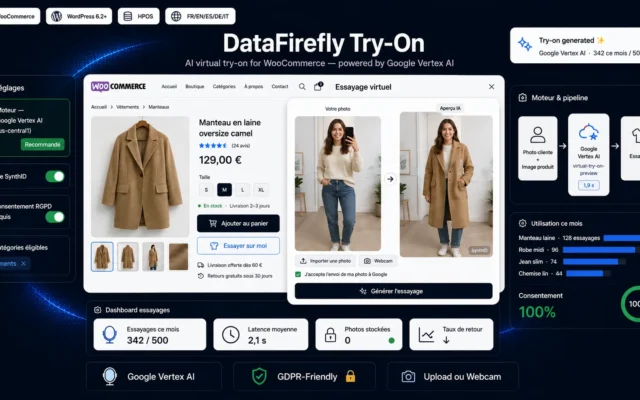
AI Virtual Try-On for WooCommerce
First — against the returnSize and fit are the leading cause of returns. The doubt gets resolved before the cart, not after it.
Shoppers upload a photo or use their webcam and see the garment on themselves, powered by Google's Vertex AI Virtual Try-On model. Fewer returns,…
€129.00 View the module -
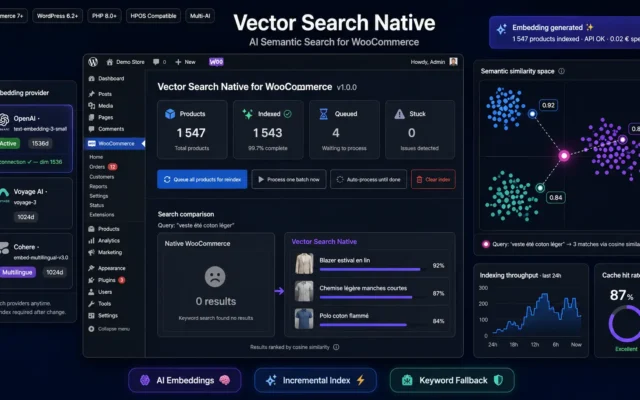
Vector Search Native — AI Semantic Search for WooCommerce
The lost sale with a timestamp"No results" isn't a technical state. Semantic search understands intent, not keywords.
Turn the WooCommerce search bar into a semantic engine. Customers who can't remember the exact product name still find it, thanks to meaning-based similarity…
€59.00 View the module -
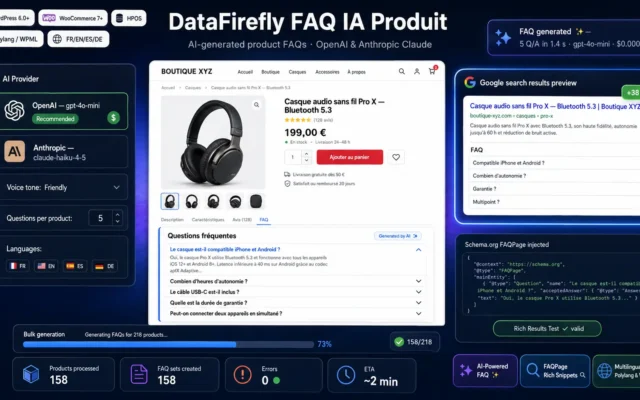
DataFirefly Product FAQ AI — Automatic AI-generated FAQs with Google rich snippets and OpenAI/Claude for WooCommerce
Questions people actually askThey're already in your support inbox. AI organises them — it doesn't invent them.
WooCommerce plugin that automatically generates product FAQs using AI (OpenAI or Anthropic Claude). Google FAQPage rich snippets, Polylang/WPML multilingual, per-product FAQ editor, bulk generation,…
€49.00 View the module -
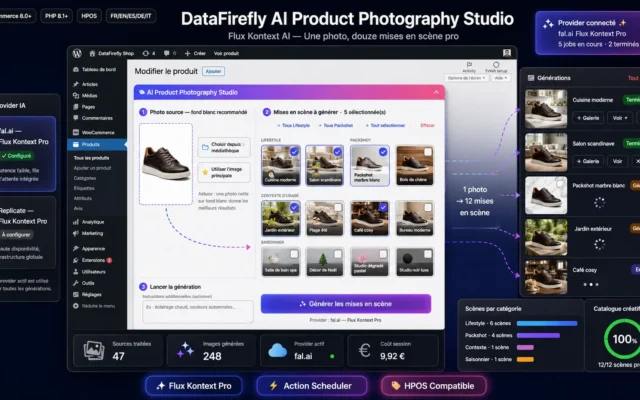
AI Product Photography Studio for WooCommerce
The doubt no text can closeA product with one image sells badly. A studio render costs less than a photo shoot.
A single white-background product photo becomes 12 pro scenes (lifestyle, packshot, context) generated by Flux Kontext AI. The product stays rigorously identical across every…
€79.00 View the module
Side-by-side comparison
| Module | Best for | Price | Rating | Link |
|---|---|---|---|---|
| AI Virtual Try-On for WooCommerce | First — against the return | €129.00 | — | |
| Vector Search Native — AI Semantic Search for WooCommerce | The lost sale with a timestamp | €59.00 | — | |
| DataFirefly Product FAQ AI — Automatic AI-generated FAQs with Google rich snippets and OpenAI/Claude for WooCommerce | Questions people actually ask | €49.00 | — | |
| AI Product Photography Studio for WooCommerce | The doubt no text can close | €79.00 | — |
AI doesn’t sell more — it sells less twice
That’s the useful inversion. The real cost of a hesitant customer isn’t the lost sale: it’s the sale you make twice — once on purchase, once on return. Shipping out, shipping back, inspection, restocking — and the margin is gone.
The wrong AI writes. The right one answers
An AI generating your product copy at scale mostly produces text nobody reads — and Google recognises it for what it is. Useful AI doesn’t write your page: it answers the one question the customer has in front of it.
And the search that finds nothing
“No results” isn’t a technical state. It’s a lost sale with a timestamp. A keyword search doesn’t understand intent: someone typing “quiet keyboard for an office” isn’t looking for a word — they’re looking for a property.
How to choose
Don't chase conversion — chase the return
The hesitant customer doesn't cost you the sale, he costs you the sale made twice: purchase, then return. Shipping, return transport, inspection, restocking — the margin is gone. So start with the category with the highest return rate, not the best-selling one.
AI that writes versus AI that answers
Descriptions generated at scale fill pages nobody reads. An AI answering a specific question — size, compatibility, material — works exactly where the doubt actually sits.
"No results" is a lost sale with a timestamp
The customer types a property, not your product title. Semantic search understands intent; keyword search compares characters. Read your search logs — they contain everything you failed to sell.
And images block more sales than price
A product with a single photo sells badly, whatever the price. Studio renders cost less than a shoot — and they close the doubt no text can close.
What you gain
Fewer returns, not more clicks
Size and fit are the leading cause of returns. A sale that comes back is a sale with no margin.
Doubt resolved before the cart
The customer sees the product on themselves. The decision happens before the purchase, not after.
A search that understands intent
Semantic search understands intent, not keywords. "No results" is a lost sale.
An FAQ built from real questions
The questions are already in your support inbox. AI organises them — it doesn't invent them.
Images that close the doubt
Missing images block more sales than price does. A studio render costs less than a shoot.
AI that answers instead of filling
No generated wall of text. Only answers to questions people actually ask.
From install to results
-
Start with the highest-return category
Not the best-selling one. That's where the money you've already lost sits.
-
Resolve doubt before the purchase
Size, fit, colour: doubt belongs before the cart, not after.
-
Read your search logs
They contain what your customers wanted and didn't find.
-
Build the FAQ from real questions
Your support inbox holds the real questions. Use them.
-
Measure return rate
Not conversion. It's the only number that measures understanding.
“We added AI to sell more. We barely sold more — but our return rate dropped sharply. By the end of the quarter, that was the bigger win.”
Frequently asked questions
Does AI actually raise my conversion rate?
Sometimes. But the more interesting effect is elsewhere: fewer returns. A sale that comes back is a sale with no margin — you shipped twice, inspected and restocked. A resolved doubt is worth more than an extra click.
Why not use AI to write my descriptions?
Because it produces text nobody reads — and Google recognises it for what it is. Useful AI doesn't replace your product page: it answers a specific question the customer has in front of it. Same word, different tool.
What does semantic search add over normal search?
Because keyword search doesn't understand intent. The customer types a property, not a word from your catalogue. Semantic search finds the right product even when your title calls it something else — and "no results" disappears.
Where do the questions in a good product FAQ come from?
In your support inbox. The questions your customers really ask are already written down — dozens of times. AI organises and phrases them; it doesn't invent questions nobody has.
Who is virtual try-on actually for?
In fashion and accessories, where size and fit are the leading cause of returns. There, the gain isn't the extra order — it's the order that doesn't come back.
Which metric shows this is working?
Return rate per category, not conversion. It's the only number that shows whether the customer understood what they were buying before they bought it.
Where do I start?
With the category that comes back the most. That's where the money you've already lost is — and where the gain shows up immediately. Not with the category that sells the most.
This need on other platforms
Not sure which one fits your store?
Tell us your context — we answer with a straight recommendation, not a sales pitch.