In 2026, a significant and growing share of commercial searches no longer go through classic Google Search. Buyers query ChatGPT (“what are the best review modules for PrestaShop”), Perplexity (“compare this product with that one”), Claude, and consult the Google AI Overviews displayed above classic results. This is no longer an emerging topic — it’s a full-fledged commercial discovery channel that rivals the traditional SERP.
The problem for e-commerce merchants: these Answer Engines don’t work like Google Search. They don’t return a list of clickable links; they synthesise an answer. If your store isn’t citable by these engines, you’re invisible. Optimising for them is AEO (Answer Engine Optimization) — the logical successor to SEO, or rather its new superimposed layer. This article details how to optimise a PrestaShop 8 store for AEO in 2026, with the techniques that actually work and those that are hollow marketing.
From SEO to AEO: what changes in 2026
Classic SEO optimises for ranking in a SERP of links. The levers: keywords, backlinks, performance, structure, intent matching. The user reads a list of results, chooses a link, lands on a page.
AEO optimises for citation within a synthetic answer generated by an Answer Engine. The levers are partly the same (authority, content quality, structure) but with an additional requirement: your content must be extractable and citable by an LLM that synthesises an answer in 200-500 words. Pages that work for SEO don’t automatically work for AEO, and vice versa.
Three fundamental differences:
The extraction unit is smaller. In SEO, Google indexes and ranks an entire page. In AEO, the LLM extracts chunks of content (paragraphs, lists, tables, FAQs) and integrates them into its synthesised answer. A long page with a relevant paragraph on the exact topic of the query can be cited even if the rest of the page is off-topic.
Structure matters more than ever. LLMs are trained to recognise structures (FAQs, bulleted lists, comparison tables, Schema.org structured data). Unstructured content, even high-quality, is less easily extractable. This explains why Schema.org-marked FAQs perform well on AEO — they’re literally ready-to-reuse question-answer pairs.
Authority is measured differently. In SEO, authority comes through backlinks and external signals. In AEO, authority also comes through the consistency of your discourse across your entire site (LLMs notice when your pages contradict each other), and through presence in training corpora (Common Crawl, licensed data).
How Answer Engines actually read your product catalogue
Three mechanisms coexist for an Answer Engine to know your catalogue.
Direct crawl. Like Googlebot, Answer Engine bots (GPTBot for OpenAI, ClaudeBot for Anthropic, PerplexityBot, etc.) visit your site regularly and index accessible content. Check your robots.txt — many stores block these bots by default without realising, making themselves invisible to Answer Engines.
Real-time retrieval-augmented generation (RAG). When a user asks ChatGPT or Perplexity a question, the engine can perform a real-time web search and read the most relevant pages to synthesise its answer. Your pages must therefore be indexed by classic search engines (Google, Bing) that these Answer Engines use on the backend.
Training corpora. LLMs are trained on massive web dumps (Common Crawl, licensed content, editorial sources). Once trained, they contain knowledge frozen at their cutoff date — your store, if old and indexed enough, is probably already in these models’ “by-heart” knowledge, even without real-time crawl.
Effective AEO works all three channels in parallel: allow bots in robots.txt, structure content for RAG, and regularly publish editorial content that will end up in future training corpora.
The LLMs.txt format: the new 2025-2026 standard
In 2024, Jeremy Howard proposed a convention: the /llms.txt file at the site root, describing the site structure in a format optimised for LLM reading (structured markdown, links to key pages, synthetic context). The format was quickly adopted by major Answer Engines as a structure and authority signal.
For an e-commerce store, a well-built llms.txt describes:
- the store identity (name, sector, USP);
- main product categories (with links);
- key editorial pages (blog, guides, general FAQ);
- support pages (contact, shipping, returns);
- optionally, a link to an
llms-full.txtcontaining the full content in synthesised markdown format.
Answer Engines read this file as a priority when they discover your site, and use it to structure their understanding. A store with a well-built llms.txt is cited more precisely than one without, on commercial and informational queries linked to its catalogue.
On PrestaShop 8, generating and maintaining llms.txt manually is viable for small catalogues (50 products) but becomes unmanageable beyond. Our LLMs.txt PrestaShop module automatically generates the file from your catalogue, keeps it updated as your products evolve, and exposes technical options (include/exclude certain categories, synthetic vs detailed format). It’s currently the fastest way for a PrestaShop merchant to align their store with this 2026 standard.
Already have an llms.txt file? Before publishing it — or to audit the one your store already exposes — run it through our free llms.txt checker: it validates the structure (H1 title, summary blockquote, link sections), flags dead links, and tells you in seconds what’s stopping Answer Engines from reading your site properly. Worth repeating every time your catalogue changes significantly.
Extended Schema.org: the lingua franca of Answer Engines
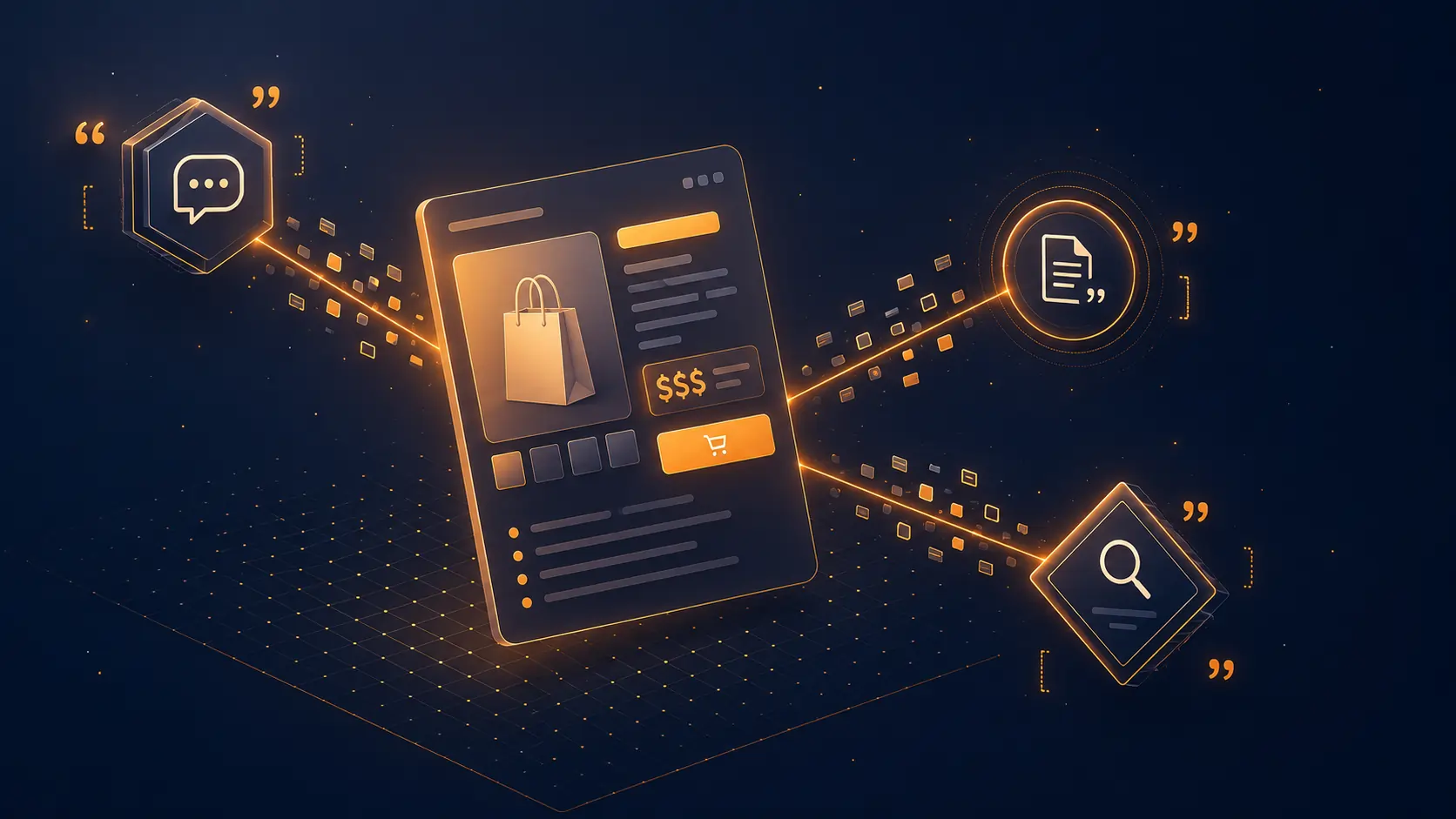
Schema.org markup remains central to AEO. Answer Engines massively consume structured data to understand your pages. On an e-commerce product page, the minimal stack is:
- Product: name, brand, price, currency, availability, image, GTIN/EAN if possible.
- Offer: commercial conditions, price, currency, shipping, return terms.
- AggregateRating: average rating, number of reviews (if you have them).
- Review: individual reviews with author, rating, content.
- FAQPage: contextual product Q&As.
- BreadcrumbList: the category hierarchy.
The classic mistake is having a basic Product Schema without the other markings, or having partial inconsistent markings (for example, price in Product differing from price in Offer). Answer Engines detect these inconsistencies and prefer not to cite a suspect page.
On PrestaShop 8, native Product Schema is minimal. To complete it properly, the DataFirefly Verified Reviews module (which adds AggregateRating + Review) and DataFirefly Product AI FAQ (which adds FAQPage) cover the three highest-impact markings for AEO. Combined, they turn a standard product page into a page highly citable by Answer Engines.
Product FAQs: the LLMs’ favourite format
On informational commercial queries (“is this product suitable for X”), Answer Engines frequently cite product FAQs found on product pages. Several reasons:
First, the question-answer format corresponds exactly to what the LLM has to produce. A FAQ “does this dress run small or large?” with its answer is directly reusable by the LLM in its synthesis, with attribution to your site.
Second, Schema.org-marked FAQs are structurally extracted from pages — the LLM sees them as discrete indexable entities, not as paragraphs buried in continuous text.
Finally, product FAQs reflect real buyer questions. These are the queries that future buyers will ask Answer Engines. The match probability is mechanically higher than on generic marketing content.
The condition for this lever to work is that FAQs must be product-specific, not generic. A FAQ “what are the delivery times?” appearing on all 500 product pages in your catalogue serves no purpose — the LLM sees it as boilerplate without informational value. A FAQ “is this chair suitable for outdoor use?” on a chair product page, with a precise answer (materials, treatment, outdoor warranty), is exactly what the LLM is looking for.
Measuring your presence in Answer Engines
Measuring AEO is harder than measuring classic SEO. There’s no (yet) Search Console for Perplexity or ChatGPT. But several signals exist.
Manual citation test. Ask 10 typical commercial questions from your sector to ChatGPT, Perplexity, Claude, and Google AI Overviews. Note whether your store appears in the answers, in what form (direct link, brand mention, precise content citation). Repeat the test every 30 days to track evolution. It’s qualitative but informative.
Referral traffic from Answer Engines. In GA4 or your analytics tool, monitor traffic sources from chat.openai.com, perplexity.ai, claude.ai, gemini.google.com. It’s still marginal in volume on most stores, but the 2024-2026 trend is clearly upward. A store with 0% AEO traffic in 2024 could be at 5-10% in 2026.
Robots.txt consistency and server logs. Check that GPTBot, ClaudeBot, PerplexityBot, OAI-SearchBot appear in your server logs (signs that bots are crawling your site) and that they’re not blocked in robots.txt. If you want to explicitly allow or block certain bots, use the User-agent syntax in robots.txt.
Emerging dedicated tools. Platforms like Profound, Otterly, or custom solutions are starting to offer AEO brand monitoring — automatically tracking your presence in AI answers across hundreds of prompts. Still in early phase, but these tools will sophisticate rapidly.
AEO marketing pitfalls in 2026
AEO being a hot topic, many actors sell consulting or tools based on promises that don’t withstand technical scrutiny. Three typical pitfalls.
“Optimise your content for ChatGPT specifically.” False. Techniques that work (structure, FAQ, Schema.org, llms.txt) work for all major Answer Engines in parallel. Optimising “for ChatGPT” or “for Perplexity” specifically makes no technical sense — you’re optimising for principles they share.
“Buy backlinks on sites cited by Answer Engines.” Dubious service offering. Answer Engines are less sensitive to backlinks than Google, and more sensitive to intrinsic content quality. Buying backlinks for AEO is money badly spent.
“We’ll inject hidden content specifically for LLMs.” Risky practice. Answer Engines detect (and penalise) cloaking — serving different content to the LLM bot vs the human visitor. It’s the modern equivalent of keyword stuffing: works briefly, ends in long-term degradation.
Effective AEO is the disciplined application of modern SEO techniques (structure, schema, performance, editorial quality) with a few specific additions (llms.txt, marked FAQs, extractable content). No magic, no shortcuts.
Conclusion: AEO is a layer above SEO, not a revolution
AEO in 2026 doesn’t invalidate SEO. It extends its principles for a new class of engines (Answer Engines) that synthesise instead of listing. Stores that do their 2026 SEO correctly (structure, schema, performance, quality) are already well-positioned on AEO. Those adding the specific bricks (llms.txt, product FAQ Schema, extended Review markup) take a 6 to 18 month lead over competitors who won’t have seen this coming.
The business angle: on commercial queries, Answer Engines will progressively replace the classic SERP for 20 to 40% of searches by 2027-2028. A store invisible to Answer Engines in 2026 takes the structural risk of losing a significant share of its discovery traffic within 2 years. Investing in AEO now is protecting future visibility.
To dig deeper, browse our AEO & Answer Engines and E-commerce SEO categories. And to align your PrestaShop 8 store with 2026 AEO standards, the combo LLMs.txt PrestaShop + Product AI FAQ + Verified Reviews covers the three highest-impact levers — llms.txt structure, per-product marked FAQs, and extended Review markup for citation.
Also worth reading: the complete e-commerce SEO guide, understanding AEO and Schema.org Product in 2026.
To put this into practice: our selection of modules to be visible in ChatGPT on PrestaShop.