
The SEO of 2026 has little to do with keyword placement. Google — and answer engines like ChatGPT or Perplexity — no longer rank isolated pages but topical entities: a site recognized as an authority on a subject sees all of its pages rank better. The question is therefore no longer “is this page optimized?” but “does my catalogue cover a subject coherently and in a structured way?”.
The answer fits in one method: topic clusters. Here is how to structure an e-commerce catalogue to build real semantic authority.
The pillar / cluster model, explained simply
A topic cluster is a set of pages connected around a subject: a pillar page that covers the subject broadly, and satellite pages (categories, subcategories, product pages, blog posts) that cover each sub-theme in depth, all linked by coherent internal linking. Google reads this structure as a signal of expertise. A coffee store with a “guide to whole-bean coffee” pillar page linked to its categories by origin, by intensity and to articles on grinding will be seen as more expert than a flat catalogue.
Step 1 — Map what you already cover
Before adding content, you must see the current structure: which clusters exist, which are incomplete, where pillar pages are missing. Doing this by eye on a large catalogue is impossible. A topic cluster detector automatically maps the catalogue’s semantics and identifies missing pillar pages.
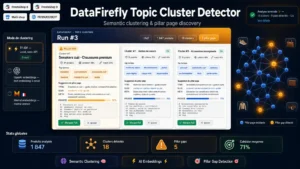 Topic Cluster DetectorSemantic mapping of your catalog and detection of missing pillar pages€29.00
Step 2 — Detect what dilutes your authority
Two silent problems sabotage topical authority:
- Cannibalization: several pages target the same keyword and compete in the SERP, splitting the signal. A cannibalization detector cross-references Search Console data to spot and resolve them (merge, deindex, reposition).
- Thin content: pages that are too shallow and drag down the domain’s perceived quality. A thin-content detector identifies these weak pages to enrich or remove them.
Step 3 — Measure semantic coherence
Beyond individual pages, it is overall coherence that counts. A semantic audit by vector clustering measures which content moves closer or further apart thematically, and reveals the pages that dilute your authority on a subject. It is the tool that turns the hunch “our SEO is going in all directions” into an actionable diagnosis.
Step 4 — Anticipate and industrialize
Once the structure is cleaned up, two levers take over: SEO traffic prediction to prioritize clusters with strong seasonal potential, and a complete SEO suite like DataFirefly All in One SEO to manage tags, structured data and technical signals at catalogue scale.
The link with AEO
This semantic structuring does not only serve Google. Answer engines cite first the sources they identify as expert on a subject — exactly what a good topic cluster builds. It is the natural extension of our AEO dossier for e-commerce: the same thematic structure feeds both classic ranking and AI citations.
Conclusion: structure before you produce
Adding content without structure does not build authority — it adds noise. The winning sequence: map the clusters, remove cannibalization and thin content, measure coherence, then produce where it matters. To go further, explore our guides E-commerce SEOSEO articles dedicated to e-commerce: meta tags, XML sitemap, multilingual hreflang, Schema.org structured data (Product, Offer, FAQPage), category pages, product pages, Search Console, technical audit, link building, international SEO.
Also worth reading: the complete e-commerce SEO guide, understanding AEO and AEO applied to PrestaShop 8.
To put this into practice: our selection of modules to produce SEO content at volume.