
Our best Shopware plugins to be visible in ChatGPT and AI search engines
Three plugins, so the machines finally know what you sell.
Shopware has a clean API — but a model doesn't read an API, it reads the page. If your storefront is decoupled, the assistant sees a shell: price, variants and availability load via JavaScript. So it doesn't cite you.
Sound familiar?
A catalogue the headless front end hides
The API is clean, but the model reads the page. Decoupled, it sees a shell with no content.
Invisible to the assistants
ChatGPT recommends your competitor. Not because they're better — because they're readable and you're not.
A catalogue with no internal cohesion
What isn't linked barely exists for the machine. Orphan pages never get found.
Links leading nowhere
A dead 404 is a dead end for the crawler — and for any assistant following your catalogue.
Our selection, ranked
Every module below is built, maintained and supported by our team. The ranking reflects what we would install first on a client store.
-
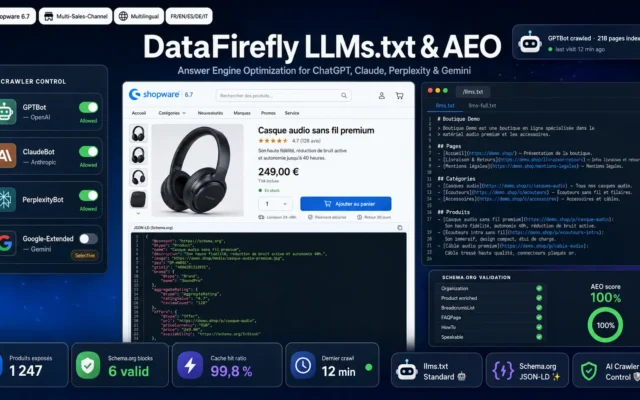
LLMs.txt & AEO Shopware — AI Search Optimisation for ChatGPT, Claude & Perplexity
First — become readablellms.txt and AEO schema. They bring back what the decoupled front end hides. Minimal cost, maximal effect.
Expose your Shopware 6.7 store to LLMs (ChatGPT, Claude, Perplexity, Gemini) through llms.txt and llms-full.txt files, enriched Schema.org structured data (Organization, Product, FAQPage, HowTo,…
€59.00 View the module -
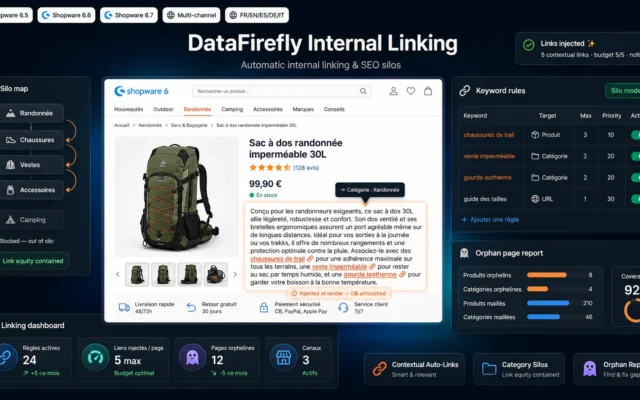
Automatic Internal Linking
Connect the catalogueAutomatic internal linking. A model follows links — what isn't linked barely exists for the machine.
Automatically inject contextual internal links into your Shopware product and category pages, build clean SEO silos and detect orphan pages. Compatible with Shopware 6.5,…
€89.00 View the module -
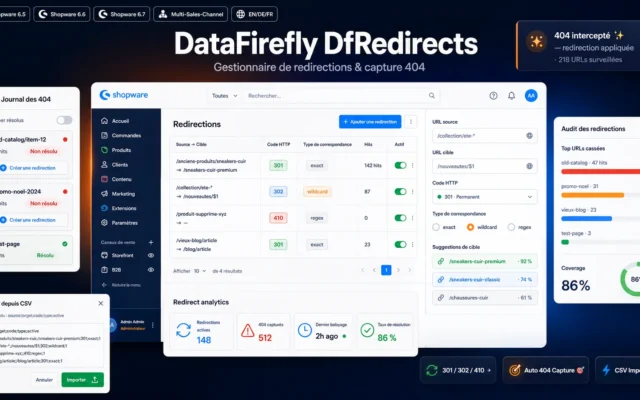
301 Redirect Manager & 404 Capture – Shopware 6
No link leading nowhere301 redirects and 404 capture. A dead page is a dead end; a 301 passes the authority on.
Manage all your 301/302/410 redirects and automatically capture 404 errors on your Shopware store. Exact, wildcard or regex matching, URL-similarity target suggestions, bulk CSV…
€89.00 View the module
Side-by-side comparison
| Module | Best for | Price | Rating | Link |
|---|---|---|---|---|
| LLMs.txt & AEO Shopware — AI Search Optimisation for ChatGPT, Claude & Perplexity | First — become readable | €59.00 | — | |
| Automatic Internal Linking | Connect the catalogue | €89.00 | — | |
| 301 Redirect Manager & 404 Capture – Shopware 6 | No link leading nowhere | €89.00 | — |
A decoupled front end is almost invisible to a language model
That’s the Shopware paradox. Your API is clean, your catalogue structured — but a model doesn’t read an API. It reads the page it’s served. And if your storefront is decoupled, it often gets a shell with no content: price, variants and availability load via JavaScript.
Citability isn’t a question of ranking
An assistant doesn’t rank. It selects, summarises and attributes to one source. To be chosen, your data has to be unambiguously structured — not pretty, but machine-readable.
And internal linking decides what gets found at all
A model follows links to understand your catalogue. Orphan pages, dead 404s, no internal mesh: what isn’t linked barely exists for the machine — however well it’s written.
How to choose
The Shopware problem WordPress doesn't have
Shopware has a clean API and a structured catalogue — but a model doesn't read an API. It reads the page. If your storefront is decoupled, the model often sees a shell: price, variants, availability load via JavaScript. It can't cite you, because it doesn't know what you sell.
Become readable first
llms.txt and the AEO schema. The cheapest, fastest brick — and the one whose absence costs most. Without it, the models have to guess your store from the HTML, and they guess badly.
Then connect the catalogue
A model follows links to understand your catalogue. Orphan pages barely exist for the machine. Automatic internal linking makes the depth visible, and redirects ensure no link leads nowhere — a dead 404 is a dead end for any assistant.
The side effect nobody mentions
What an assistant deems citable — clear structure, clean data, a connected catalogue — is exactly what Google has rewarded for years. AEO isn't a break from SEO: it's its extension. The investment pays twice.
What you gain
Read by the assistants
llms.txt and AEO schema describe your store in a format the models read natively.
What the headless front end hides
A decoupled front end shows the model a shell. Structured data brings the content back.
A catalogue that holds together
A model follows links. Automatic internal linking surfaces what would otherwise stay orphaned.
No link leading nowhere
A dead 404 is a dead end for the crawler. A 301 passes the authority on instead of losing it.
AEO and SEO at once
What an assistant deems citable is what Google has rewarded for years. The investment pays twice.
The right metric
Not traffic. Your citation rate on the questions your customers actually ask is the number that counts.
From install to results
-
Understand what the model really sees
A model doesn't read an API, it reads the page. Decoupled, it sees a shell.
-
Become readable first
llms.txt and AEO schema. The cheapest brick, the one whose absence costs most.
-
Connect the catalogue
A model follows links. Orphan pages barely exist for the machine.
-
Seal the holes
A dead 404 is a dead end. A 301 passes the authority on.
-
AEO isn't a break from SEO
What an assistant cites, Google has rewarded for years. The investment pays twice.
“We were proud of our headless storefront — fast, modern, clean. Then we measured what ChatGPT sees on our pages: a title and an image. Prices, variants, availability — none of it existed for the machine.”
Frequently asked questions
Why does AI read my Shopware badly when the API is clean?
Because a model doesn't read an API — it reads the page it's served. If your storefront is decoupled, it often gets a shell with no content: price, variants and availability load via JavaScript. The API is clean, but the assistant never sees it.
What exactly is llms.txt?
It's a file at the root that describes to the models what you sell and how your catalogue is organised. Like robots.txt, but for understanding rather than crawling. The cheapest first step — and the one whose absence costs the most.
What does internal linking have to do with AI visibility?
Because a model follows links to understand your catalogue. A page nothing points to barely exists for the machine — however well written. Automatic internal linking connects what would stay orphaned and makes the depth of your catalogue visible at all.
Why do redirects matter for AI visibility?
Because a dead 404 is a dead end for the crawler — and for any assistant following your catalogue. A 301 passes the authority you built on, instead of losing it. Broken links are citability draining into nothing.
Does AEO conflict with my classic SEO?
Very little, and that's the good news. What an assistant deems citable — clear structure, clean data, a connected catalogue — is exactly what Google has rewarded for years. AEO isn't a break from SEO, it's its extension to other recipients.
Where do I start?
With llms.txt and the AEO schema: low cost, immediate effect, no prerequisite. Then the internal linking, so the models find your whole catalogue. The redirects close the holes. In that order — become readable, then connect, then seal.
Which metric should I track?
Your citation rate on the questions your customers actually ask — not your traffic. An assistant doesn't pass a classic referrer; you'll never see that traffic cleanly in Analytics. What you can measure is whether you're named. And that's the number that counts.
This need on other platforms
Not sure which one fits your store?
Tell us your context — we answer with a straight recommendation, not a sales pitch.