
Our best Shopware plugins for B2B selling
Three plugins — and the insight that B2B is a different process, not the same one at a different price.
B2B isn't B2C with less VAT — one person decides, a second approves, a third pays. And nobody buys before they have a document they can present internally.
Sound familiar?
A checkout for one person, not three
A "buy now" button demands a decision the buyer isn't allowed to make alone.
No document for internal approval
Without a proforma, your customer can't get the order approved internally. So they don't buy.
An invoice their system can't process
A PDF in an inbox isn't an invoice their ERP can read.
The same order, entered three times
Store, ERP, accounting. Typed three times, three chances of an error.
Our selection, ranked
Every module below is built, maintained and supported by our team. The ranking reflects what we would install first on a client store.
-
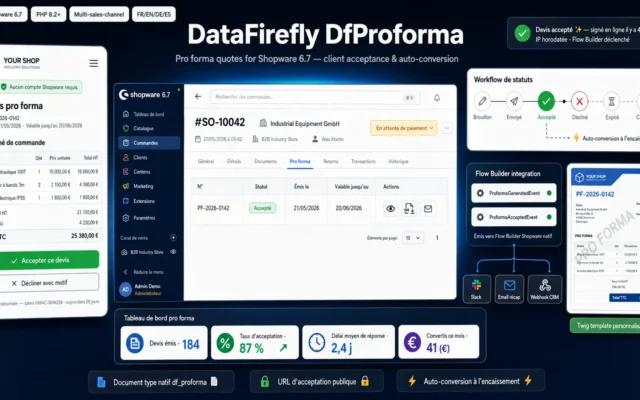
DfProforma Shopware — Pro forma quotes for Shopware 6.7 with client acceptance and auto-conversion
First — the missing documentThe proforma enables internal approval before buying. Accepted online, it becomes the order automatically.
Issue real pro forma quotes from any Shopware 6.7 order, send them by email with a public acceptance URL, and convert them to orders…
€129.00 View the module -
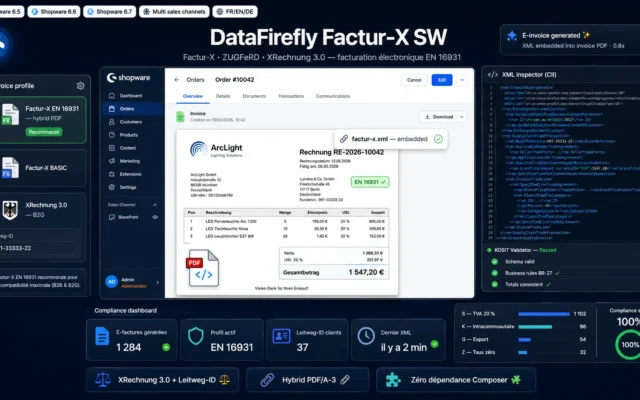
DataFirefly Factur-X SW — E-Invoicing for Shopware 6: ZUGFeRD & XRechnung 3.0
The invoice their ERP readsXRechnung and ZUGFeRD following EN 16931. The B2B customer processes structured, not a PDF in an inbox.
EN 16931 electronic invoices for Shopware 6: Factur-X / ZUGFeRD embedded in the invoice PDF, XRechnung 3.0 with Leitweg-ID for B2G, automatic generation, e-mail…
€89.00 View the module -
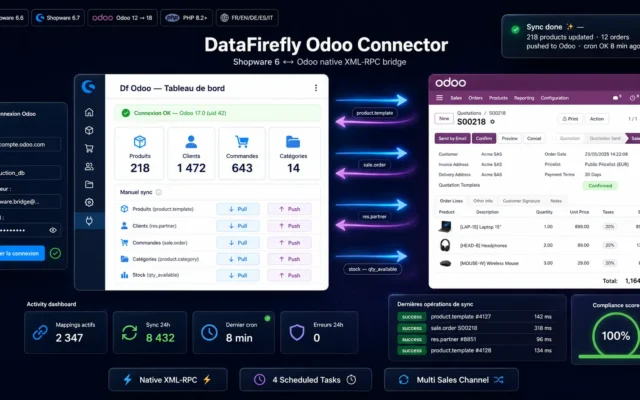
DataFirefly Odoo Connector — Shopware ↔ Odoo
The chain, all the way to the ERPInvoice, customer and payment in the ERP without anyone retyping. Three entries become one.
Two-way Shopware 6.6 / 6.7 ↔ Odoo sync via native XML-RPC. Products, real-time stock, customers, orders, categories. Compatible with Odoo 12 to 18, Community…
€119.00 View the module
Side-by-side comparison
| Module | Best for | Price | Rating | Link |
|---|---|---|---|---|
| DfProforma Shopware — Pro forma quotes for Shopware 6.7 with client acceptance and auto-conversion | First — the missing document | €129.00 | — | |
| DataFirefly Factur-X SW — E-Invoicing for Shopware 6: ZUGFeRD & XRechnung 3.0 | The invoice their ERP reads | €89.00 | — | |
| DataFirefly Odoo Connector — Shopware ↔ Odoo | The chain, all the way to the ERP | €119.00 | — |
B2B isn’t B2C with less VAT
That’s the mistake that costs most Shopware stores. In B2C, one person decides and pays immediately. In B2B, one person decides, a second approves, a third pays — and nobody buys before they have a document they can present internally.
That document is the proforma — and it’s almost always missing
Without it, you’re asking a buyer to press a “buy now” button before their accounting, their manager or their budget has agreed. You’re demanding a decision they aren’t allowed to make alone.
And the invoice afterwards isn’t a detail
It has to be electronic — XRechnung, ZUGFeRD — and land in their ERP, not their inbox. The B2B customer judges you not on price, but on whether you fit their process.
How to choose
First, understand what makes B2B different
B2B isn't B2C with less VAT. In B2C, one person decides and pays. In B2B, one decides, a second approves, a third pays. Your checkout has to map that path — not ignore it.
Then the missing document: the proforma
It lets the buyer approve internally before buying. Without it, you demand a decision they aren't allowed to make alone. It isn't a duplicate of the invoice — it precedes it, and it's often the real trigger of the order.
Then the invoice their ERP can read
XRechnung, ZUGFeRD, following EN 16931. The B2B customer doesn't process PDFs in an inbox — they expect a structured invoice in their system. A PDF isn't an invoice to them, it's extra work.
And the chain doesn't stop at the store
Proforma, order, invoice, ERP, accounting. Every re-entry is an error waiting for its moment. A connection turns three entries into one — and a structured format makes the rest visible.
What you gain
The document that enables approval
The proforma lets the buyer approve internally before buying. The document that precedes the order.
From approval to order, no break
The customer accepts the proforma online, it becomes the order automatically. No retyping.
A connection, not a PDF sent by email
Invoice, customer and payment land in the ERP, not an inbox. The B2B customer expects this.
The invoice their ERP can read
XRechnung and ZUGFeRD following EN 16931. B2B accounting reads structured, not PDF.
The right criterion
Not price. Whether you fit their approval and accounting process is what decides the B2B purchase.
A chain with no third entry
No double typing between store, ERP and accounting. Every re-entry is an error waiting.
From install to results
-
Map the B2B path, not the B2C one
One person decides, a second approves, a third pays.
-
Give them the proforma
Without it, the buyer can't approve internally — so they don't buy.
-
Connect approval and order
Accepted online, it becomes the order automatically. No retyping.
-
Deliver an invoice their system reads
XRechnung, ZUGFeRD. Their ERP reads structured, not a PDF.
-
Connect the chain to the ERP
Three entries become one. Every re-entry is an error waiting.
“We thought our B2B area was a B2C store with net prices. Buyers added items to the cart and never purchased. What was missing was the proforma — the document they needed to present internally to be allowed to buy at all.”
Frequently asked questions
Why isn't a normal checkout enough in B2B?
Because in B2B the person who decides is rarely the one who pays. There's an approval in between — a manager, an accounting department, a budget. A "buy now" button ignores that step and demands a decision the visitor isn't allowed to make alone.
Why a proforma in B2B?
It lets your customer get an order approved internally before buying. It isn't a fiscal document and it isn't the invoice — it precedes the order. Without it, you're asking a buyer to purchase before their organisation has agreed.
What's the difference between a proforma and an invoice?
The proforma announces; the invoice taxes. The customer presents the proforma internally, gets their approval, accepts online — and only then does the order exist. The invoice is the fiscal document that follows.
Why must the invoice be electronic?
Because their accounting can't process a PDF in an inbox — and eventually won't be allowed to accept it. XRechnung and ZUGFeRD land structured in their ERP. The B2B customer expects it because their own process demands it.
Why connect the ERP instead of sending PDFs?
Because an order typed three times — in the store, in the ERP, in accounting — offers three chances of an error. A connection to your ERP turns three entries into one. And a structured format makes every typo visible.
Where do I start?
With the proforma, because it's what's missing in B2B and blocks the purchase. Then the electronic invoice, because the B2B customer needs it in their ERP. The ERP connection closes the chain — after that.
This need on other platforms
Not sure which one fits your store?
Tell us your context — we answer with a straight recommendation, not a sales pitch.