
A professional customer ordering twice a week receives around a hundred invoices a year. Their accountant processes a hundred, your accountant issues a hundred, and each one potentially generates a transfer to reconcile. Consolidated invoicing solves this by issuing a single invoice per customer per period, generally the month.
PrestaShop has no such notion. One order equals one invoice, generated automatically on status change. Here is what moving to monthly invoicing actually assumes.
What consolidation changes in practice
For the customer, a single document to approve and a single payment to schedule. On low-value orders placed at high frequency, that is often the condition the purchasing department sets before working with you.
For you, three effects add up: fewer documents to issue and archive, fewer transfers to reconcile, and a clearer receivables picture because it is reasoned per customer rather than per order. The counterweight is real: you get paid later. An order placed on the 2nd, invoiced on the 30th, payable at 30 days, is settled at the end of the following month, close to sixty days of lag. This decision is a financial one before it is a technical one.
The four cases to settle
The date that determines the period
An order placed on 30 January and shipped on 2 February belongs to which invoice? The safest rule attaches the order to the period of its delivery, because in a sale of goods it is delivery that makes the receivable due. Choose one rule and document it, inconsistency on this point is what triggers customer disputes.
Returns and credit notes
A return happening before the cut-off has to be deducted from the consolidated invoice in progress. A return happening after issuance requires a separate credit note, with its own numbering. Never amend an invoice already sent, even if it has not been paid yet.
VAT
The applicable rates are those in force at the date of each delivery, not at the date the consolidated invoice is issued. On a period straddling a rate change, the invoice therefore carries two distinct rates. The document has to break down the taxable bases per rate, which a simple sum of orders does not do.
The level of detail required
A consolidated invoice is not a statement of account. It has to carry the detail of the deliveries: date, order or delivery note reference, item description, quantities, unit prices. A document that merely listed amounts would not meet the conditions of an invoice and will be refused by the customer’s accounting department.
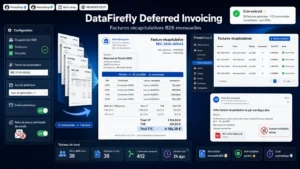 B2B Consolidated Invoicing Module for PrestaShop 8 & 9 — Monthly Invoice per CustomerOne monthly invoice per B2B customer, instead of one invoice per order.€89.00
Numbering
This is where a homemade implementation most often fails. Invoice numbering has to be continuous, chronological and without gaps. If you keep generating per-order invoices for your B2C customers while issuing consolidated ones for your B2B customers, both flows have to share the same sequence, or use two distinct series clearly identified by a prefix.
What you cannot do: generate the individual invoices and then “replace” them with a consolidated one. The numbers already assigned would stay in the sequence with no corresponding document, which constitutes a gap. Consolidation has to happen upstream, by not issuing an invoice at order level.
What PrestaShop does, and why it blocks
In PrestaShop, the invoice is generated by moving to an order status whose invoice option is ticked, typically “Payment accepted” or “Shipped”. The number is assigned at that moment, from the shop’s global counter.
Two consequences follow. First you have to neutralise automatic generation for the customers concerned without disabling it for the others, which means reasoning per customer group. Then you need an intermediate state for orders delivered but not yet invoiced, otherwise you lose track of what remains to be consolidated at month end.
The e-invoicing context
The rollout of business-to-business electronic invoicing across the EU makes this topic more sensitive than it used to be. A consolidated invoice remains perfectly admissible, but it will have to be issued in a structured format and travel through an approved channel, with machine-readable line detail. A consolidation improvised by stitching PDFs together will not clear that step.
That is a good reason to handle the subject now rather than under pressure: the data structure you put in place today to consolidate cleanly is exactly the one that will be required tomorrow.
Putting consolidation in place
The B2B Consolidated Invoicing module handles this chain on PrestaShop 8 and 9: suspension of per-order invoicing by customer group, grouping by period, delivery detail per line, credit note handling and continuous numbering.