
Our best PrestaShop modules for customer retention
Eight modules to bring them back without paying, and without sacrificing margin.
The second sale costs five times less than the first. And yet your whole budget goes into acquisition — because the customer who does not come back does not complain. They simply disappear.
Sound familiar?
A budget spent only on acquisition
You pay for every new visitor. For the one who already bought, you pay nothing — and you never speak to them.
An email nobody opens
A 20% open rate is good. It also means 80% of your customers never saw your message.
A discount that destroys your margin
You send a voucher. They come back — and never buy at full price again.
A customer who ordered a sample — and nothing since
They ordered a sample, gave their address, proved their intent. Nobody ever reminded them.
Our selection, ranked
Every module below is built, maintained and supported by our team. The ranking reflects what we would install first on a client store.
-
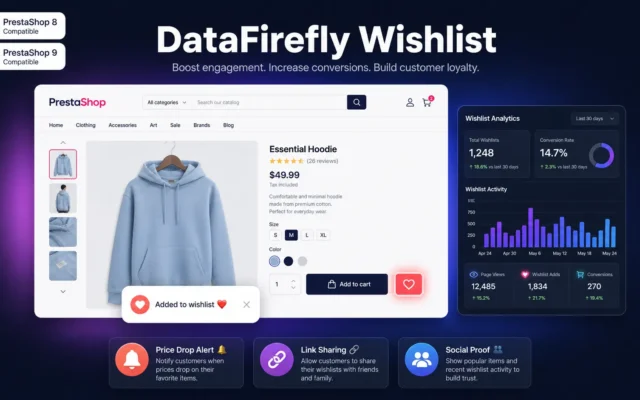
DataFirefly Advanced Wishlist – Sharing, Alerts & Analytics
The most honest signalThe wishlist tells you what they want before they buy. It's already in your database, and almost nobody uses it.
Advanced wishlist for PrestaShop 8 and 9: multiple lists per customer, link sharing, price drop and back-in-stock email alerts, configurable reminders, social proof and…
€49.00 View the module -
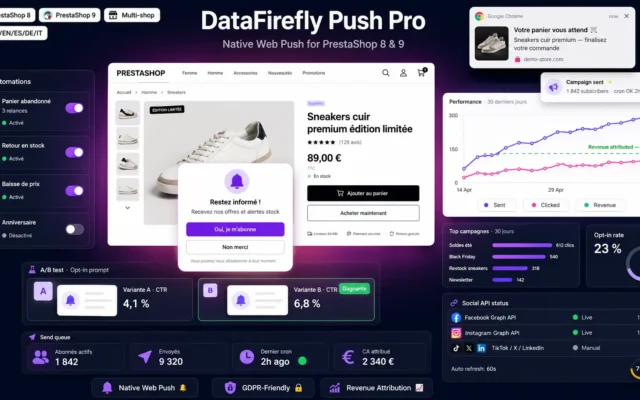
Web Push Notifications for PrestaShop 8 & 9 (Pro)
The channel that arrives90% reach versus 20% for email, and nothing to pay per send. Reaches the people who never open your emails.
Native web push notifications for PrestaShop 8 and 9: smart opt-in, 9 automations (abandoned cart, back in stock, price drop, confirmation, shipping, review, birthday,…
€99.00 View the module -
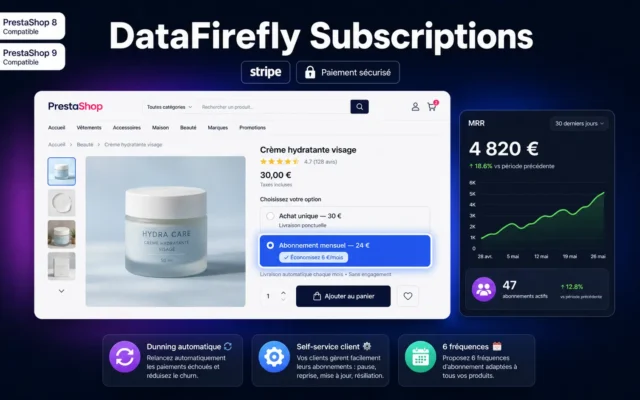
DataFirefly Subscriptions — Subscriptions and Stripe Recurring Payments for PrestaShop 8 & 9
The customer you don't need to chaseA subscription isn't a discount: it's a customer who buys every month without you doing anything.
Complete subscription system for PrestaShop 8 and 9: Stripe payment at checkout with card on file, 6 billing frequencies, decoupled deliveries, automatic renewals as…
€169.00 View the module -
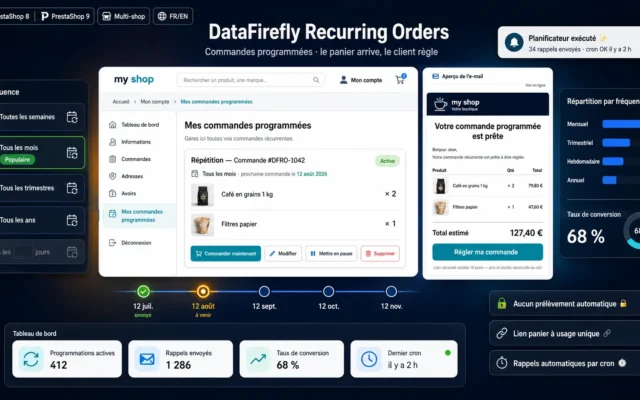
Recurring & Scheduled Orders — Automatic Reordering for PrestaShop 8 & 9
Replenishment without a subscriptionThe customer schedules a repeat order and receives, before each due date, an email with a cart ready to pay. For those who don't want to commit to a subscription.
Recurring orders for PrestaShop 8 & 9: customers schedule the repetition and receive an email with a ready-to-pay cart link before each due date.…
€109.00 View the module -
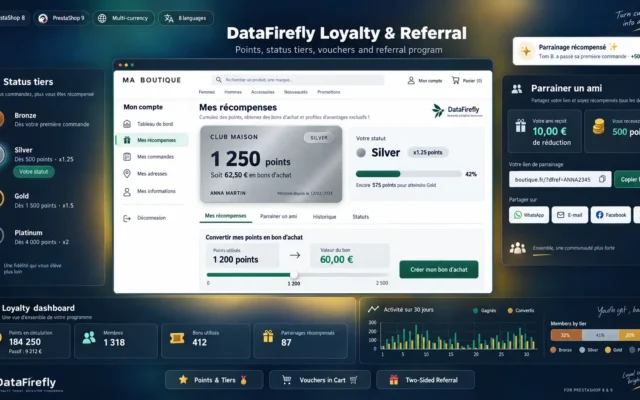
Loyalty Points and Referral Program Module for PrestaShop 8 & 9
The reward comes after the purchasePoints per euro spent, status tiers, bonus points on selected products, vouchers and referrals rewarded on both sides. Unlike a promo code sent to everyone, the reward is earned by buying.
A complete loyalty program for PrestaShop 8 and 9: points per amount spent, status tiers, bonus points on selected products, conversion into vouchers from…
€89.00 View the module -
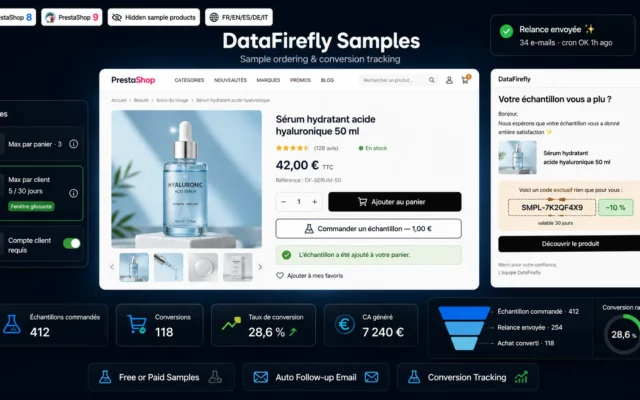
Product Sample Ordering: Follow-up & Conversion Tracking (PrestaShop 8 & 9)
The most obvious lost saleThey ordered a sample and proved their intent, and nobody followed up. Follow-up with conversion tracking.
Add an "Order a sample" button (free or paid) to your product pages, per product or per combination. Quantity locked to 1, per-customer limits,…
€129.00 View the module -
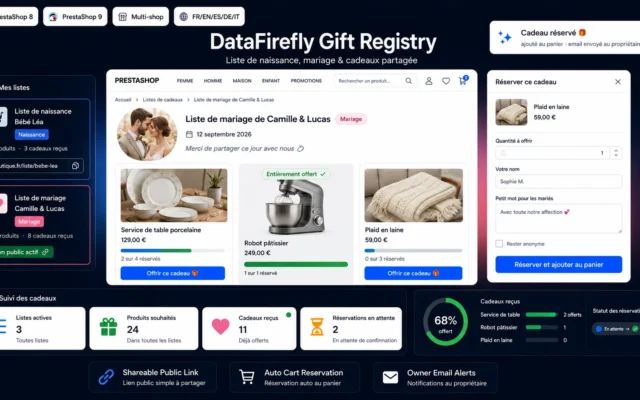
Baby, Wedding & Gift Registry — PrestaShop 8 & 9
Retention that creates acquisitionThe gift registry brings you the guests: new customers you paid nothing to acquire.
Give your customers real baby, wedding and shared gift registries: created from the customer account, public link, reserve-to-cart gifting, received-gift tracking and owner email.…
€129.00 View the module -
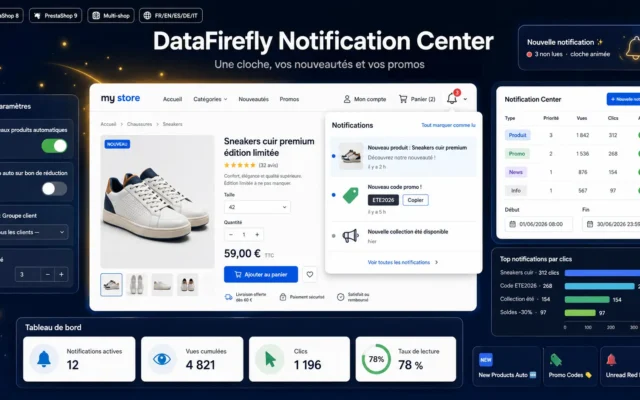
Notification Center
Everything in one placeCentralised notifications: email, push, SMS, WhatsApp. The right channel for the right message.
A notification bell next to the cart: new arrivals added automatically, promo codes in one click, a red badge on unread items.
€45.00 View the module
Side-by-side comparison
| Module | Best for | Price | Rating | Link |
|---|---|---|---|---|
| DataFirefly Advanced Wishlist – Sharing, Alerts & Analytics | The most honest signal | €49.00 | — | |
| Web Push Notifications for PrestaShop 8 & 9 (Pro) | The channel that arrives | €99.00 | — | |
| DataFirefly Subscriptions — Subscriptions and Stripe Recurring Payments for PrestaShop 8 & 9 | The customer you don't need to chase | €169.00 | — | |
| Recurring & Scheduled Orders — Automatic Reordering for PrestaShop 8 & 9 | Replenishment without a subscription | €109.00 | — | |
| Loyalty Points and Referral Program Module for PrestaShop 8 & 9 | The reward comes after the purchase | €89.00 | — | |
| Product Sample Ordering: Follow-up & Conversion Tracking (PrestaShop 8 & 9) | The most obvious lost sale | €129.00 | — | |
| Baby, Wedding & Gift Registry — PrestaShop 8 & 9 | Retention that creates acquisition | €129.00 | — | |
| Notification Center | Everything in one place | €45.00 | — |
The second sale costs five times less than the first
You pay for every visitor who arrives on your site. For the one who has already bought, you pay nothing — they know you, they trust you, their address is saved. And yet most stores put their entire budget into acquisition and nothing into the return.
Not out of stupidity: because acquisition is visible and measurable, while retention happens in silence. A customer who does not come back does not complain — they simply disappear.
Retention is not a discount problem
The reflex is to send a voucher. But a customer who comes back only for the discount is not a loyal customer — they are a customer waiting for a price. And you have just taught them never to buy at full price again.
What works is something else: hitting the right moment. The customer whose consumable is running out. The one whose wished-for product is back in stock. The one who ordered a sample and never came back.
The channel nobody uses
You send emails. Your open rate is 20%, at best. Web push notifications reach 90% — and cost nothing per send. They do not replace email: they reach the 80% who never opened it.
How to choose
First, stop sending discounts
It is the reflex, and it is expensive. A customer who comes back only for the discount is not loyal — they are price-sensitive, and you have just taught them never to buy at full price again. What brings them back is the moment, not the price.
The channel before the message
Before thinking about what to say, check whether you are being heard at all. An email at 20% open rate means 80% of your customers never saw your message. Web push reaches around 90% and costs nothing per send — it does not replace email, it reaches the people who never open it.
The signal already sitting in your database
The wishlist. It tells you what the customer wants before they buy it. A product on the list and no purchase means they are waiting for something. It is your most honest purchase signal, and almost nobody uses it.
The customer you do not have to bring back
If you sell consumables (cosmetics, coffee, pet food, filters), the subscription is the strongest lever there is — and the only one where you have to do nothing. The customer no longer buys every month afresh: they buy once and stay.
The metric nobody looks at
Your repeat-purchase rate. The customer who does not come back does not complain — they disappear. That is why retention gets neglected: it raises no alarm. Track that number like your conversion rate. It matters just as much and gets looked at ten times less.
What you gain
Five times cheaper than the first sale
The customer who has already bought costs you nothing in acquisition. They know you, they trust you.
The channel that arrives
Web push reaches 90% against email's 20% — and costs nothing per send.
The right moment, not the discount
It is not the discount that brings them back, it is the moment: the consumable running out, the product back in stock.
The sample that leads to purchase
The customer who ordered a sample and never came back is the most obvious lost sale you have.
The customer who returns on their own
A subscription is not a discount — it is a customer who buys every month without you having to bring them back.
Knowing what they want
The wishlist tells you what they want before they buy it. It is your most honest purchase signal.
From install to results
-
Stop sending vouchers
A customer who comes back for the discount is not loyal — they are price-sensitive. And you trained them.
-
Check whether you are being heard at all
A 20% open rate means 80% never saw your message. Push reaches the others.
-
Use the wishlist
It tells you what they want before they buy. Your most honest purchase signal — and it costs nothing.
-
Follow up on the samples
They proved intent and gave their address. If they do not come back, nobody reminded them.
-
Track your repeat-purchase rate
The customer who does not come back does not complain — they disappear. That is why nobody looks.
“We spent years sending vouchers to win customers back. It worked — they came back, and never at full price again. We had bred ourselves a price-sensitive customer base.”
Frequently asked questions
Is a voucher enough to bring a customer back?
It is the most expensive reflex on this page. A customer who comes back only for the discount is not loyal — they are price-sensitive. And you have just taught them never to buy at full price again. What brings them back is not the discount, it is the moment: the consumable running out, the product back in stock.
Why web push if I already have a newsletter?
Because your email is not being opened. A 20% open rate is good — which means 80% of your customers never saw your message. Web push reaches around 90% and costs nothing per send. It does not replace email: it reaches the people who never open it.
Which signal is most underrated?
The wishlist — and almost nobody uses it that way. It tells you what the customer wants before they buy it. A customer who adds a product and does not buy is waiting for something: a price, availability, an occasion. It is your most honest purchase signal — and it is already sitting in your database.
Samples: is following up worth it?
Yes, and it is the most obvious lost sale in the whole store. Someone who orders a sample has proved intent and given you their address. If they do not come back, it is almost never the product — it is that nobody reminded them.
Why a subscription rather than a loyalty programme?
A subscription is not a discount mechanic — it is a change in the relationship. The customer no longer buys every month afresh, they buy once and stay. On consumables (cosmetics, coffee, pet food, filters) it is the strongest retention lever there is — and the only one where you do not have to bring the customer back.
Is a gift registry retention or acquisition?
Both, but the second effect is bigger and never mentioned: a gift registry brings you new customers — the guests. They arrive via the list, they buy from you, and you paid acquisition for none of them. It is one of the rare retention levers that also generates acquisition.
Where do I start if my customers do not come back?
Ask yourself why they do not come back. Usually the answer is not “because it was too expensive” — it is “because nobody reminded them at the right moment”. Before offering a discount, check whether you ever spoke to them at all.
How do you even measure retention?
The customer who does not come back does not complain — they simply disappear. That is why retention gets neglected: it raises no alarm. Track your repeat-purchase rate like your conversion rate — it matters just as much and gets looked at ten times less.
This need on other platforms
Not sure which one fits your store?
Tell us your context — we answer with a straight recommendation, not a sales pitch.