
The subscription with automatic payment is not the only way to create recurring repurchase. On many catalogs, it is even counter-productive: the customer refuses the banking commitment, and you lose a sale that a simple reminder would have triggered.
The alternative model comes down to two elements: a reminder sent at the right moment, and an order rebuilt in one click.
Why the payment subscription holds back
Three resistances, all legitimate.
The perceived commitment. Authorising a recurring charge is experienced as a lasting commitment, even a cancellable one. The customer hesitates where they would not hesitate for a one-off purchase.
The loss of control. On consumable products, the quantity and the moment vary. A fixed charge does not adapt to the real rhythm, and the customer ends up with stock or out of it.
The complexity for the merchant. Managing payment failures, expired cards, information and cancellation obligations. It is an infrastructure to build and maintain.
On products with regular consumption but irregular volume, the reminder suits everyone better.
The reminder plus repurchase model
The principle: at the estimated consumption deadline, the customer receives a message offering to renew their previous order. One click rebuilds the cart, they confirm and pay normally.
Four advantages.
No commitment on the customer side, so no resistance at the first order.
No recurring payment infrastructure on the merchant side.
The customer keeps control over the quantity, the date and the content.
Each renewal is a positive decision, which produces a different relationship from an endured charge.
The cost: a renewal rate lower than that of a subscription, since an action is needed at each cycle. That is the central trade-off of this model.
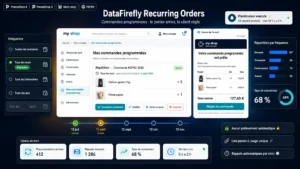 Recurring & Scheduled Orders — Automatic Reordering for PrestaShop 8 & 9Recurring and scheduled orders: the customer picks a frequency and receives a ready-to-pay cart link before every due date.€109.00
Calculating the right moment
This is what decides the effectiveness of the mechanism, and this is where the work lies.
Three methods, in order of increasing precision.
The fixed duration per product. You estimate that a box lasts six weeks and you remind at five. Simple, imprecise on products whose consumption varies.
The duration calculated on the ordered quantity. Three boxes last three times longer than one. A simple multiplication clearly improves the relevance.
The duration observed per customer. You measure the real interval between their previous orders and you remind on their own rhythm. It is the most accurate method, and it requires at least two orders of history.
The effective configuration combines the three: fixed duration for the first reminder, adjusted by the quantity, then replaced by the observed rhythm from the second order.
Calibration point: remind before the estimated run-out, with a margin corresponding to your delivery time plus a few days. A reminder that arrives when the customer is already out has sent them to a competitor.
The content of the reminder
Five elements, in this order.
The reminder of what was ordered, with the date. “You ordered on 12 March” reactivates the context.
The renewal button, immediately visible, which rebuilds the cart identically.
The possibility to modify before confirming: quantity, content, address. It must be obvious, otherwise the customer who wants to change something gives up.
The option to postpone the reminder: “not yet, remind me in two weeks”. It is the most profitable element of the message, because it avoids an unsubscription and it refines your rhythm calculation.
The unsubscribe link for this specific reminder.
What not to do: send a promotion instead of a reminder. The customer who systematically receives a discount at the deadline expects that discount and no longer orders at the normal price.
The rebuilt cart
Three technical precautions.
Unavailable products must be flagged, not silently removed. A cart rebuilt with three items instead of four, without explanation, produces an incomplete order and a complaint.
Prices may have changed since the previous order. The new price applies, and it must be visible before confirmation.
The link must remain valid for several weeks, and work without prior login for customers who ordered as guests.
On this last point, a personal link with limited validity in time settles the question without imposing an account.
The legal framework, lighter
It is one of the interests of the model and it deserves clarification.
A repurchase reminder is not a contract with successive performance. There is neither a duration commitment, nor tacit renewal, nor an online cancellation obligation to respect, since there is nothing to cancel.
Two obligations remain, and they fall under electronic prospecting. The consent or the commercial relationship: on an existing customer and for similar products, the existing relationship is enough, provided you have informed them and allow objection. And the simple unsubscribe, present in each sending.
A point not to neglect: each order remains a full order, with confirmation, right of withdrawal and invoice. The fact that it is triggered by a reminder changes nothing.
Combining the two models
The most effective configuration does not choose.
Offer the reminder by default, without commitment, to all your customers on the products concerned.
Offer the subscription as an option, with a real advantage: permanent discount, free delivery, priority on new arrivals. The customer who accepts the commitment gets something in exchange.
And offer the transition from reminder to subscription after two or three renewals. At that stage, the customer has demonstrated their rhythm, they know the product, and the commitment costs them less psychologically.
This progression converts clearly better than a subscription proposal from the first order.
Measuring
Four indicators.
The open rate of the reminder, which must be high since the message is expected and personalised. Below 30%, your subject line or your timing need reviewing.
The conversion rate of the reminder into an order. It is the main figure.
The postponement rate, which tells you whether your rhythm calculation is right. A high postponement rate signals reminders that are too early.
The average purchase frequency before and after setup, which measures the real effect on behaviour.
The Recurring and Scheduled Orders module sets up this model on PrestaShop 8 and 9: deadline calculation per product, per quantity or on the customer’s observed rhythm, reminder with one-click cart rebuild and postponement option, handling of unavailable products and optional transition to an automatic order.