
A loyalty programme is a certain cost against an uncertain revenue. It only becomes profitable if it actually changes buying behaviour, and it costs money immediately whatever its effect. That is why it should be designed from the cost calculation, not from the mechanism.
Two models, often confused
Points-based loyalty. The customer accumulates points on every purchase and converts them into a discount. The mechanism is immediately understood, it rewards spending, and it creates a liability: every point issued is a future discount you will have to honour.
Status-based loyalty. The customer reaches a tier according to their purchase volume over a period, and that tier opens permanent benefits: a discount, free shipping, early access. It creates no liability, it creates an expectation.
The two do not address the same behaviour. Points push towards the next transaction. Status pushes the customer to concentrate their purchases with you rather than with a competitor. On a high average basket with low frequency, status works better. On frequent low-value repurchases, points are more effective.
Calculating the real cost
This is the step most programmes skip, and the one that decides their profitability.
On a points programme the formula is simple: your reward rate multiplied by the point redemption rate. If you grant 1 euro of discount for 20 euros spent, your headline cost is 5%. But not all points get used: between a third and a half expire without being converted, depending on the programme. Your real cost therefore sits closer to 2.5 to 3.5%.
That real cost has to be compared with your margin, and above all with the behaviour of the customers who join. The trap is right there: if your best customers would have bought anyway, you are handing them 3% without changing anything. The programme is only profitable if the behavioural gap between members and non-members exceeds that cost.
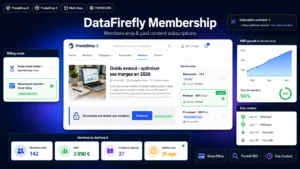 Membership & Subscription Module PrestaShop 8 & 9 — Paid Content, Paywall & StripeTurn your shop into a membership platform, with genuine recurring revenue.€129.00
The accounting provision
A technical point often discovered at year end. Points issued and not yet redeemed constitute a commitment towards your customers. They have to appear as a liability, as a provision, calculated on the points outstanding and your observed redemption rate.
Two practical consequences. You have to be able to extract the outstanding point balance at any moment. And an expiry date mechanically reduces that provision, which is an accounting argument in favour of expiry, independently of its commercial merit.
Expiry
It is necessary, and the way it is communicated decides whether it is perceived as normal or as theft.
Three rules. A duration long enough to be reachable, twelve to twenty-four months depending on your purchase frequency. A rolling expiry, reset on every new purchase, which rewards loyalty instead of punishing it. And a reminder before the deadline, which is also an excellent excuse for a commercial follow-up.
What to avoid: a fixed expiry date for everyone, which produces a spike of complaints on 31 December and no commercial value.
Building the tiers
On a status model, four decisions.
The number of tiers. Three is enough. Beyond that, progression becomes unreadable and the benefits dilute.
The thresholds. Calculate them on the real distribution of your customers, not on round numbers. A good marker: the first tier should be reached by around 20% of your customers, the last by 3 to 5%.
The calculation period. Twelve rolling months is fairer than a calendar year, which penalises customers who arrived in October.
Demotion. Does a customer who cuts their volume lose their status? Yes, otherwise the programme becomes a permanent cost. But with notice and a holding period, not overnight.
The mistakes that cost money
Uncontrolled stacking. Loyalty points, tier discount, promo code and a running promotion can pile up until they wipe out the margin. The stacking rules have to be written before launch.
Points on shipping costs. Granting points on an amount that earns you nothing is a straight loss. The calculation base should be the product amount excluding shipping and excluding tax.
Points on returned orders. They have to be clawed back at refund time. Without that rule, a customer can order, earn points, return, and keep the benefit.
No visibility. An invisible point balance motivates nobody. It has to appear in the customer account, in the transactional emails, and ideally in the cart with the discount available to use.
Measuring
Three metrics, comparing members and non-members on similar profiles.
Purchase frequency, the main expected effect of a points programme. Average basket, the main expected effect of a status programme. And the twelve-month retention rate, which is the only figure that justifies a programme over time.
A fourth figure, worth watching closely: the share of your revenue generated with a loyalty discount applied. If it exceeds what you had planned, your programme is too generous or your stacking rules are too loose.
On PrestaShop, status-based loyalty is built on membership tiers with associated benefits. The Membership and Subscription module covers that part on PrestaShop 8 and 9: tiers, price benefits per tier, expiry and renewal reminders. Point accumulation is a separate mechanism that has to be handled on its own.