

Since 13 December 2024, Regulation (EU) 2023/988 on general product safety — the GPSR — applies to any store selling physical products to consumers in the European Union. In 2026 this is no longer a novelty you can put off: it is a checkpoint that marketplaces, carriers and market-surveillance authorities actively verify. A non-compliant product page can be delisted, and the merchant bears the liability.
The trap, for most PrestaShop merchants, is believing the GPSR boils down to a footer notice. It actually requires specific information on every product page, a responsible person established in the EU, and traceability. Here is the concrete checklist to be compliant without spending weeks on it.
What the GPSR really requires on a product page
The regulation requires that, before buying, the consumer can identify who manufactures the product and who is responsible for it within the EU. In practice, each page must display:
- The manufacturer’s identity and postal address (company name + full address).
- The name and contact details of the responsible person established in the EU when the manufacturer is outside the EU.
- A product identifier: reference, model, type or batch number.
- Safety warnings and instructions, in the language of the country of sale.
- Where applicable, regulatory pictograms (minimum age, choking hazard, etc.).
The key point: this information must be visible on the online page, not only on the physical packaging. A store that fails to display it is non-compliant, even if the product itself is safe.
The EU responsible person: the point everyone forgets
This is the most common blind spot. If you resell products made outside the EU (China, post-Brexit UK, USA…), there must be a “responsible person” established in the EU — manufacturer, importer, authorised representative or fulfilment service provider. Their name and contact details must appear on the page. Without an identified EU responsible person, the product cannot legally be placed on the market. For a catalogue of several hundred imported references, filling in this field manually product by product is unmanageable: you need a system that handles it by manufacturer or by supplier.
Warnings, pictograms and the language of sale
Warnings must be understandable by the consumer, therefore translated into the language of each market. On a multilingual store (Polylang or PrestaShop multistore), this means managing GPSR notices per language, not a single French version copied everywhere. Pictograms (toys, chemicals, electronics) must be associated with the right product categories, ideally by automatic rule rather than by hand.
GPSR, accessibility and compliance: the same regulatory project
The GPSR does not arrive alone in 2026. It is part of a regulatory wave that also covers accessibility (the European Accessibility Act, which you can address with our EAA Accessibility Auto-Fixer) and data protection. The winning reflex is to treat these obligations as a single compliance project rather than as separate emergencies. If GDPR concerns you, our piece on the GDPR Article 17 right to erasure on PrestaShop usefully complements this checklist, as does our guide on FEC accounting export and e-commerce tax compliance.
Automating GPSR compliance on PrestaShop
Manually entering manufacturer, EU responsible person, identifiers and warnings on every page of a large catalogue is both time-consuming and error-prone. That is exactly the role of a turnkey GPSR module: define the manufacturer and EU responsible person globally or per manufacturer/supplier, propagate warnings and pictograms by category, and automatically display the compliant block on every page, in the right language.
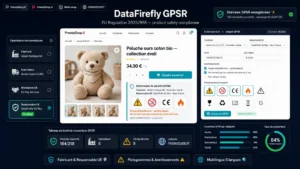 DataFirefly GPSRTurnkey GPSR compliance: manufacturer, EU responsible person, safety warnings and pictograms on every product page€69.00
Conclusion: GPSR compliance is an ongoing state, not a one-off project
The GPSR is not a box to tick once and for all: every new product added to the catalogue must be born compliant. The challenge is therefore not to “update” 300 pages once, but to industrialise the display of mandatory information so compliance is automatic and durable. To go further into other regulatory and technical topics on PrestaShop, browse our E-commerce NewsE-commerce news: PrestaShop 8 and 9 releases, WordPress and WooCommerce updates, Google evolutions (algorithms, Core Web Vitals, AI Overviews), GDPR and DMA regulations, DataFirefly news, industry trends.
Also worth reading: WCAG 2.2 accessibility and the EAA, the Omnibus Directive and reference pricing and age verification (CBD, vape, alcohol).
To put this into practice: our product compliance module selection.



1 comment