On average, 98% of a store’s visitors leave without buying, and nearly 70% of carts are abandoned. The real e-commerce battle is not fought over acquisition but over win-back: bringing those visitors back. Two channels dominate — email and Web Push — and most merchants wrongly pit them against each other. They do not play the same role, and used well, they complement each other.
This article honestly compares the two channels and proposes a win-back stack with no monthly subscription, where market SaaS tools bill by send volume.
Email: depth, but the friction of opt-in
Email remains unbeatable for rich messages: detailed cart reminders with product visuals, nurturing sequences, personalized offers, invoices. Its drawback: it requires an address, hence a visitor already at least partly engaged (account created, cart filled). Open rates often cap at 15-25%, and reaction time is long. Email is the channel of the relationship.
Web Push: immediacy, without asking for an address
Web Push only needs an “Allow” click — no email, no form. The message lands directly on the screen, even when the visitor is no longer on the site. Click rates are structurally higher than email on short, urgent messages (price drop, back in stock, end of sale). Its drawback: the message is brief and the opt-in is lost if you trigger it at the wrong moment. Web Push is the channel of the trigger.
On PrestaShop, a native Web Push module lets you win visitors back with no SDK and no subscription; the WooCommerce equivalent is DataFirefly Push, native web push with no third-party tracking.
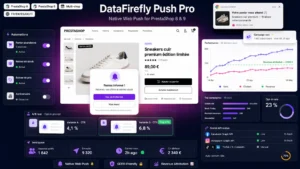 Web Push Notifications for PrestaShop 8 & 9 (Pro)Win back your visitors with native Web Push, no monthly subscription€99.00
The allocation rule: urgency to push, depth to email
The right trade-off is not “one or the other” but “the right message on the right channel”:
- Web Push: back in stock, price drop on a viewed product, final hours of a sale, new arrival. Short, urgent, instant.
- Email: a multi-step cart recovery sequence, a detailed recap, a personalized discount code, reassurance.
Abandoned-cart recovery deserves a special mention: it is the highest-ROI scenario in e-commerce. A multi-step recovery (reminder at H+1, incentive at D+1, last chance at D+3) structurally recovers more than a single send.
Don’t neglect on-site: the notification center
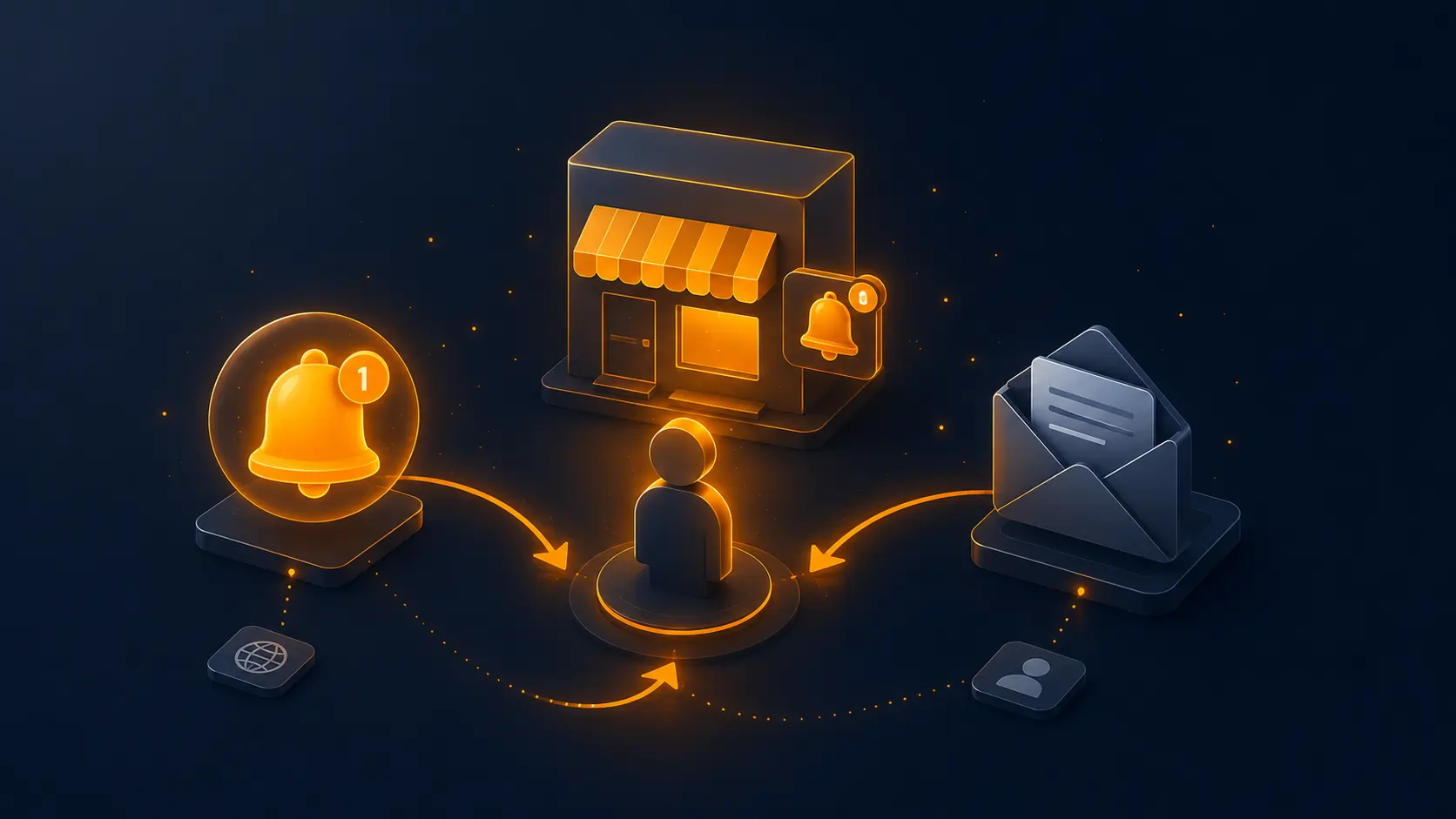
Between email (off-site) and push (off-site), one brick is often missing: the on-site notification. A bell with an unread badge announcing new arrivals and promo codes turns a present visitor into a buyer, with no opt-in at all. The PrestaShop notification center (or its WooCommerce version) plays this on-site relay role.
The real issue: cost
Most Web Push and recovery solutions are SaaS that bill per subscriber or per send. At high volume, the monthly bill quickly exceeds the price of a module bought once. For a merchant who already controls their data, native modules with no subscription eliminate that recurring cost and keep the data in-house — an argument that is both budgetary and GDPR-related.
Conclusion: a win-back stack, not a single channel
Effective win-back combines three moments: the on-site notification while the visitor is there, Web Push to recall them on a precise trigger, email for deep recovery. No single channel is enough on its own. To go further on funnel optimization, browse the category Conversion and UXConversion rate optimisation (CRO) and e-commerce UX: one-page checkout, side cart, cross-sell and up-sell, A/B testing, product page, cart abandonment, newsletter popups, express payment, social proof, urgency and scarcity.
To put this into practice: our selection of modules for customer retention.