

On a catalogue of consumables, a significant share of revenue comes from customers who come back to order the same thing. They think of it when the product has run out, which is often too late, and sometimes they do not come back at all because a competitor has appeared in the meantime.
The recurring order removes that tipping moment. The customer decides once, and the order goes out on its own at the chosen interval.
Identifying candidate products
Not everything lends itself to recurrence. The criterion is simple: the interval between two orders of the same product by the same customer has to be stable.
You can establish it from your own history. For every reference bought at least twice by the same customer, calculate the gap between successive orders, then take the median per product. A tight median gap indicates a predictable consumption rhythm, therefore a good candidate. A widely dispersed gap indicates an opportunistic purchase, where recurrence makes no sense.
Three families come out almost every time: cleaning and maintenance consumables, supplements and health products, refills and cartridges. What they share is not the category but the regularity of use.
Recurrence is not subscription
The distinction matters, commercially and legally.
A subscription establishes a commitment over time, with an automatic charge on a stored payment method. It falls under the rules on tacit renewal and cancellation, and it asks a lot of trust from the customer.
A recurring order reproduces an order at a regular interval, with no time commitment. Depending on the implementation, it can trigger automatically with a stored payment method, or send a reminder the customer approves in one click.
The second form is markedly less binding, and therefore easier to get adopted. It produces a lower renewal rate, but on a far wider base of subscribers. On a first rollout, that is the format to favour.
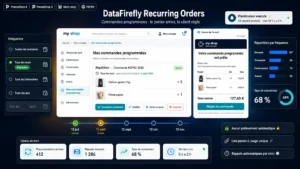 Recurring & Scheduled Orders — Automatic Reordering for PrestaShop 8 & 9Recurring and scheduled orders: the customer picks a frequency and receives a ready-to-pay cart link before every due date.€109.00
The right moment to offer it
Three placements work, in this order of effectiveness.
- On the product page, next to the buy button, as a choice between a one-off order and regular delivery with a preselected interval. The customer decides at the moment they are already convinced.
- In the post-purchase email, a few days after delivery. The product has been received, use has started, the offer arrives without pressure.
- After the second order of the same product. This is the most qualified moment: the customer has demonstrated repetition. A personalised offer at that point gets a high take-up rate.
A point of method: offer a default interval calculated from actual consumption, not a menu of six options. “Every 2 months” with the option to change converts better than six boxes to choose from.
What the customer must be able to do alone
This is the factor that determines whether the scheme holds over time or generates cancellations. Four actions have to be reachable from the customer account, without going through customer service.
- Postpone the next delivery. The most requested action, and the one that prevents the most cancellations. A customer going on holiday wants to shift, not stop.
- Change the quantity or the interval. Actual consumption always differs from the initial estimate.
- Skip one occurrence. A variant of postponement, useful when the customer’s own stock is in surplus.
- Stop, with no friction. Making it hard to stop keeps nobody, it produces payment rejections and negative reviews.
A reminder sent a few days before each due date, with links to those four actions, sharply reduces cancellations and removes the feeling of a charge being imposed.
Price, stock and stockouts
Three questions to settle before opening.
The price applied is the one on the day of the order, not the one on the day of sign-up. Any other rule commits you on future prices. State it clearly, and warn the customer of an increase before the next due date.
A stockout has to postpone the order, not cancel it. A silent cancellation is perceived as a unilateral termination and ends in abandonment.
Any discount granted for recurrence has to be calibrated. Five to ten percent is enough to tip the decision. Beyond that, you are funding a commitment the customer would have made anyway.
The three figures to track
The take-up rate, meaning the share of orders for the product that go recurring. The average number of occurrences before stopping, which gives the real value of a subscriber. And the postponement rate, which signals a badly calibrated default interval when it is high.
The Recurring and Scheduled Orders module covers this chain on PrestaShop 8 and 9: offer on the product page with a configurable interval, customer area to postpone, modify or stop, reminder before each due date and postponement handling on stockouts.