
Selling content by subscription differs fundamentally from selling a physical product by subscription. There is nothing to ship, but there is an access to open and to close, files to protect, and a question that never arises with physical goods: what happens to what the customer has already consumed when they cancel?
The recurring billing, webhooks and failed payment handling are common to all subscriptions and have been covered separately. This article deals with what is specific to content.
The access rights model
This is the founding decision, and it shapes the whole architecture.
A subscription does not give access to products, it gives access to a scope. That scope can be defined in three ways.
By tier. The Discovery subscription opens content marked level 1, the Full subscription opens levels 1 and 2. This is the simplest model to maintain and the clearest commercially.
By category. The subscription gives access to one or more families of content, chosen or imposed. Useful on thematic catalogues, heavier to manage.
By quota. The subscription entitles the member to a number of downloads or views per period. This model suits valuable individual pieces of content, but it requires a counter and it generates complaints at the end of each period.
The tier model covers the majority of needs. Choose it by default and only move away from it for a specific reason.
The access date, a central question
A point implementations rarely settle explicitly, and one that produces disputes.
Does a subscriber who signs up today get the entire catalogue, or only content published from their sign-up onwards?
Full access sells best: the new subscriber discovers a substantial back catalogue, which justifies the price immediately. It has one drawback: nothing stops them subscribing for a month, downloading everything, and cancelling.
Rolling access, limited to publications during the subscription period, protects the back catalogue but makes the initial offer unattractive.
The common compromise: full access for viewing, a quota on downloads. The subscriber can see everything, but cannot take everything away in one month.
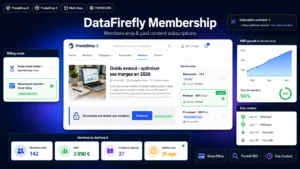 Membership & Subscription Module PrestaShop 8 & 9 — Paid Content, Paywall & StripeTurn your shop into a membership platform, with genuine recurring revenue.€129.00
Protecting the files
This is the most important technical point, and the one most often botched.
A file stored in a public folder reachable by its address is not protected, whatever interface surrounds it. Hiding the link protects nothing: the address circulates, and it stays valid indefinitely.
Three levels of protection, to be combined.
Storage outside the public folder. The files live in a directory the web server cannot serve directly. That is the baseline, and it is non-negotiable.
Delivery through a script. A controller checks the active subscription, then serves the file. Every download goes through that check, which also makes it loggable.
Signed addresses with a short lifetime. The generated link carries a signature and an expiry, usually a few minutes. After that it stops working. This is essential for videos and large files served by an external service.
Also plan a download limit per period. It inconveniences no normal usage and blocks large-scale account sharing, which is the main leak in this model.
Account sharing
An unavoidable subject, to be handled with measure.
Three signals point to sharing: an unusual number of distinct network addresses over the same period, simultaneous connections from distant locations, and abnormally high download volume.
The proportionate response is not immediate suspension. It is limiting the number of simultaneous sessions, which hinders sharing without penalising a subscriber who reads on their phone and their computer.
Careful not to overcorrect: an overly strict setup produces false positives on mobile connections, whose address changes frequently, and generates more complaints than it prevents losses.
Offline access
A question to settle explicitly, because it has contractual consequences.
If your content is downloadable, the customer keeps it after cancelling. That is a technical fact you cannot change, and it must be owned in your model.
Two coherent positions. Downloading is an acquired right: what was downloaded during the subscription stays with the customer. That is clear, honest, and it requires a quota to stay viable.
Or viewing only, online, with no download possible. Access ends with the subscription. This model is more protective and less well accepted on some content, particularly professional documents.
What is not coherent: allowing downloads then stating in the terms that the customer must destroy the files on cancellation. The clause is unenforceable and it damages the relationship.
What happens on cancellation
Four decisions to take, and to write down.
Does access end immediately or at the end of the paid period? At the end of the paid period, no discussion: the customer paid for a month, they get the month.
What happens to the history? Keep it. A former subscriber returning six months later must find their favourites, their progress, their past downloads. That is a significant argument for coming back.
Does downloaded content stay accessible? See above, and the answer must appear on the sales page.
What happens on re-subscription? Access resumes at the tier bought, with the history restored. Do not make a former customer start from zero.
The legal framework specific to digital content
Three points come on top of the general obligations of subscriptions.
The right of withdrawal. On digital content supplied immediately, the customer loses their right of withdrawal if they have expressly consented to immediate performance and acknowledged losing that right. This double consent must be collected explicitly, through a separate tick box, before access is granted.
Information on interoperability. You must state formats, technical restrictions and compatibility of the content with common hardware and software.
Conformity of digital content. A specific regime imposes a conformity obligation for the duration of supply, which covers among other things the effective availability of the service.
The metrics specific to content
Beyond recurring revenue and churn, common to every subscription, three specific measures.
The consumption rate, meaning the share of subscribers who viewed at least one piece of content during the month. It is the best leading indicator of cancellation: a subscriber who does not consume will cancel.
The delay before first view after sign-up. If it exceeds a few days, your onboarding is not guiding people to the content well enough.
The content that retains, by comparing retention rates between subscribers who viewed one piece of content or another in their first month. That analysis tells you what to promote at sign-up.
The Membership and Subscription module for PrestaShop covers this architecture on PrestaShop 8 and 9: access tiers per subscription, file protection outside the public folder with controlled delivery, download limits, recurring payment backed by Stripe and retention of history after cancellation.