
Urgency and social proof are, with data to back it, among the most powerful conversion levers in e-commerce. They are also the most misused: counters that reset on every visit, permanent “only 2 left in stock”, fake flash sales. Used badly, they are not just ineffective — they destroy trust and can attract penalties for misleading commercial practices.
This article explains why these levers work psychologically, when they backfire, and how to implement them honestly.
Why urgency works: loss aversion
The human brain weighs a potential loss more heavily than an equivalent gain — this is loss aversion, documented by Kahneman and Tversky. “This offer ends in 3 hours” triggers the fear of missing out (FOMO) more strongly than “enjoy this offer” triggers desire. Urgency turns a vague intention (“maybe I’ll buy”) into an immediate decision. That is why a real flash sale with a countdown timer outperforms a promotion with no deadline: the cutoff date creates the decision.
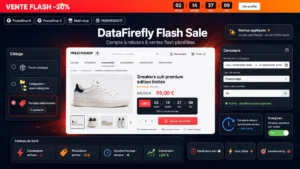 DataFirefly Flash Sale & CountdownFlash sale & countdown for PrestaShop 8 and 9€99.00
Why social proof works: validation by numbers
Faced with uncertainty, we look at what others do. “47 people are viewing this product”, “312 sold this month”: these signals reduce perceived risk and validate the choice. Social proof is especially effective on products where the buyer hesitates over quality or reliability. Animated social-proof counters (live views, recent sales, stock) restore these signals on the product page.
The red line: honesty
This is where most stores get it wrong. The non-negotiable rules in 2026:
- A countdown must correspond to a real deadline. A counter that restarts on every visit is misleading — and the Omnibus directive penalizes fake discounts and fake urgency.
- An “only X left in stock” must reflect real stock, not a fixed cosmetic figure.
- Social-proof counters must rely on real data (real views, real sales), not random numbers.
The reason is not only legal: a visitor who spots fake urgency loses trust in the whole store. The short-term conversion gain is paid back in return rates and reputation.
Urgency paired with the offer
Urgency is even more effective when backed by a well-built offer. A flash sale on a pack or a bundle combines two levers: the perceived value of the offer and time pressure. That is the logic of smart bundle offers, which benefit from being driven by a deadline.
Measure rather than believe
Like any conversion lever, urgency and social proof are validated by A/B testing, not by intuition. On some segments (considered purchases, technical B2B), aggressive urgency can even reduce conversion by signalling unwelcome pressure. The rule: test by product category and keep what truly works.
Conclusion: powerful levers to wield with integrity
Urgency and social proof convert because they speak to real cognitive mechanisms. Their lasting effectiveness depends entirely on their honesty: real deadline, real stock, real numbers. Used well, they increase conversion without eroding trust. For other CRO levers, browse the category Conversion and UXConversion rate optimisation (CRO) and e-commerce UX: one-page checkout, side cart, cross-sell and up-sell, A/B testing, product page, cart abandonment, newsletter popups, express payment, social proof, urgency and scarcity.
To put this into practice: our selection of modules for credible urgency and the one for social proof.