
In rental, the security deposit protects against damage and non-return. It is also the main brake on online booking: blocking 800 euros on a customer’s card for a 60-euro rental demands a level of trust they do not yet have.
The whole challenge is to secure without deterring.
Three mechanisms, three experiences
The charge with refund. You collect the deposit, you refund it on return. Technically simple, commercially bad: the customer sees a real debit, waits for their refund, and bank delays add several days.
It is also the most expensive mechanism, since you pay transaction fees on the collection and sometimes on the refund.
The pre-authorisation. The amount is blocked on the card without being debited. On return of the item, you release the hold. The customer sees a reserved sum, not a debit, and nothing moves.
This is the right mechanism, with one limit: the validity period. A pre-authorisation generally does not hold beyond seven days, sometimes thirty depending on the network and the acquirer. On a longer rental, it expires before the return.
The card on file without a hold. You keep a stored payment method, usable in case of damage. No sum is blocked, friction is zero, and the guarantee is weaker: the later charge can fail or be disputed.
Choosing by duration
Three cases, and the rule is simple.
Short rental, one to seven days: the pre-authorisation is the best answer. It covers the period, debits nothing, and is released on return.
Medium rental, one week to one month: the pre-authorisation risks expiring. Two options: renew it before expiry, which requires an automatic mechanism and customer notification, or switch to the card on file with a conditional charge.
Long rental, more than one month: neither. The contract takes over, possibly with a deposit collected and refunded at the end of the period, or a contractual guarantee.
 DataFirefly Product RentalTurn your PrestaShop products into rentable items€199.00
Setting the amount
Two approaches, with a trade-off between protection and conversion.
The fixed amount per product, aligned with the replacement value. It is the fairest economically and the most deterrent on valuable equipment.
The percentage of the rental amount, between 100% and 300% depending on the risk. Its advantage is being proportionate to the customer’s perceived commitment; its drawback is under-protecting on long rentals, where the rented amount becomes high but the value of the item stays the same.
The formula that works combines the two: a percentage with a floor and a cap, the cap matching the replacement value of the item.
A commercial benchmark: beyond three times the rental amount, the deposit becomes a serious obstacle to booking. If your calculation ends up there, the question may be the product itself, which is too valuable for this rental model.
The alternative to the deposit
Two mechanisms make it possible to reduce or remove the deposit, and they convert well.
Damage or theft insurance, offered as an option at booking. The customer pays a supplement and their deposit is reduced or waived. This is what vehicle and professional equipment rental practise.
The reduced deposit for loyal customers. A customer who has already rented three times without incident can benefit from a lighter deposit. It rewards loyalty and reduces the risk on a population whose behaviour you know.
Caution on the first point: offering insurance means complying with the framework applicable to insurance distribution, which is not trivial. A contractual guarantee you carry yourself is not subject to the same rules as an insurance product distributed on behalf of an insurer.
What must be announced
Four pieces of information, before the booking and not in the terms and conditions.
The exact amount of the deposit for the requested rental.
The mechanism used: hold without debit, or collection with refund. The difference is major for the customer and must be explicit.
The release time after the equipment is returned, in days.
The cases of retention, with the price list if one exists. A customer who discovers after the fact that a cleaning is billed at 50 euros disputes it; the same customer informed beforehand accepts.
The release
This is the moment that decides your reputation, and it is often neglected because it happens after the sale.
Three rules.
The release is automatic upon confirmation of a compliant return, not on a manual intervention that drags. Every day of delay produces a customer service request.
The customer is informed by email at the moment of release, with the amount. Without this notification, they keep seeing the reserved sum on their statement, since bank display is not instantaneous.
The bank delay is announced. The release of a pre-authorisation can take several days to appear on the customer side. Saying so avoids the complaint.
Retention in case of damage
A sensitive point, where the rigour of the process protects both parties.
Four elements to gather before any retention. An outbound condition report, with time-stamped photos. A return report established the same way. A price list communicated in advance. And a reasoned notification to the customer before the charge, with the photos.
Without the first element, no retention is defensible: you cannot prove the damage did not exist at the start.
A complementary point: the retention must match the actual loss, repair or replacement cost, not the amount of the deposit. Keeping the entirety of a 500-euro deposit for a scratch repairable at 80 euros is a questionable practice.
The special cases
The late return. Plan an announced daily penalty, distinct from the deposit, and a rule on the moment when the equipment is considered not returned.
The declined pre-authorisation. The customer’s card limit may not absorb the deposit. Plan an explicit message and an alternative rather than a silent failure.
The card expiring during the rental. On a long rental, check validity at booking time and refuse a card expiring before the return date.
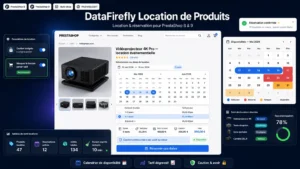
The Product Rental module for PrestaShop handles this mechanism on PrestaShop 8 and 9: deposit as a fixed amount or a percentage with floor and cap, hold without debit on short rentals, customer notification on release, and outbound and return reports attached to the booking with photos.