
The bubbles announcing “Sarah just bought this product” have spread across online stores. A significant share of them display sales that never happened, with first names drawn from a list and cities picked at random.
It is a misleading commercial practice, and it is also a bad commercial idea.
Why fake notifications are a problem
Three reasons, in order of gravity.
It is illegal. Claiming that a purchase took place when it did not is a false claim about the product’s popularity, likely to alter the consumer’s behaviour. It falls under misleading commercial practices.
It is detectable. A visitor who stays ten minutes sees fifteen purchases go by on a product whose displayed stock has not moved. The doubt they form does not only concern the notification, it concerns everything else on your site.
It is ineffective. Generic purchase notifications have lost their effect as they became commonplace. Visitors recognise them as a marketing device and ignore them.
The question is therefore not how to make fake notifications credible, but whether real notifications have any value.
What can be displayed honestly
Four pieces of information, all verifiable in your data.
A recent real sale, with an exact timestamp and a location at county or region granularity.
The number of sales over a period: “34 orders of this product in the last 30 days”. More sober, more credible, and no personal data question.
The number of people viewing the product, if you really measure it. To handle with caution: “12 people are looking at this product” is verifiable by opening two tabs, and if the figure does not move, it is false.
The real remaining stock, when it is low. It is the most useful information for the customer and the most honest, since it actually helps them decide.
The second option is the one that offers the best ratio between effect and risk. It requires no personal data and it remains true as long as the counter is calculated.
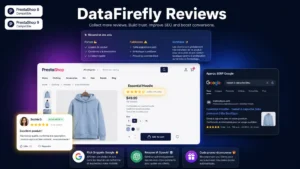 DataFirefly Verified Reviews — PrestaShop 8 and 9 customer reviews with rich snippets and AI summaryVerified reviews, photos, rich snippets, AI summary and reward discount — no subscription.€89.00
The personal data question
A point that implementations rarely address, and which has real consequences.
Displaying “Sarah in Leeds just bought” broadcasts information about an identifiable person to other visitors, without their consent.
Three precautions if you display individual purchases.
Do not show the full first name and the exact city. The combination can identify someone in a small town.
Widen the geographic granularity to the county or region.
Inform and allow objection, which implies a mention in your privacy policy and an option on the customer side.
The solution that avoids the subject entirely: display aggregates rather than individual purchases. “34 orders this month” concerns no one in particular.
The frequency setting
This is where the device tips from useful to painful.
Three parameters.
The interval between two notifications. One every 45 to 90 seconds is a maximum. Below that, it becomes a blinking banner.
The total number per session. Three to five, then nothing more. A visitor who has seen five notifications has got the message.
The delay before the first one. Wait until the visitor is settled on the page, ten to fifteen seconds. A notification that pops up during loading is perceived as an advert.
The threshold beyond which the device becomes counter-productive sits around five to six notifications per session. Past that point, the bounce rate increases instead of decreasing.
Where and how to display them
Four rules.
Bottom left on desktop, where the notification masks neither the price, nor the buy button, nor the main content.
Not on mobile, or only very discreetly. On a phone screen, a bubble occupies a significant part of the useful surface and genuinely gets in the way.
Closable, with the closing remembered for the session.
Never in the checkout funnel. A visitor who is paying does not need to be distracted by what others are doing.
This last point is regularly broken and it costs orders.
The alternatives that work better
Social proof is not limited to notifications, and the other forms are more solid.
Verified customer reviews, with the checked-purchase mention. It is the most consulted social proof and the most decisive in the decision.
Customer photos, which show the product in real use. On categories where looks matter, they weigh more than text.
The sales counter on the product page, mentioned above.
Real scarcity mentions, when the stock is actually low.
An observation worth stating: on most stores, the effort devoted to setting up notifications would produce more if it were devoted to collecting reviews. Notifications are an auxiliary device, not a main lever.
What makes social proof credible
Three characteristics, valid for all forms.
Verifiability. A review attached to a checked purchase is worth more than an anonymous review. A sales counter consistent with the stock is worth more than an isolated figure.
Variety. An average rating of 5 out of 5 over two hundred reviews is less credible than a rating of 4.4 with a few critical reviews. Unanimity arouses suspicion.
Proportion. Announcing 34 sales is credible, announcing 3,400 on a site the visitor does not know is not.
Measuring
Three indicators, with one precaution.
The click-through rate on the notifications, which measures the interest they arouse.
The closing rate, which measures the annoyance. A high rate is a clear signal.
The conversion rate with and without notifications, over comparable periods. It is the only figure that settles it.
The precaution: this last test must be conducted seriously, over a sufficient duration and a significant volume. Many stores keep this device without ever having checked that it brings anything, and a share of them observe an improvement when removing it.
The Verified Reviews module for PrestaShop builds the most solid form of social proof on PrestaShop 8 and 9: review requests sent after actual receipt of the order, attachment of each review to a checked purchase, display of the rating and volume on the product page and in the listings.