
Everything you'd want to know before you install.
A detailed look at how SERP Rank Tracker (Google Positions) for PrestaShop works, why we built it the way we did, and the thinking behind the features above.
§ 01
Why SERP Tracker?
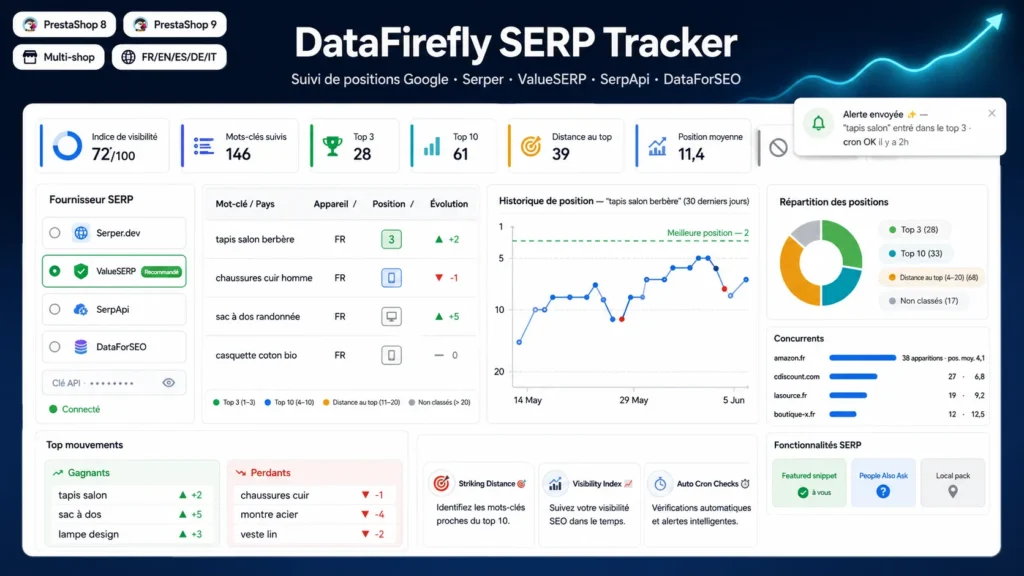
Knowing your Google positions is the foundation of SEO, but tracking them by hand is tedious: opening a third-party tool, exporting, cross-referencing with your pages, monitoring drops one by one. SERP Tracker brings this tracking directly into the PrestaShop back office. You declare your keywords, the module checks their positions, keeps the history, computes your opportunities and alerts you when a page slips. All cross-referenced with your URLs and your stores.
§ 02
Reliable checks, no scraping
Scraping Google directly is fragile, quickly blocked and against its terms of service. SERP Tracker therefore relies on a SERP API provider you choose: Serper.dev, ValueSERP, SerpApi or DataForSEO. You enter your key in the configuration, the module queries the provider cleanly and extracts the organic results, SERP features and competitors. The provider architecture lets you add another provider in a single class.
§ 03
Keywords by country and device
Each keyword carries its context: target URL, grouping tag, language, country and device (desktop or mobile). The module locates your domain's position in the results, prioritising an exact match with the target URL when you provide one. Position 0 marks a keyword that is not ranking, tracked separately so it does not distort your averages.
§ 04
Striking distance and visibility index
The dashboard highlights two key notions. Striking distance automatically isolates your keywords in positions 4 to 20: the fastest wins, where a small optimisation effort has the most impact. The visibility index condenses all your positions into a single 0–100 score weighted by a per-position CTR curve — one number to track the overall trend and share it easily.
§ 05
Competitors and SERP features
For each check, the module detects the SERP features: featured snippet (with ownership identification — you or a competitor), People Also Ask, local pack. The competitor view aggregates the domains that appear on your queries, counts their occurrences and computes their average position, to spot at a glance who is on your heels across your whole scope.
§ 06
History and charts
Each check writes a history row: position, ranking URL, provider, total results, detected features and competitors. The dashboard displays the distribution of your positions as a doughnut chart, along with your top gainers and losers between two checks. Chart.js is bundled locally in the module: no CDN dependency.
§ 07
Automatic drop alerts
SERP Tracker warns you when things slip: entering or leaving the top 3, leaving the top 10, an outright lost ranking, a drop above the threshold you set, or losing a featured snippet. Alerts go out as an HTML and text email digest, in French and English. You keep control of the threshold and the destination address.
§ 08
Shared-hosting cron
The module exposes a token-protected cron endpoint, validated with hash_equals, to trigger from your host's cron. You can limit the processed batch and target a store. Checks are spaced to respect your provider, and an automatic purge applies your retention period. No Redis, no worker, no Composer: just a custom autoloader and native cURL calls. Works on o2switch, OVH shared and any standard Linux hosting.




There are no reviews yet.