
Our best PrestaShop modules to speed up your store
Four modules for what actually loads, not for the score nobody sees.
You are sold speed as an SEO factor. It is a weak one. Where it actually decides things is in your customer's cart — and the real culprit is almost always your images.
Sound familiar?
Images choking your page
Full resolution, 2010-era JPEG, no lazy loading. They account for the largest share of your page weight.
A visitor who does not wait
They do not wait: they leave. And they never appear in your figures — only the conversion falls.
A score that says nothing about your customers
You measure on your office machine with fibre. Everything is fast there — and that is precisely the problem.
A cache nobody clears
You have to clear it by hand. One day someone forgets — and you display old prices for days.
Our selection, ranked
Every module below is built, maintained and supported by our team. The ranking reflects what we would install first on a client store.
-
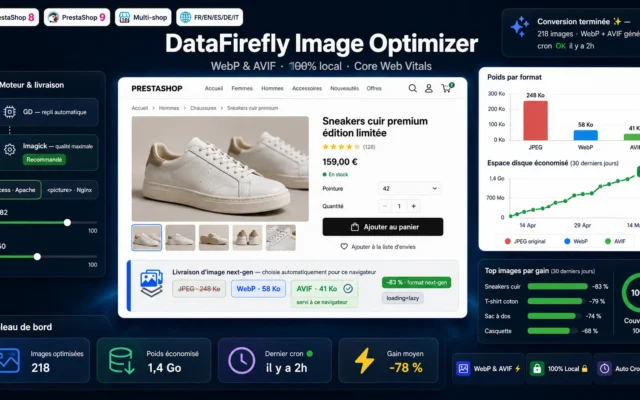
WebP & AVIF Image Optimizer for PrestaShop
The real culpritWebP and AVIF: the same image, a fraction of the weight, no visible difference. Everything else is fine-tuning.
100% local WebP/AVIF conversion, with no subscription or quota. Transparent delivery via .htaccess, native lazy-loading and original compression for green Core Web Vitals.
€59.00 View the module -
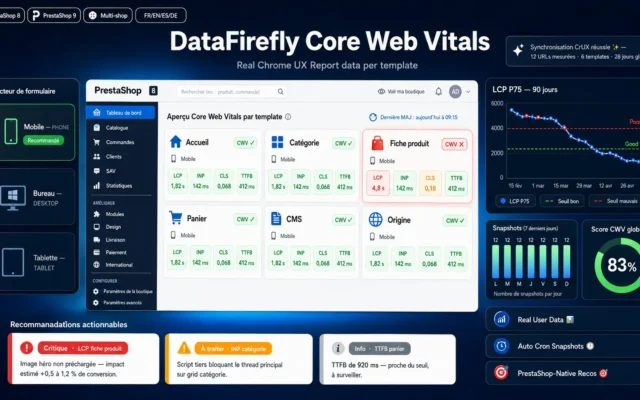
Core Web Vitals PrestaShop — CrUX tracking per template
Measure, don't guessReal figures from your real visitors, not a lab test score.
Measure your shop's perceived performance with real Chrome data, per template type — home, category, product, cart — with 28-day history and actionable PrestaShop…
€69.00 View the module -
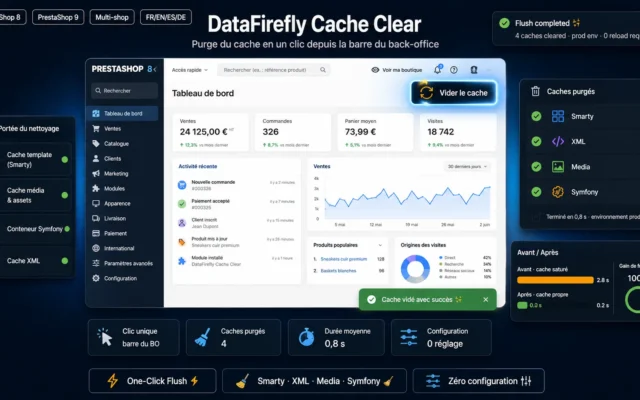
Clear PrestaShop Cache — One-Click Purge (PS 8 & 9)
The Friday-night mistakeAutomatic cache purge. Not a performance tool: a tool against the wrong price you'd otherwise display for days.
Add a "Clear cache" button to the back-office toolbar. One click purges Smarty, XML, Media, Symfony and OPcache. Compatible with PrestaShop 8 and 9,…
€0.00 View the module -
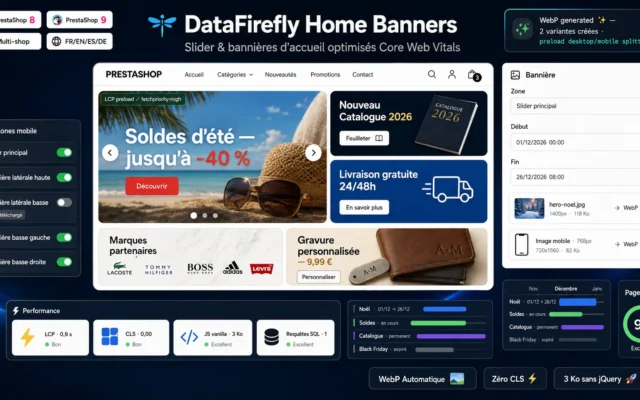
PrestaShop Homepage Slider Module 8/9: Fast WebP Banner Blocks
The carousel that no longer weighs you downHomepage slider and banner grid in WebP, first image preloaded for LCP, dedicated mobile image, campaign dates. The answer to the carousel that loads fifteen images to show two.
Build a complete homepage hero: main slider, two stacked side banners and two wide promotional banners, all managed from the back office. Automatic WebP…
Side-by-side comparison
| Module | Best for | Price | Rating | Link |
|---|---|---|---|---|
| WebP & AVIF Image Optimizer for PrestaShop | The real culprit | €59.00 | — | |
| Core Web Vitals PrestaShop — CrUX tracking per template | Measure, don't guess | €69.00 | — | |
| Clear PrestaShop Cache — One-Click Purge (PS 8 & 9) | The Friday-night mistake | €0.00 | — | |
| PrestaShop Homepage Slider Module 8/9: Fast WebP Banner Blocks | The carousel that no longer weighs you down | €79.00 | 5.0 |
Speed is not an SEO issue — it is a conversion issue
People sell you performance as a ranking factor. It is one — but a weak one. A slow store with excellent content regularly beats a lightning-fast one with nothing to say.
Where speed actually decides things is in your customer’s cart. A visitor waiting for a page does not wait: they leave. And they will not tell you — they simply never appear in your figures.
The culprit is almost always the same
Not your hosting. Not PrestaShop. Your images. On a typical e-commerce page, images account for by far the largest share of the weight — and most stores serve them as 2010-era JPEGs, at full resolution, with no lazy loading.
And you cannot optimise what you do not measure
A score in a testing tool is a laboratory measurement. What counts is the real numbers from your real visitors, on their real devices, on their real network. The rest is decoration.
Further reading
Three in-depth guides from the blog complete this selection: the complete Core Web Vitals guide, the LCP, INP, CLS technical checklist and cache, Critical CSS and next-gen images.
How to choose
Start with the images — everything else is fine-tuning
On a typical e-commerce page, images account for by far the largest share of the weight. Scripts, fonts, CSS: fine-tuning beside them. Optimising the rest without touching the images is polishing the door handle on a car with no engine. WebP and AVIF serve the same image at a fraction of the weight — with no visible difference.
Measure in the field, not in the lab
A score in a testing tool is a laboratory measurement: simulated device, simulated network. Your real visitors have different phones. What counts is field data — and it rarely says the same thing as the score.
The honest reason to do it
Not SEO. Core Web Vitals are a ranking factor, but a weak one: a slow store with excellent content regularly beats a fast one with nothing to say. The real gain is in conversion — and that is a better reason, because it is measurable in money.
Where you should actually measure
On mobile, on a cellular network, with a three-year-old phone. Not on your office machine with fibre — everything is fast there, and that is precisely the problem: you never see what your customer sees.
And the home page carousel
It loads fifteen full-resolution images so the visitor can look at two. If you want to keep it, load the first image immediately and the rest on demand. Otherwise you are paying for images nobody will ever see.
What you gain
The real culprit: images
Images account for the largest share of an e-commerce page's weight. Everything else is fine-tuning.
The same image, a fraction of the weight
WebP and AVIF serve the same image at a fraction of the weight — with no visible loss of quality.
Field data, not a lab score
Real measurements from your real visitors, not a score from a testing tool in a lab.
The visitor who does not wait
A visitor waiting for a page does not wait — they leave. And they never appear in your figures.
A cache that manages itself
A cache you have to clear by hand after every change is a cache that eventually stops being cleared.
The honest reason to do it
Ranking factor: weak. Conversion factor: strong. Optimise for your customers, not for your score.
From install to results
-
Images first
They account for the largest share of the weight. Optimising everything else without touching them is wasted time.
-
Measure in the field, not in the lab
A score in a testing tool is a lab measurement. Your real visitors have different phones.
-
Measure on mobile
Not on your office machine with fibre. Everything is fast there — and that is precisely the problem.
-
Optimise for conversion
Ranking factor: weak. Conversion factor: strong. The second is measurable in money.
-
Distrust the carousel
Fifteen full-resolution images so the visitor can look at two. Load the rest on demand.
“We spent months optimising scripts and fonts to raise our score. Then we converted the images. We gained more in one afternoon than in the previous six months.”
Frequently asked questions
Are Core Web Vitals really a ranking factor?
Yes, but a weak one — and you are sold the opposite. A slow store with excellent content regularly beats a lightning-fast one with nothing to say. The real gain from speed is in conversion, not ranking. And that is a better reason.
Why images before anything else?
On a typical e-commerce page, images account for by far the largest share of the weight. Everything else — scripts, fonts, CSS — is fine-tuning beside them. Optimising the rest without touching the images is polishing the door handle on a car with no engine.
Why is a score from a testing tool not enough?
It is a laboratory measurement: a simulated device, a simulated network. Your real visitors have different phones and a different network. What counts is field data — your real customers, on their real devices. The score is a clue; the field data is the truth.
Do I lose image quality with WebP and AVIF?
No, and that is the point. WebP and AVIF serve the same image at a fraction of the weight, with no visible difference. It is one of the rare levers in e-commerce where you sacrifice nothing — you simply stop wasting bandwidth.
Why a cache-clearing module?
Because a cache you have to clear by hand after every price change is a cache that eventually stops being cleared — and then you display old prices for days. Automatic purging is not a performance tool: it is a tool against the mistake you will make one Friday evening.
And my home page carousel?
Almost always worse. A carousel loads fifteen full-resolution images so the visitor can look at two. If you want to keep one, load the first image immediately and the rest on demand — otherwise you are paying for images nobody ever sees.
Where should I measure?
On mobile, on a cellular network, with a three-year-old phone. Not on your office machine with fibre — everything is fast there. The only honest measurement is the one taken by the customer who does not have your equipment.
Which metric proves speed is worth it?
Your conversion rate on mobile. If it sits well below desktop, your problem is rarely the design — it is load time. The visitor who waits does not wait: they leave, and they never appear in your figures.
This need on other platforms
Not sure which one fits your store?
Tell us your context — we answer with a straight recommendation, not a sales pitch.