
The one-stop shop return is filed every quarter, and it calls for data that PrestaShop does not produce as such: the amount of your sales to consumers in the European Union, broken down by country of destination and by VAT rate applied.
This article deals with the extraction. How the 10,000-euro threshold works and when to switch regime is a separate subject.
The exact scope of the export
The first source of error, and it is fixed upstream rather than at the end of the quarter.
Included in the return: sales of goods dispatched from France to a consumer located in another member state, and electronically supplied services to consumers in the Union.
Not included: domestic sales, sales to businesses holding a valid VAT number, which fall under the reverse charge, sales outside the Union, and goods dispatched from stock held in another member state, which fall under a different regime.
That last exclusion deserves attention if you use a logistics service that spreads your stock across several countries. The rule follows the physical place of departure of the goods, not your registered office.
The data to extract
Five fields per order line, and the fourth is the one most often missing.
- The country of destination, meaning the country of the delivery address, not the billing address.
- The taxable base, the amount excluding tax, shipping costs included since they follow the regime of the goods.
- The rate applied, as it appears on the order.
- The type of rate: standard, reduced, super-reduced. The return distinguishes these categories, and the same percentage can correspond to different types depending on the country.
- The VAT amount corresponding.
The expected grouping is by country and by rate. An order containing items at two different rates therefore produces two lines in your aggregation.
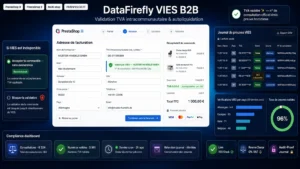 Intra-Community VAT VIES Validation & B2B Reverse ChargeIntra-community VAT verified, reverse charge automated, audit evidence timestamped.€79.00
The question of dates
The point that produces the most frequent discrepancies between two extractions of the same quarter.
Which date should be used to attach an order to a quarter? Three candidates exist: the order date, the payment date, the invoice date.
The general rule attaches the transaction to the moment VAT becomes chargeable, which in practice corresponds to the delivery of the goods for sales of goods, with particular rules where a deposit is taken.
What matters for your process: choose a reference date and stick to it. An extraction made on the order date one quarter and on the invoice date the next produces duplicates or gaps at the junction of the periods.
A useful checkpoint: the orders from the last days of the quarter. An order placed on 30 June and delivered on 2 July must be attached unambiguously, according to the rule you have chosen and documented.
Credit notes and refunds
An element systematically forgotten in the first returns.
A refund reduces the taxable base of the country concerned. It must therefore appear in the extraction, as a negative, in the quarter in which it occurs.
Two cases to distinguish. A full refund cancels the transaction. A partial refund, one item returned out of three, only reduces the corresponding share, with the VAT at the rate of the item concerned.
Also plan for a refund occurring in a quarter later than the sale: it is charged to the quarter of the refund, which can produce a negative base in a country where you made no sales that quarter.
The consistency check
Three verifications before filing, which take half an hour and avoid corrections later.
The reconciliation with total turnover. Domestic sales, plus intra-Union B2C sales, plus exempt B2B sales, plus sales outside the Union must equal your turnover for the quarter. A gap signals a misclassified order.
The check on the rates applied. For each country present in the extraction, verify that the rates used match the rates in force. An outdated rate in your configuration produces a false return across the whole quarter.
Consistency with the accounts. The VAT collected per country must match the accounting entries. If your chart of accounts does not distinguish countries, now is the time to change it, otherwise this reconciliation will remain impossible.
The calendar
The return is quarterly and is filed after the end of the quarter, within a deadline that leaves little margin.
A realistic working rhythm: extraction in the first days after the close, consistency check straight afterwards, filing before the deadline. Do not leave the extraction to the eve: an anomaly discovered at that moment cannot be corrected.
Two organisational points. The payment accompanies the return, so plan the cash. And a return must be filed even if there was no transaction in the quarter, in the form of a nil return.
Automating the extraction
At any significant volume, quarterly manual extraction becomes a chore and a source of errors.
Three levels of automation, in order of effort.
A saved query on the database, run each quarter with the date boundaries. That is the minimum, and it is enough on many shops.
A scheduled export that produces the file in the expected format and drops it in a location agreed with your accountant.
A continuous check, verifying each week that the rates applied match the rates in force and raising an alert on any gap. That is the level that avoids nasty surprises at the end of the quarter.
Not to be confused with the B2B return
A useful clarification, because the two obligations coexist and get confused.
The one-stop shop covers your intra-Union B2C sales, with the VAT of the country of destination.
The recapitulative statement covers your exempt intra-Union B2B supplies, with the VAT number of each business customer. It is monthly and has nothing to do with the one-stop shop.
A shop selling to both audiences must therefore produce two distinct extractions, on mutually exclusive scopes. That is in fact a good check: no order should appear in both.
On the B2B side, the Intra-Community VAT Validation module (VIES) produces the corresponding data on PrestaShop 8 and 9: identification of exempt transactions with the customer’s verified VAT number, and export of intra-Union supplies by period. The OSS extraction covers B2C orders and is built on the same principles of breakdown by country and by rate.