The French electronic invoicing reform has two distinct parts. The first, e-invoicing, covers invoices between French businesses and goes through accredited platforms. The second, e-reporting, covers the transmission to the tax administration of data on the operations that escape the first: sales to consumers and international operations.
For an online merchant selling mostly to consumers, the second part weighs the most, and it is the least discussed.
What e-reporting covers
Three families of operations, the first of which represents the bulk of a consumer store’s activity.
Sales to consumers, which do not give rise to an electronic invoice between businesses. These are your everyday orders.
Operations with foreign businesses, on the purchase side as on the sales side, which fall outside the national scope of e-invoicing.
Payment collection data for services, where VAT becomes due on payment and not on delivery.
An important framing point: a store selling both to consumers and to French businesses is covered by both parts. Invoices to French businesses fall under e-invoicing, the rest under e-reporting.
The timetable, with the caution it requires
The timetable of this reform has been changed several times since its announcement. Any quoted date must be checked at the source before starting any work.
The chosen structure distinguishes two milestones. The obligation to receive electronic invoices, which applies to all liable businesses from the first deadline, whatever their size. And the obligation to issue and transmit data, which is staggered by company size, the largest first.
A second structuring point: transmission goes through an accredited platform. The initial project planned a public portal providing this role for free, which was abandoned. Using a private accredited platform must therefore be built into your budget and into your provider selection schedule.
Practical advice: check the deadline that applies to your business according to its category, and go back six months to set your start date for the work.
The data to prepare
This is the heart of the subject, and the good news is that most of it already exists in PrestaShop. The difficulty lies in its reliability and completeness.
For sales to consumers, transmission covers data aggregated by period: total amount of operations, broken down by VAT rate, with the corresponding VAT, and the currency.
Five points of vigilance on these aggregates.
The breakdown by rate must be exact. An order containing items at two rates splits over two lines. Check that your extraction does not settle for the dominant rate.
Shipping costs follow the regime of the goods. On a mixed-rate order, their breakdown follows a precise rule that must be applied, not improvised.
Credit notes and refunds reduce the base of the period in which they occur.
Exempt or out-of-scope operations must be identifiable separately, not drowned in a total.
The attachment date must be consistent and documented, as for any periodic reporting obligation.
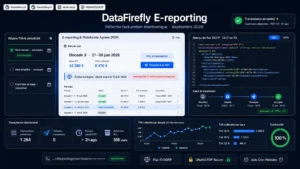 E-reporting French E-invoicing 2026 (PDP)E-reporting & certified platform (PDP) for PrestaShop€89.00
The frequent gaps with current exports
This is what takes time once you get started, and what justifies starting now.
Identifying business customers. To distinguish what falls under e-invoicing from what falls under e-reporting, you need to know reliably whether a customer is a French business, a foreign business or a consumer. On many stores, this information rests on an unverified declarative checkbox.
This is the first work stream to open, and there is nothing technical about it: it is about qualifying your customer base and making collection at registration reliable.
The identification number of French business customers. The addressing of electronic invoices relies on a company identifier. If you do not collect it today, you will not be able to address your invoices tomorrow.
The completeness of invoice data. The electronic invoice format imposes mandatory mentions, some of which are optional in current templates. Compare your invoice template against the expected list rather than discovering the gaps at connection time.
The consistency of references. Continuous numbering without gaps, uniqueness, correspondence between order number and invoice number. These are classic invoicing requirements, often approximate on stores that have gone through migrations.
The treatment of marketplaces. If you sell via third-party platforms, the question of who declares what arises, and it depends on the regime applicable to the operation. To be handled with your adviser.
What to do right now
Five actions, none requiring you to wait for a deadline.
Qualify the customer base by distinguishing consumers, French businesses and foreign businesses. On an old base, this exercise generally reveals a significant proportion of misclassified accounts.
Collect the identification number at business registration, and launch a completion campaign on existing accounts.
Audit your invoice template against the expected mentions.
Clean up the numbering and check the uniqueness of references over the last three years.
Produce a test extraction of the aggregated data on a past quarter, and reconcile it with your accounting. The gaps found indicate exactly what remains to be fixed.
This last action is the most useful: it turns an abstract obligation into a concrete list of corrections.
Choosing the platform
Three criteria, beyond price.
Integration capability. Your store must transmit automatically. A platform without a programmable interface condemns you to manual deposits, which is unmanageable on an online commerce volume.
The scope covered. Some platforms handle e-invoicing and not e-reporting, or the reverse. Check that both parts are covered if you are concerned by both.
Directory management and addressing. To send an invoice to a business customer, you need to know on which platform they receive it. This resolution must be handled for you, not left to you.
The order of the work
A realistic sequence over twelve months.
Quarter 1: qualification of the customer base and data audit. It is the longest and depends on no technical choice.
Quarter 2: data corrections, invoice template update, collection of missing identifiers.
Quarter 3: platform choice and integration work.
Quarter 4: tests in real conditions on limited flows, then switchover.
Point to remember: the first three quarters are about your data, not about technology. This is why businesses that start late do not catch up with a simple software purchase.
The E-reporting Electronic Invoicing module for PrestaShop prepares this chain on PrestaShop 8 and 9: customer qualification by category, collection and control of company identifiers, aggregation of operations by period and by rate with credit note handling, and transmission to an accredited platform.