
In rental, the price is not read off the page, it is calculated. A customer who sees “25 euros per day” on equipment they want to keep for two weeks does a multiplication that scares them, when your actual rate for that duration is far lower.
The tiered grid is therefore as much a commercial tool as a pricing tool.
Why tiered pricing is not a discount
It reflects your real cost structure.
Every rental, whatever its length, involves a fixed cost: preparation, inspection, refurbishment, administration, transport out and back. That cost is identical for one day and for one month.
On a one-day rental, this fixed part makes up most of the price. On a thirty-day rental, it is diluted. A strictly proportional rate therefore overcharges long durations and undercharges short ones.
The practical consequence is counter-intuitive: your margin is often better on a long tiered rental than on a single day at full rate.
Building the grid
Three tiers are enough in the vast majority of cases: the day, the week, the month.
The method that works starts from the bottom. First set your daily rate, which must cover the full fixed cost plus a margin. This is your floor price, and it will look expensive on a per-day basis: that is normal.
Then set your weekly rate. A common benchmark in the sector: between four and five times the daily rate for seven days. Since the fixed cost is only borne once, the apparent discount costs almost nothing.
Then the monthly rate, between two and three times the weekly rate for thirty days.
Then check the consistency of the tiers: the price of six days must never exceed the price of seven. If it does, the customer will book a week and return early, which is not a problem in itself, but you will have lost the readability of your grid.
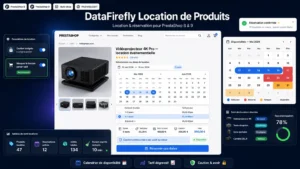 DataFirefly Product RentalTurn your PrestaShop products into rentable items€149.00
Calculating in-between durations
This is the technical point that decides whether your prices hold together. Three methods, with very different results.
Full tier. Ten days are billed as one week plus three days at the daily rate. Easy to understand, but it produces large price jumps.
Best rate. The system computes every combination and keeps the cheapest one for the customer. Ten days could therefore be billed as two weeks if that is cheaper than one week plus three days. This is the most customer-friendly and the most reassuring method.
Interpolation. The price moves continuously between tiers, with no jump. More elegant mathematically, harder to explain and to verify.
The second method generates the fewest complaints. A customer who discovers they pay less than the calculation they did themselves gets a pleasant surprise, which is rare in a buying journey.
Rounding and the return day
Two rules to put in writing, on pain of disputes.
How is a day counted? Does a rental from Monday morning to Wednesday evening count as two days or three? The most widespread convention counts occupied calendar days, so three. It must be stated before the booking, not discovered on the invoice.
What happens on early return? Do you refund unused days? The most common commercial answer is no, the booked duration is owed, because the equipment was blocked over that period. That position is defensible provided it is announced.
Minimum duration
It protects your profitability on small rentals and it is justified by the fixed cost.
Two possible forms. The minimum booking duration: the customer cannot rent for less than two or three days. Simple, but it turns away real demand.
Or the minimum billed amount: the customer can rent for one day, but a floor applies. More flexible commercially, and it keeps the short-rental clientele, who are often trial customers.
Always show the total price
This is the point with the greatest effect on conversion, and it costs nothing to implement.
As soon as the customer has selected their dates, show the total for the period, in large type, with the breakdown underneath: rate applied, number of days, deposit if any.
Two useful additions. The effective price per day for the chosen duration, which makes the benefit of tiering concrete: “that is 12 euros a day instead of 25”. And a suggestion to move up a tier when the customer is close: “rent for 2 more days, move to the weekly rate and pay 15 euros less”.
That second message is the most profitable part of the whole setup. It increases the average rental duration, and therefore your revenue per booking, while giving the customer the feeling of having got a good deal.
Special periods
On seasonal or event equipment, the base grid is not enough.
Three overlays to plan for: a high-season rate, a weekend surcharge on event equipment, and a long-term rate beyond three months, which belongs more to long-term leasing than to occasional rental.
Each must apply automatically according to the dates chosen, never through manual intervention after booking.
The Product Rental module for PrestaShop handles this pricing on PrestaShop 8 and 9: day, week and month tiers, best-combination calculation for in-between durations, minimum duration or amount, special periods and total price display before adding to cart.