
Renting out ski gear or bikes online involves constraints a classic rental does not face: a short season that concentrates most of the revenue, a fleet that comes in sizes, and a customer who will collect the equipment in store rather than have it delivered.
The season, a structural constraint
On seasonal sports equipment, eight to twelve weeks often represent 80% of the activity. Three direct consequences.
The utilisation rate of the fleet during the season determines your annual profitability. A pair of skis rented twelve times over the winter does not earn the same as a pair rented four times.
Bookings arrive in waves, aligned with school holidays. Your calendar must reflect those peaks, and a pair booked over the February week blocks the most profitable slot of the year.
Preparation happens off season. Equipment serviced, sharpened and checked in October is what runs without interruption in January.
The pricing formats
Three formats coexist in sports rental, and they do not address the same customers.
The stay package, generally six days, matching a week of holiday from Saturday to Friday. It is the best-selling format in resorts, and it should be offered first.
Daily rental, for locals and short stays. It is priced higher per day, which is consistent with the fixed cost of preparation.
The full season, for regular customers or families equipping growing children. It secures revenue well in advance and frees up follow-up time.
Add period-based pricing: school holiday weeks and public holidays justify a higher rate, applied automatically according to the dates chosen.
The fleet and the sizes
A modelling point that decides feasibility.
A pair of skis is not a single product, it is a model available in lengths. Each length has its own physical stock and its own availability calendar.
The variant is therefore the right level of management: the model carries the description and the price, each size carries the stock and the bookings.
Two practical points. Stock is a number of physical units, not an unlimited quantity: three pairs in 170 centimetres means three simultaneous bookings are possible on that size. And substitution should be considered: a customer who books 170 can often accept 168, which raises your utilisation rate. That flexibility is a management rule, not a promise made to the customer.
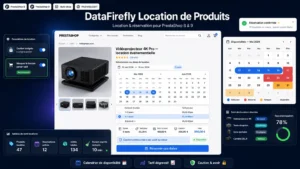 DataFirefly Product RentalTurn your PrestaShop products into rentable items€149.00
The pack, central mechanic
In ski rental, the customer does not rent skis: they rent a set of skis, boots and poles. On bikes, it is the bike plus the helmet and possibly panniers.
The pack is therefore the natural selling unit, and it creates a technical constraint: its availability depends on that of all its components over the requested period.
Three rules to make it work. Each component keeps its own stock and its own calendar. The pack is only bookable if all components are, over the whole period. And component sizes are asked separately: ski length does not determine boot size.
Plan for pack ranges as well: discovery, comfort, performance. They simplify the customer’s choice and let you rotate your whole fleet rather than only the premium end.
The data to collect at booking
This is what separates a usable booking from a simple order intake.
For skiing: height, weight, boot size, skill level. These four pieces of information determine the binding settings, a regulated operation that engages your liability.
For bikes: rider height, intended use, and possibly weight for electrically assisted models.
Collect this data at booking time, not at the counter. You save time on handover day, and you prepare the equipment in advance, which is decisive on a school-holiday Saturday.
Store collection
Almost all sports rentals are collected on site. Two things to plan for.
The collection slot. On a changeover Saturday, every customer arrives between 3pm and 7pm. Offering slots at booking spreads the load and removes the queue, which is a real commercial argument.
Handover confirmation. Moving from booked to collected must be done at the counter, with the condition of the equipment recorded. That is what starts the period count and documents the departure condition.
Return and refurbishment
Sports equipment comes back dirty and sometimes damaged. Two points to build into your calendar.
A refurbishment margin between two rentals, set per equipment type. A bike comes back washed and checked in an hour, a pair of skis needing sharpening takes longer.
A return report with the condition of the equipment, which conditions the release of the deposit and documents any damage. On sports equipment, disputes about condition are frequent and the report is your only protection.
The Product Rental module for PrestaShop covers this setup on PrestaShop 8 and 9: availability per unit and per size, packs conditional on the availability of all components, period-based rates with stay packages, refurbishment margins and rental documents attached to the booking.