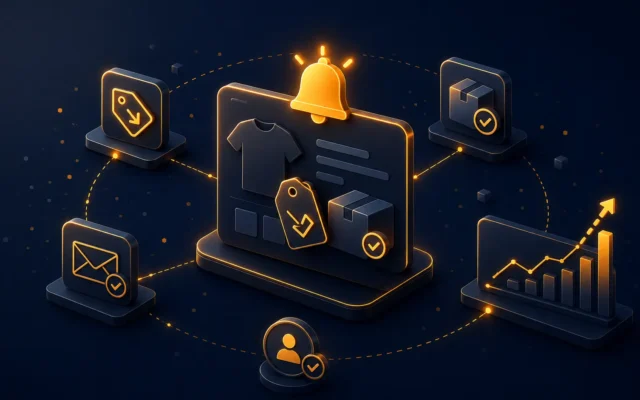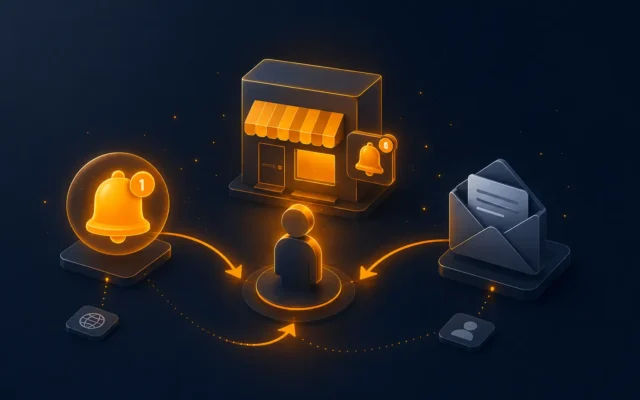
Web push notifications have crossed three cycles since 2015: initial enthusiasm (« the new email »), saturation and user fatigue (intrusive popups, deceptive opt-in), regulatory maturation (GDPR, ePrivacy). In 2026, web push is again an interesting lever — provided you understand what’s changed and what hasn’t.
Web push isn’t a mass channel like email. It’s a niche re-engagement channel, with a low opt-in rate (5-10% of visitor base), specific technical constraints, and high quality requirements — too many sends and the user unsubscribes. This article reviews what works in 2026, protocols, tools, and the relevance test to conduct before investing.
What web push is technically
Web push relies on the Web Push API standardized by the W3C. Mechanics:
- Visitor arrives on the site. After some time or an action, a permission request appears (native browser modal).
- If the user accepts, the browser generates a unique endpoint (URL of Mozilla, Google, or Apple push servers) and shares it with the site.
- The site stores this endpoint, associated with a user identifier if known.
- To send a notification, the site (or its push tool) sends a VAPID-signed request to the endpoint, which pushes the notification to the browser.
- The user sees the notification even if the site isn’t open, as long as the browser runs (or in background on mobile).
2026 browser support
- Chrome, Edge, Firefox, Opera on desktop and Android: full support long-time.
- Safari macOS and iPadOS: native support since macOS 13.
- Safari iOS (iPhone): partial support since iOS 16.4 (March 2023), provided the site is installed as a PWA on home screen. The big limitation: on iPhone, web push requires prior PWA installation.
Consequence in 2026: web push is powerful on Android and desktop, marginal on iPhone unless the PWA is installed. For a majority-iOS audience without PWA, web push only covers 20-30% of the base.
GDPR and ePrivacy framework
Web push falls under the ePrivacy directive and GDPR:
- Explicit consent: the native browser push modal serves as consent collection, but it triggers only if called properly (in response to a clear user action, not on page load).
- Prior information: the user must know what they’ll receive before accepting. Best practice: display a custom pre-prompt (« Receive our promo alerts? ») before the native modal.
- Easy unsubscription: an unsubscribe button must be accessible at all times, ideally directly in the notification.
- Personal data: the push endpoint isn’t personal data in itself, but association with a customer identifier makes it personal data. To document in the GDPR registry.
Deceptive opt-ins (« Click OK to access the site ») are sanctioned by data protection authorities and remain the most frequent error. From 2024-2025, jurisprudence is firm: an ambiguous opt-in equals absence of consent.
Use cases that justify the channel
Web push is only profitable on high-signal use cases. Bad usage: daily newsletter. Good usages:
1. Cart abandonment
Push notification 1-4h after cart abandonment: « Your cart is waiting, finalize before promo ends. » Typical click rate 4-12%, click-to-sale conversion 8-15%. Generally positive ROI starting at 50 abandoned carts/day.
2. Back in stock
Buyer had subscribed to a waitlist for an out-of-stock product. « Product X is back. » Push triggered on restock. Click rate 25-45%, conversion rate 15-30%. The king use case.
3. Price drop
Buyer had favorited or viewed a product. « Product X price just dropped 20%. » Push triggered on significant price change. Click rate 10-20%, conversion 5-12%.
4. Major event confirmation
« Your order has shipped », « Pickup code available ». But competing with SMS and transactional email — often less relevant for these events.
5. Limited offer launches
« 2h flash sale » on watched products. Use sparingly to avoid base exhaustion.
Tools in 2026
OneSignal
- Global leader, generous free plan (up to 10K subscribers).
- Official PrestaShop module and rich SDK.
- Segmentation, dynamic tags, A/B testing included.
- Paid price from $9/month, scaling to several hundred.
PushOwl
- E-commerce specialist, Shopify-focused but PrestaShop-integrable via API.
- Native e-commerce templates (cart abandonment, back in stock, etc.).
- Price from $19/month.
Wonderpush
- European solution, EU hosting, stricter on GDPR compliance.
- Specific PrestaShop module.
- Price from €1/1000 pushes, negotiable enterprise plans.
DIY via Web Push API
- Custom development using native Web Push API.
- Initial cost €5-15K dev.
- Relevant only for specific needs not covered by SaaS solutions, or data sovereignty argument.
ROI arithmetic
On a PrestaShop store at 100K unique visitors / month:
- Realistic opt-in rate in 2026: 5-10% after 30 days of optimization = 5,000-10,000 subscribers.
- Unsubscribe / churn: 2-4% per month — base must be renewed.
- Transactional pushes (back in stock, cart abandon, price drop): 100-500 sends/day depending on catalog size.
- Typical CTR: 6-15%.
- Click-to-sale conversion: 5-12%.
On this basis, web push typically generates 2-5% of total store revenue. On a €500K / month store, that’s €10-25K / month additional revenue for a tool cost of €20-150 / month. Clearly positive ROI as long as base is maintained with quality.
When web push is a nuisance killing trust
The same channel can lose 2-5% revenue if poorly used. Bad-usage signals:
- Daily generic promotional sends: visitor unsubscribes and associates brand with spam.
- Opt-in on arrival: modal appears as page loads. Result: 95% « Refuse » and opt-in permanently blocked by browser (on Chrome, after 2-3 refusals, button disappears).
- Deceptive content: title promising promo, click leading to standard product page. Result: browser complaint rate rises, future delivery degraded by push servers.
- Channel confusion: pushing notifications that should have been emails. Push is short (< 200 characters), ephemeral, without rich content. Bad channel for a newsletter.
Opt-in mechanics that work
- No opt-in on arrival page. Trigger after 30-60 seconds of session, or after engagement signal (3-page consultation, favorite add, cart abandonment).
- Custom pre-prompt: a card « Receive your promo alerts, back-in-stock and new arrivals? » with « Yes » / « Later » buttons. If « Yes », trigger native modal.
- Clear value: indicate what the user will receive (« maximum 2 pushes per week », « only back-in-stock you follow »).
- No more than 1 request per session, with memorization: if refused, don’t ask again before 30 days.
Pitfalls to avoid
1. Over-soliciting and burning the base
More than 2 promotional pushes per week and unsubscriptions explode. Empirical rule: max 1 transactional push per day, max 1 promotional push per week.
2. Confusing opt-in and newsletter subscription
GDPR requires distinct consent for each channel. Newsletter subscription doesn’t grant push rights. And vice versa.
3. Not measuring deliverability
Google and Mozilla push servers degrade send deliverability on high complaint rate or suspicious content. Monitor delivery rate via push tool dashboard, correct as soon as it drops below 90%.
4. Forgetting inactive base re-engagement
A subscriber who hasn’t clicked in 90 days is a likely unsubscribe-soon. Better to proactively remove from base than continue polluting their notifications.
5. Neglecting iOS PWA
On majority-iPhone audience, web push without installable PWA covers a fraction of the base. If PWA is set up and actively promoted (« Install our app »), web push becomes relevant. Without PWA, prioritize other channels.
Conclusion: niche lever, not mass channel
In 2026, web push is neither the miracle solution sold in 2018 nor the dead channel predicted in 2022. It’s a niche re-engagement lever, delivering 2-5% additional revenue on well-targeted use cases (cart abandonment, back in stock, price drop). Provided you respect three rules: honest opt-in without trickery, transactional content with strong value, restraint on promotional.
For a mid-market PrestaShop store, OneSignal on free or entry-paid plan covers most needs, with 2-5 days deployment. The relevance test takes 60-90 days: if after this delay, opt-in stagnates below 3% or pushes generate less than 1% of revenue, the channel isn’t a priority for this audience. If it exceeds 4%, it’s now a structural lever to maintain long-term.