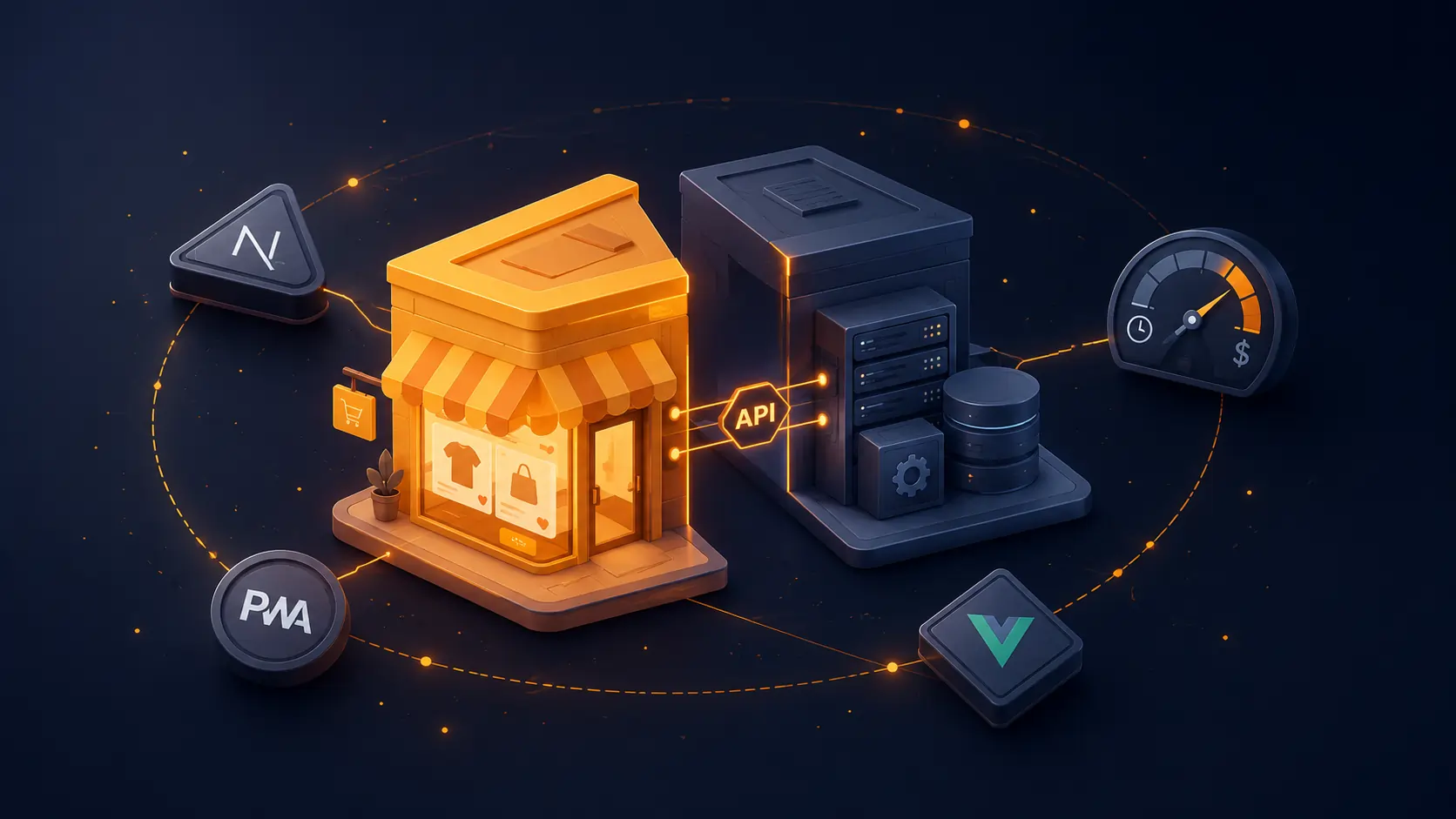
Since 2022, « headless commerce » has become a recurring marketing argument in the e-commerce ecosystem: decoupled front in React or Vue, PrestaShop / WooCommerce / Shopware backend exposed via API, perfect Core Web Vitals performance, mobile-native PWA experience. The promise is appealing. In 2026, after four years of real-world project feedback, the picture is more nuanced.
On PrestaShop specifically, going headless is a €30-150K initial budget project, 6 to 12 months of implementation, and a break with much of the module ecosystem. This article reviews what headless really changes, which store profiles it pays off for, and the hybrid alternative that captures most of the gain without the cost.
Headless, defined technically
A traditional PrestaShop store is a monolith: Smarty generates HTML server-side from .tpl templates, populated by Symfony controllers and module hooks. Front and back share the same PHP process.
A headless store decouples the two. The front is a standalone application (often Next.js, Nuxt, Vue Storefront, or a custom PWA) calling the PrestaShop API to fetch products, categories, cart, order. HTML rendering happens client-side (CSR) or Node server-side (SSR), not by PHP.
Three variants exist in 2026:
- Full headless: complete Next.js front, pure API back. No Smarty templates used.
- Composable commerce: multiple data sources (PrestaShop for catalog, Algolia for search, Stripe for checkout, Contentful for CMS) aggregated by the front.
- Hybrid PWA: a PWA front that stays connected to the traditional PrestaShop back, with a service worker for static assets and API calls for dynamic data. Not true headless, but often sufficient.
What headless promises, and what it actually delivers in 2026
Promise 1: Core Web Vitals performance
This is the central argument. A well-built Next.js front does indeed achieve better CWV scores than an unoptimized classic PrestaShop. But comparing an optimized Next.js front to an unoptimized PrestaShop is misleading — that’s comparing a recent, polished project to a legacy one. On a PrestaShop 8 with a clean cache stack (Redis + edge CDN + OPcache), CWV gaps with Next.js are marginal: 0.2 s on LCP, sometimes less.
Promise 2: mobile PWA experience
True. A PWA front can be installed like an app, works partially offline, and offers smoother navigation than classic mobile web. But real PWA adoption stays low (3-8% of visitors install the PWA), and business benefit rarely matches the investment.
Promise 3: multi-channel and omnichannel
The idea: the same PrestaShop backend serves a web front, native mobile app, in-store kiosks, a chatbot. Technically true, but most mid-market stores have only one channel (web) and will never have a real omnichannel need. Marketing argument most relevant for retail chains above €50M revenue.
Promise 4: modern stack and developer talent
Recruiting on React and Next.js is easier than on Smarty and Twig PrestaShop. True. But once hired, the developer must learn PrestaShop-specific data modeling, hooks, multishop, combinations. Net talent gain is smaller than advertised.
The real cost of a headless PrestaShop project
Initial development
- Complete front (Next.js or Nuxt): catalog pages, product pages, search, cart, checkout, customer account, blog. 3 to 6 months of full-time front dev.
- PrestaShop API integration: the PrestaShop REST webservice covers 80% of needs, but stays limited on specific cases (complex cart rules, multishop, third-party modules). Often 1-2 months of custom endpoint dev.
- Redesigned checkout: the most complex module. Shipping calculation, taxes, promo codes, payment, error handling. 1 to 2 months.
- SEO and redirections: sitemap, hreflang, meta, schema.org, legacy URL handling. If unprepared, violent SEO loss. 2-3 weeks.
Typical total budget: €30-80K for a simple store, €80-150K for a B2B or multilingual / multi-country store.
Infrastructure
- Vercel or Netlify hosting: $50-300/month depending on volume.
- Self-hosted Node SSR: dedicated VPS €30-100/month.
- Externalized search (Algolia, Meilisearch): $50-500/month.
- Image CDN (Cloudinary, Imagekit): $30-200/month.
Ongoing maintenance
- Two codebases to maintain instead of one.
- Compatibility to validate on every PrestaShop update (the webservice changes occasionally).
- Purchased PrestaShop modules become largely useless: they hook into Smarty theme display, which no longer exists.
What you lose going headless
1. The PrestaShop module ecosystem
The most underestimated loss. PrestaShop 8 has an ecosystem of over 3,500 modules on the Addons Marketplace. The vast majority hook into the front via theme hooks (displayProductButtons, displayLeftColumnProduct, etc.). In headless, these hooks are no longer called. Every front module must be reimplemented in React/Vue: product reviews, cross-sell, configurator, promo sticker, new badge.
On a store using 15 front modules, plan for 2 to 4 weeks of dev just to reimplement the strict minimum.
2. Admin and merchandiser UX
The PrestaShop back-office stays, but some features lose their purpose. The PrestaShop CMS module generates HTML the headless front must interpret — works if you stay on simple structures, not if the merchandiser wants to place rich components. Modern headless CMSes (Builder.io, Storyblok) are typically added as a supplement, adding a third stack to orchestrate.
3. Iteration speed
Modifying a Smarty theme is fast (FTP, refresh). Modifying a Next.js front means a build / deploy / test cycle. For teams used to iterating quickly on the storefront, going headless slows the rhythm.
Which stores does headless really pay off for?
Three profiles where the investment really justifies itself in 2026:
1. Store with serious omnichannel ambition
Multiple channels to serve (web, native mobile app, in-store kiosks, marketplaces) from a single source of truth. PrestaShop becomes the product back-office, the front is deduplicated per channel. Justification: from €5-10M revenue and 2+ channels.
2. Store with extreme front experience requirements
Luxury fashion catalog with sophisticated animations, 3D configurator, editorial-rich storefront. Smarty templating quickly hits limits compared to a well-built React front. Minority profile (high-end, very visual sectors).
3. Store with mature composable stack
The tech team has already chosen to aggregate multiple sources: Algolia for search, Stripe for checkout, external PIM, dedicated CMS. PrestaShop is just one catalog engine among others. The front is the natural aggregator.
The hybrid alternative: 80% of the gain for 10% of the cost
For 80% of mid-market PrestaShop stores, the right compromise in 2026 isn’t headless but a hybrid optimization:
- Keep the PrestaShop monolith with a clean cache stack (Redis + edge CDN, see the dedicated cache strategy article).
- Optimize the Smarty theme: inlined critical CSS, deferred JS, native lazy loading, WebP/AVIF images, preloaded fonts.
- Add interactive islands in Vue or React on highly interactive zones (configurator, search, sticky cart). This is the « islands architecture » philosophy that combines fast SSR with targeted interactivity.
- Externalize only with clear ROI: Algolia for search if search is a lever, Cloudinary for images if volume justifies it.
This approach costs €5-15K in implementation, deploys in 2-6 weeks, and achieves Core Web Vitals scores close to a well-built headless — without breaking the module ecosystem or doubling maintenance.
Conclusion: a project, not an optimization
Headless PrestaShop is a strategic architectural choice, not a Core Web Vitals optimization. Justifiable for stores with real omnichannel ambition, exceptional front experience requirements, or an already composable tech stack. Hard to pay off for a mid-market store whose goal is to improve mobile conversion and performance.
In 2026, the majority of headless PrestaShop projects DataFirefly has been consulted on would have gotten better ROI from a clean cache stack + optimized theme + targeted interactive islands. Headless remains relevant — but only for stores whose constraints truly justify it, not as a default solution to a performance problem.