
The right of withdrawal is the best-known obligation in online retail and one of the worst configured. The errors rarely concern the fourteen-day principle itself, and almost always the starting point, the exceptions and the refund calculation.
The rules below come from the European Consumer Rights Directive as transposed in each member state. The United Kingdom applies the same fourteen-day period under the Consumer Contracts Regulations, with wording that differs on some details.
When the period starts
This is the first source of error, because it differs with the nature of the sale.
For goods, the period runs from receipt by the consumer or by a third party they designated. Not from the order, not from the dispatch.
For a service, it runs from the conclusion of the contract.
Three particular cases worth knowing.
An order delivered in several shipments. The period runs from receipt of the last item. A customer receiving three parcels spread over two weeks has fourteen days after the third.
Goods made of multiple lots or pieces, delivered in several shipments: same rule, the last element starts the clock.
Regular delivery over a defined period. The period runs from receipt of the first item.
Practical consequence: your system must work from the delivery date, not the order date. Many configurations calculate from the order, which unduly shortens the customer’s period.
Failure to inform
A point with heavy consequences and one that is little known.
If you have not informed the consumer of their right of withdrawal, the period is extended by twelve months from the expiry of the initial period.
If you supply that information during the extension, the fourteen-day period runs from the day the information is received.
In other words: one missing piece of information can turn a fourteen-day period into one of more than a year. That is why the information must appear in several places.
Where to inform: in your terms and conditions, on the order confirmation page, and in the confirmation email. All three, not one of the three.
The model form
You must supply a model withdrawal form to the consumer.
Three clarifications.
Supplying is not imposing. The customer is not required to use it: any unambiguous statement expressing their decision to withdraw is enough, including a plain email.
Refusing a withdrawal because it did not use your form is therefore an error.
The form must be attached to the contractual information, not merely available somewhere on the site.
Recommended practice: additionally offer an online form in the customer account, which simplifies handling on both sides, while still accepting other forms of request.
The exceptions, precisely
The right of withdrawal has an exhaustive list of exceptions. The ones most relevant to online retail.
Goods made to the consumer’s specifications or clearly personalised. Mind the interpretation: a product chosen from predefined options is generally not a personalised good within the meaning of this exception.
Goods liable to deteriorate or expire rapidly.
Sealed goods which cannot be returned for health protection or hygiene reasons. The exception only applies if the item has actually been unsealed.
Sealed audio, video or software recordings.
Newspapers and periodicals, subscriptions aside.
Digital content supplied on an intangible medium, where performance has begun with the consumer’s prior express consent and their express acknowledgement that they thereby lose the right.
That last case requires a double explicit consent, collected through a separate checkbox. A mention buried in the terms and conditions is not enough.
A point of method: these exceptions are configured per product or per category, not globally. And they must be flagged on the product page, before purchase.
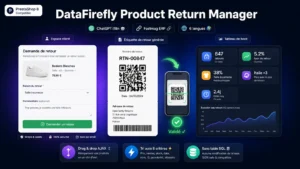 DataFirefly Product Return Manager — Product returns with QR scan, analytics and ChatGPT translation for PrestaShop 8Complete PrestaShop 8 product return management: QR scan, PDF label, 13-axis analytics, ChatGPT translation, Fastmag hook, admin manual return, guest return. Original price was: €129.00.€89.00Current price is: €89.00.
The return period
A distinction often confused with the withdrawal period.
The consumer has fourteen days to notify their withdrawal. They then have a further fourteen days to send back the goods.
That is potentially twenty-eight days between receipt and the actual return of the merchandise. Your stock management and your cash position have to absorb it.
Return shipping costs stay with the consumer, provided you informed them before the contract was concluded. Failing that, they fall on you.
The refund
This is where disputes concentrate. Four rules.
The deadline. You refund no later than fourteen days after being informed of the decision to withdraw.
The option to defer. You may wait until the goods are recovered, or until the consumer provides evidence of dispatch, whichever comes first. That is an option, not an obligation.
The amount. It covers the price of the goods and the initial delivery costs. This is the most frequent error: many merchants refund only the product.
The refund method. It uses the same means of payment as the initial transaction, unless the consumer expressly agrees to another means and incurs no charge for it.
A clarification on delivery costs: if the customer chose a more expensive delivery method than the standard one you offer, you refund only the cost of the standard method.
Partial returns
A frequent situation, rarely configured correctly.
A customer who orders three items and sends back only one is withdrawing partially. The refund covers that item.
The delivery cost question becomes delicate. The reasonable position: if the original order qualified for free delivery through a threshold the return drops it below, the situation needs examining, and a fair practice is not to recharge delivery costs after the fact.
This point deserves to be settled in your terms and applied consistently.
Diminished value of the goods
A delicate point where overzealousness produces disputes.
The consumer may handle the goods to establish their nature, characteristics and functioning, as they would in a shop.
They can be held liable for any diminished value resulting from handling beyond that, provided you informed them of their right of withdrawal.
Three practical consequences. A garment that has been tried on cannot be refused. Nor can a device that has been unboxed and tested. On the other hand, a product that is visibly used or damaged can justify a proportionate deduction.
Caution is warranted: refusing a return or applying a large deduction on this basis is frequently challenged and rarely upheld.
What to configure
Six configuration points.
The period calculation from the delivery date, covering the multi-parcel case.
Exceptions per product or category, displayed on the product page.
The double consent on digital content with immediate performance.
The withdrawal form, reachable and attached to the contractual information.
The refund calculation including standard delivery costs.
Processing deadlines, with an alert as the fourteen-day refund window approaches.
That last point is the most useful in practice: missing the refund deadline is the most frequent source of dispute and the easiest to avoid.
Going further
A commercial remark to close.
The legal floor is a minimum. Many merchants offer thirty days, free returns, or exchange at no cost.
These have a measurable value at conversion and they raise the return rate. The equation is calculated per category, and it generally tilts in favour of flexibility on products with high uncertainty.
A point of caution: whatever you grant beyond the legal minimum must be announced as clearly as the rest, and applied consistently. A generous policy badly explained does not convert.
The Product Return Manager module for PrestaShop equips this on PrestaShop 8 and 9: period calculated from delivery with multi-parcel handling, exceptions configurable per product, an online withdrawal form, refund deadline tracking with alerts, and partial return processing.