
Everything you'd want to know before you install.
A detailed look at how DataFirefly Product FAQ AI — Automatic AI-generated FAQs with Google rich snippets and OpenAI/Claude for WooCommerce works, why we built it the way we did, and the thinking behind the features above.
§ 01
Why product FAQs have become essential
Three reasons stacked together. SEO first: since FAQPage rich results arrived, Google displays Q&A directly in the SERP, taking three to four times more visual height than a plain result — it's one of the most effective SEO levers of the decade, and it's free. Conversion next: a hesitant visitor almost always has an unanswered question (compatibility, sizing, warranty, returns). A FAQ visible on the product page lifts that objection without them contacting your support, turning hesitation into a purchase. Support time last: your team answers the same questions dozens of times a month — every question in the product FAQ is one less ticket. Across 200 products with 5 questions each, that's 1,000 entries that pay back in weeks.
§ 02
Why generate the FAQ with AI rather than by hand
The math speaks for itself. 200 products × 5 questions × 3 languages = 3,000 FAQ entries to write. At 5 minutes per entry (reading the listing, formulating a relevant question, clean translation), that's 250 hours of work — over six weeks full-time. No e-commerce team can realistically allocate that budget. Outsourcing to a copywriter typically costs €1 per entry — €3,000 per campaign, before iterations. AI generation brings the cost down to a few dozen euros (OpenAI or Anthropic usage) and the time down to a few minutes per product, bulk generation included. Quality is well above a junior copywriter as long as you configure tone, audience and directives correctly.
§ 03
Choosing between OpenAI and Anthropic Claude
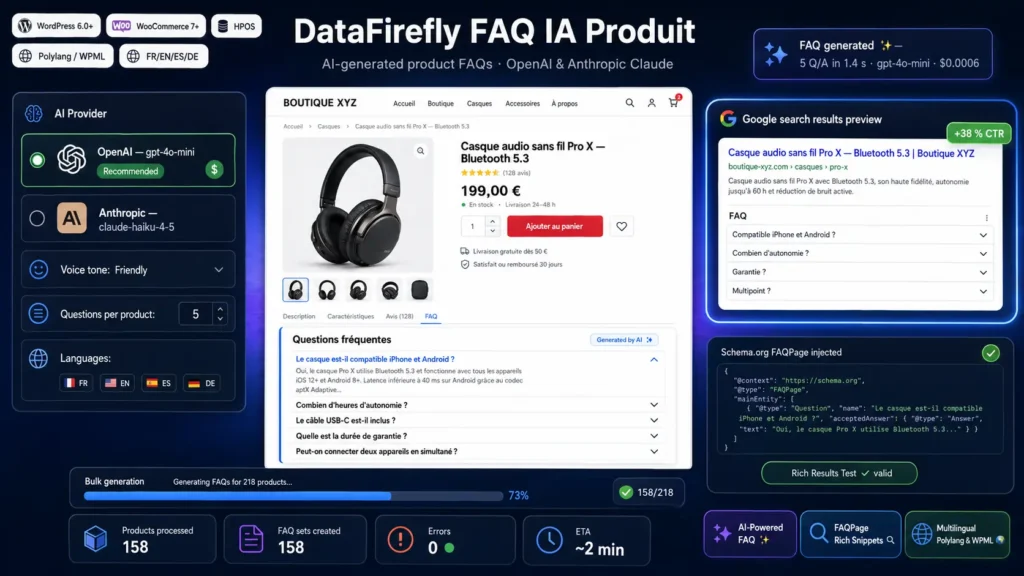
The plugin supports both providers and automatically routes to the right API based on your settings. OpenAI offers gpt-4o-mini (the most economical, ~$0.0005 per generation of 5 questions, quality more than sufficient for most products), gpt-4o (sharper, ideal for technical or B2B products), gpt-4-turbo and gpt-3.5-turbo. Anthropic Claude offers claude-haiku-4-5 (equivalent to gpt-4o-mini in cost and positioning), claude-sonnet-4-6 (sharper, comparable to gpt-4o) and claude-opus-4-7 (the most powerful for long or technical content). Both providers return structured JSON that the plugin parses robustly (resilient to markdown fences). You can switch providers at any time without breaking anything.
§ 04
Fully customisable prompt
This is what sets the plugin apart from a plain ChatGPT integration. Three cumulative levels of customisation. Level 1: voice tone across 6 preconfigured styles (professional, friendly, casual, technical, enthusiastic, reassuring) — each tone reshapes the answers without any code. Level 2: target audience as free text (e.g. "medical professionals (B2B)", "first-time buyers", "DIY enthusiasts") — the AI adapts vocabulary, references and depth. Level 3: custom system prompt (complete override of the default instructions, for stores with strict editorial guidelines) and additional user directives (e.g. "always mention the 2-year warranty", "avoid superlatives", "do not compare to competitors"). You can also enable/disable inclusion of the category, brand and WooCommerce attributes in the prompt — which radically changes precision on technical products.
§ 05
Schema.org FAQPage rich snippets and SEO impact
The plugin automatically injects Schema.org FAQPage structured data in the head of every product page that has at least one active FAQ. The markup conforms to Google Search Central requirements and the encoding uses JSON_HEX_TAG, JSON_HEX_AMP, JSON_HEX_APOS and JSON_HEX_QUOT — fully stripping HTML-special characters and passing the Rich Results Test. SERP-side, the effect is immediate: your product listing displays a Q&A accordion below the title, multiplying visible surface and CTR. According to public benchmarks, FAQPage results have CTRs averaging 30-40% higher than plain results — across dozens of product pages, the cumulative impact on organic traffic far exceeds the plugin's price.
§ 06
The per-product FAQ editor
AI generation gets you 90% of the way — but you always need to be able to take over. The FAQ AI meta box, added to the product edit screen, offers full CRUD per product and per language: add a manual question, edit a question or answer, reorder via drag-and-drop (jQuery UI sortable), enable/disable without deleting, delete permanently. Each row auto-saves on blur — no Save button to click. A language selector at the top of the meta box lets you switch between Polylang or WPML translations instantly with no full page reload.
§ 07
Bulk generation, force regenerate, excluded categories
Three levers for managing a large catalogue. Sequential bulk generation: one click to generate all missing FAQs in the chosen language or in every active language — useful for catching up on an existing catalogue. The Bulk page shows a live progress bar, a processed-products counter, a per-product error log, and a stop button to abort cleanly between products. Force regenerate: a checkbox in the UI to overwrite existing FAQs (useful after a prompt or provider change). Excluded categories: a comma-separated list of WooCommerce category IDs — products in those categories are automatically skipped in bulk and auto-generation (e.g. virtual products, gift cards, drafts).
§ 08
Five WooCommerce display positions to choose from
Depending on your theme and your UX preferences, you pick where the FAQ block appears on the product page: woocommerce_after_single_product_summary (below the WooCommerce tabs, the default, works on every theme), woocommerce_single_product_summary (inside the summary, more visible), woocommerce_product_meta_end (end of the product meta, below the buy button), woocommerce_after_single_product (after the whole product area), woocommerce_before_single_product (before). You change the position via a simple dropdown in the settings, and the hook priority is also configurable to coexist with other plugins.
§ 09
HPOS, Polylang, WPML and all major SEO plugins compatible
HPOS-compatible: explicit declaration via FeaturesUtil in the before_woocommerce_init hook — no HPOS warning in the WooCommerce admin. Polylang detected via pll_languages_list and pll_get_post_translations, WPML via the wpml_active_languages and wpml_object_id filters — each translation of a product gets its own FAQ set, generated in the target language. Compatible with Yoast SEO, RankMath and SEO Press: the plugin emits its own FAQPage JSON-LD block distinct from the Product JSON-LD those plugins generate — no collision possible. The code follows WordPress standards: nonces on every AJAX endpoint, manage_woocommerce capability check, full input sanitisation, prepared SQL statements, clean uninstall.
§ 10
Typical use cases
Fashion or equipment store with a rich catalogue: multilingual bulk generation + friendly tone + "general public" audience — every listing gets a FAQ that addresses classic objections (size, material, care, returns). Technical or industrial B2B: technical tone + "professionals" audience + product attributes inclusion — generated FAQs focus on compatibility, certifications, minimum order quantities, lead times. Cosmetics or food: reassuring tone + user directive "always mention organic/cruelty-free certifications" — FAQs focus on ingredients, shelf life, allergies. Polylang or WPML multilingual store: single configuration, automatic generation in each target language — your translations get a native FAQ in their own language, not a translation of the original.


There are no reviews yet.