
Smart Live Search — Complete Guide
Install, configure and use DF Live Search 2.1: instant search panel, optional filters, hybrid semantic search, self-learning, merchandising rules, synonyms, redirects and dashboard for PrestaShop 1.7.8, 8 and 9.
Overview and requirements
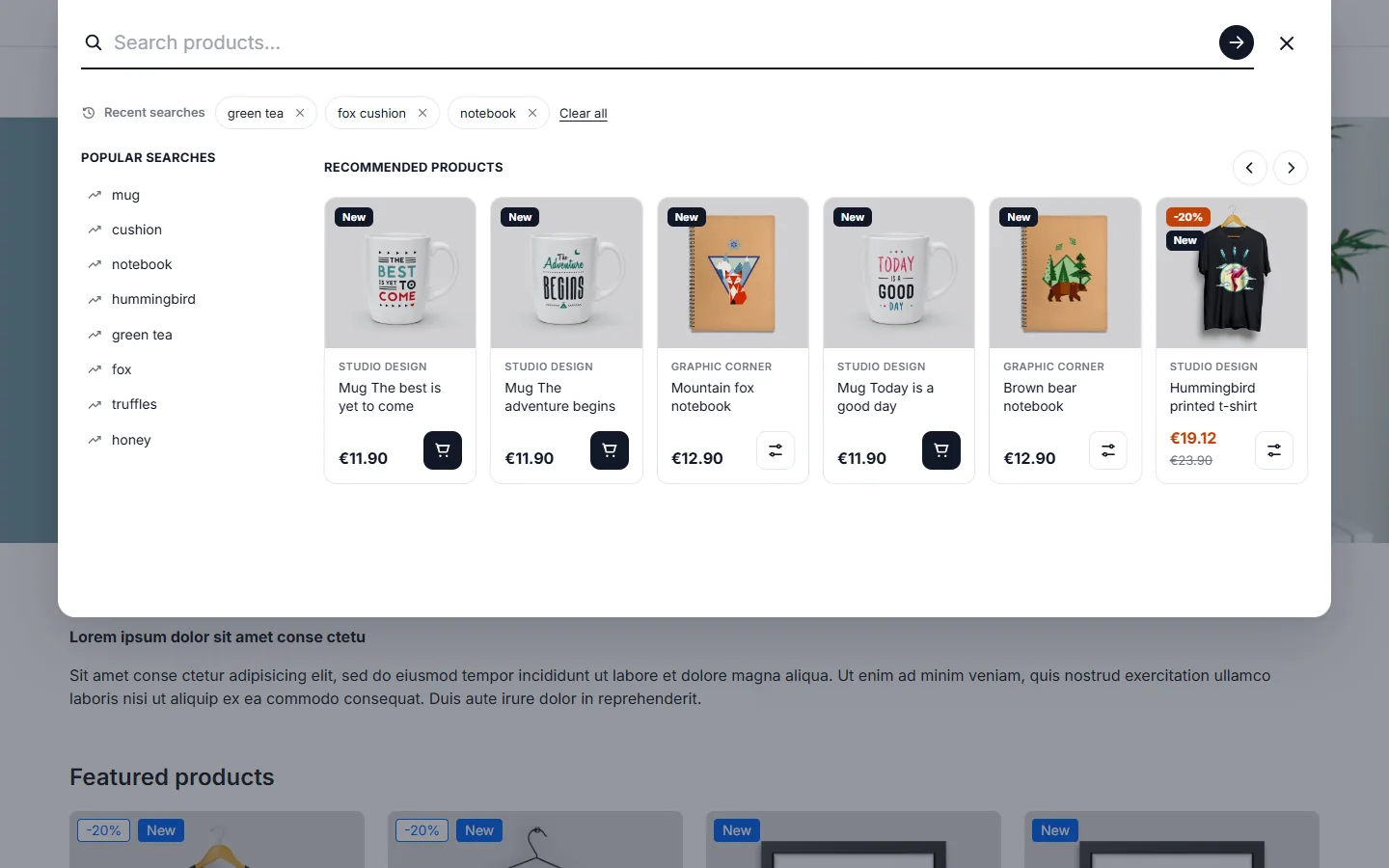
DF Live Search replaces your shop search with an instant search panel. Before typing, it shows the visitor’s recent searches, popular searches and recommended products. While typing, it offers inline completion, suggestions and the results grid, with direct add to cart. Filters (price, availability, categories, brands, attributes, features) and sorting are available as an option.
- Compatible with PrestaShop 1.7.8 to 9.x, Hummingbird, Classic and child themes, Warehouse (iqit) theme.
- PHP 7.4 to 8.5.
- Multilingual (FR, EN, ES, DE, IT, PT, PL, NL) and multistore.
- No overrides, no external resources.
Installation and update
- Download
dflivesearch-2.1.0.zipfrom your customer account. - In the back office, open Modules > Module Manager, click Upload a module and drop the archive.
- Click Configure.
On installation, the module creates its tables, builds its search index and typo dictionary, and pre-fills common synonyms in every language. The search is live right away: by default, your theme’s search field opens the panel.
Updating from a 1.x version: upload the new zip in the Module Manager and run the update. Your settings, synonyms and statistics are kept. New options keep the 1.x behaviour (module bar plus theme fields, references shown) and filters stay disabled until you enable them. IP addresses already stored are replaced by an anonymous hash.
After an update, clear the PrestaShop cache (Advanced Parameters > Performance). If your theme combines CSS and JS files (CCC), the new script is then loaded straight away.
General settings
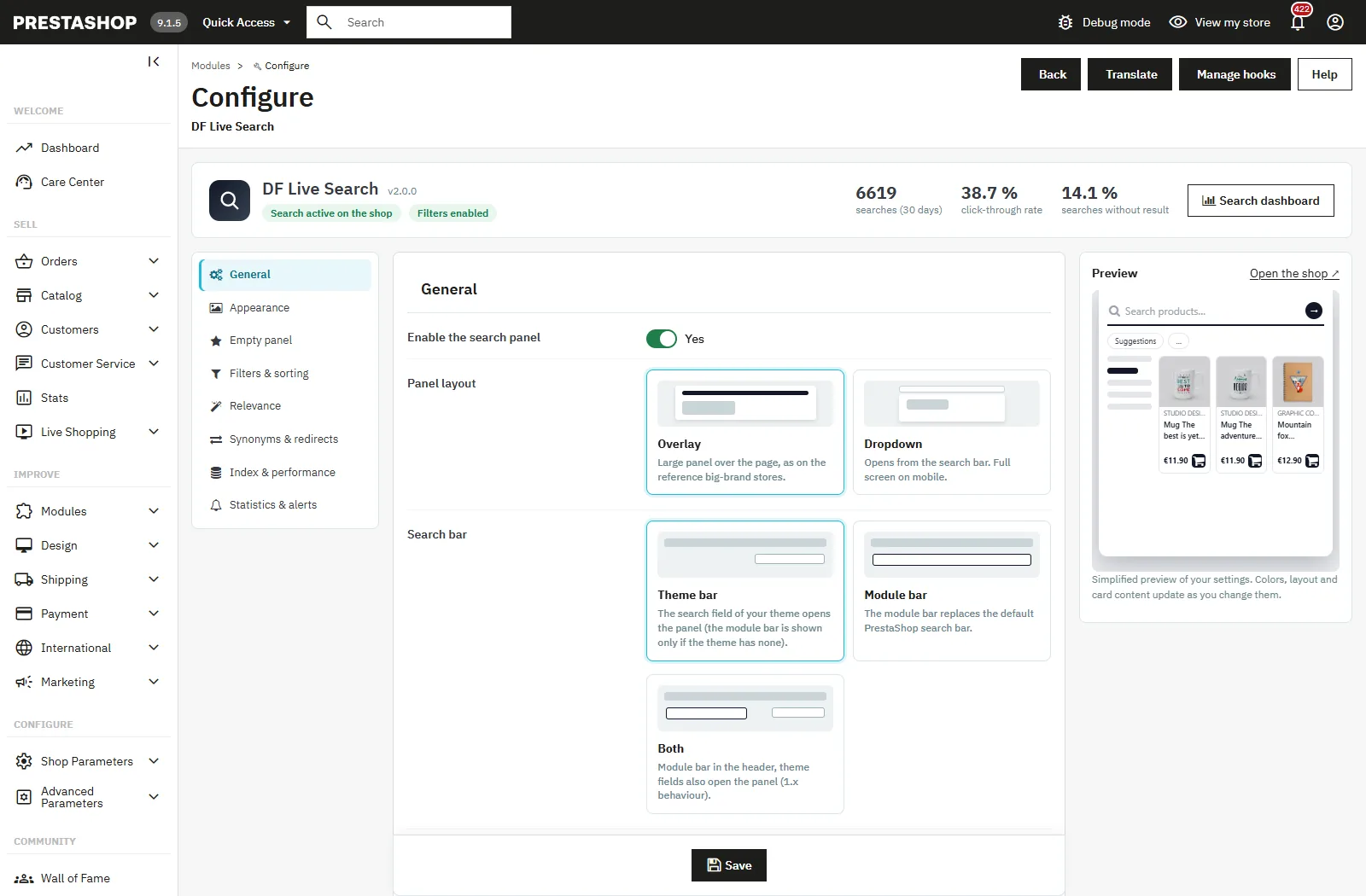
The configuration page is organised in tabs, with a live preview on the right that follows your settings (colors, layout, card content). The General tab contains:
- Panel layout: Overlay (large panel over the page) or Dropdown (opens from the search bar, full screen on mobile).
- Search bar: Theme bar (the theme’s search field opens the panel, recommended), Module bar (replaces the default PrestaShop bar) or Both (1.x behaviour).
- Search field placeholder per language, characters before searching, products per page (more are loaded with “Show more products”).
- Keyboard shortcut: Ctrl+K (⌘K on Mac) or
/opens the search from any page. - Use this engine on the search results page: the full PrestaShop results page then lists the same products, in the same order, as the panel.
Appearance and product cards
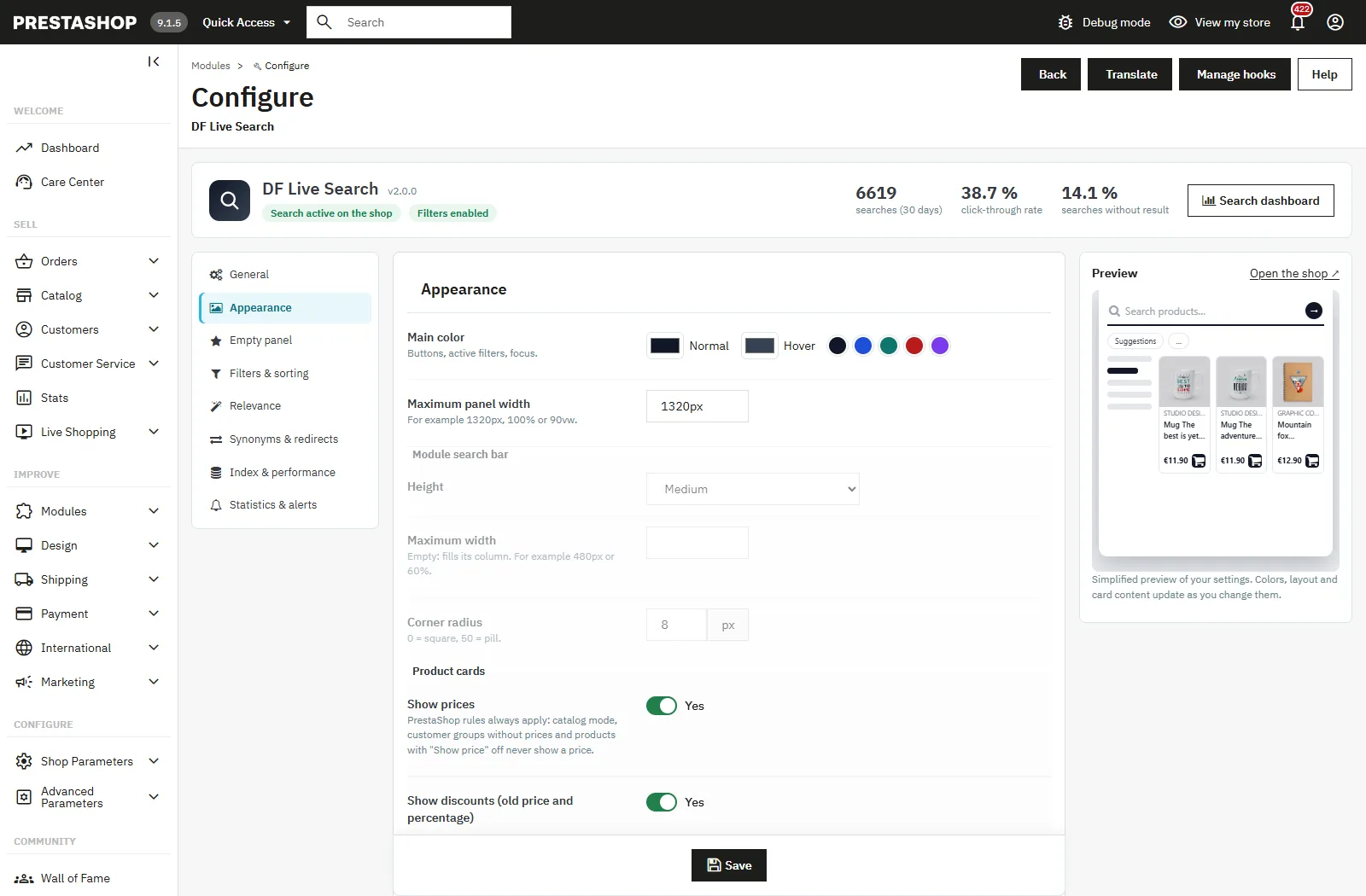
- Main color and hover color (buttons, active filters, focus), with suggested colors.
- Maximum panel width: for example
1320px,100%or90vw. - Module bar: height, maximum width and corner radius (0 = square, 50 = pill).
- Product cards: prices, discounts (old price and percentage), brand, reference, add to cart button, quantity selector, image size.
PrestaShop rules always apply: catalog mode, customer groups without prices and products with “Show price” off never show a price or a cart button. Prices follow the visitor’s group (tax incl. or excl.), its discounts and its currency.
The search panel on the shop
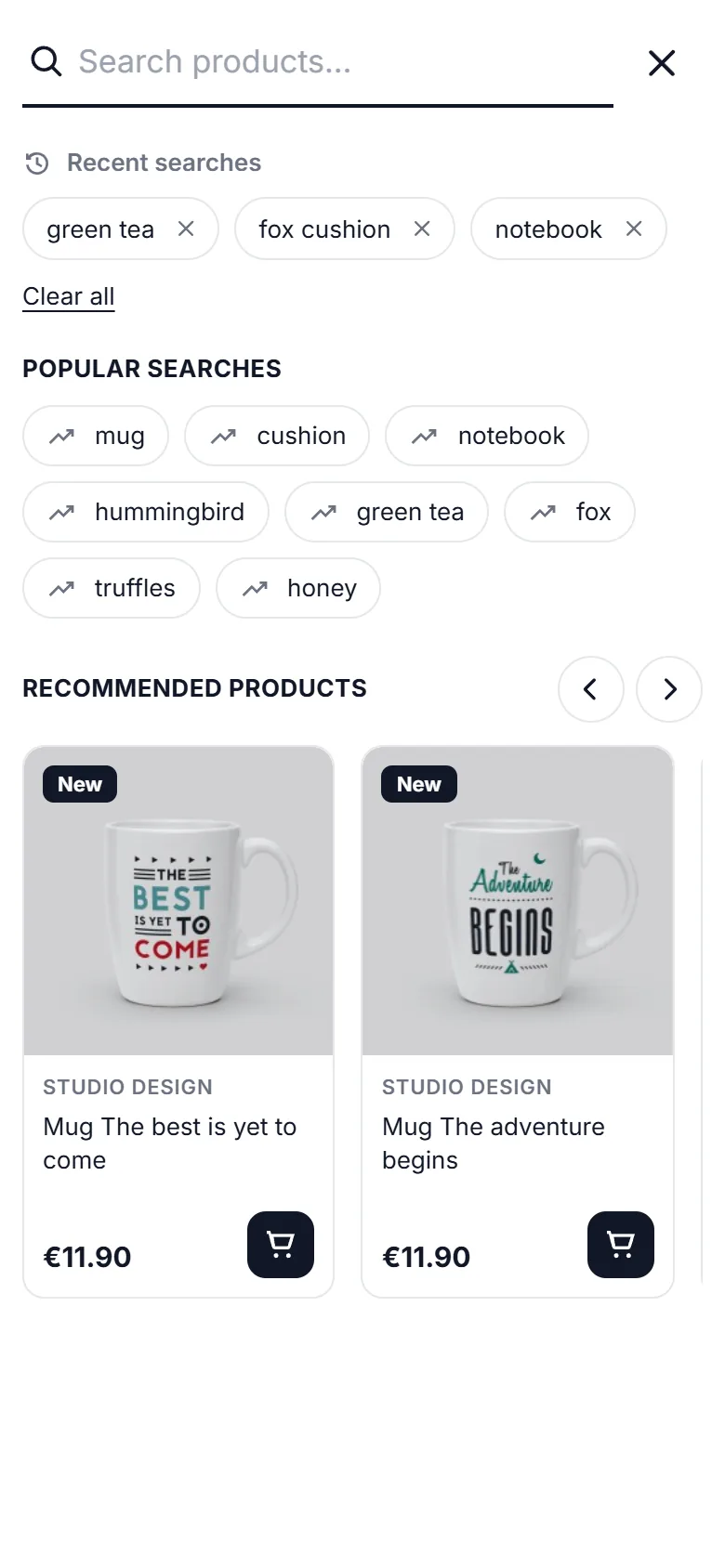
Before typing
The Empty panel tab sets what visitors see when the panel opens:
- Recent searches: stored in the visitor’s browser only, removable one by one or all at once.
- Popular searches: automatic (statistics), your list per language, or your list completed by statistics. A query is shown only if it found products for a minimum number of different visitors (2 by default): nobody can publish text in this list. You can exclude words; links and e-mail addresses are always excluded.
- Recommended products: best sellers then newest products, your selection (search, drag and drop or arrows to set the order), or personalization for logged-in customers.
While typing
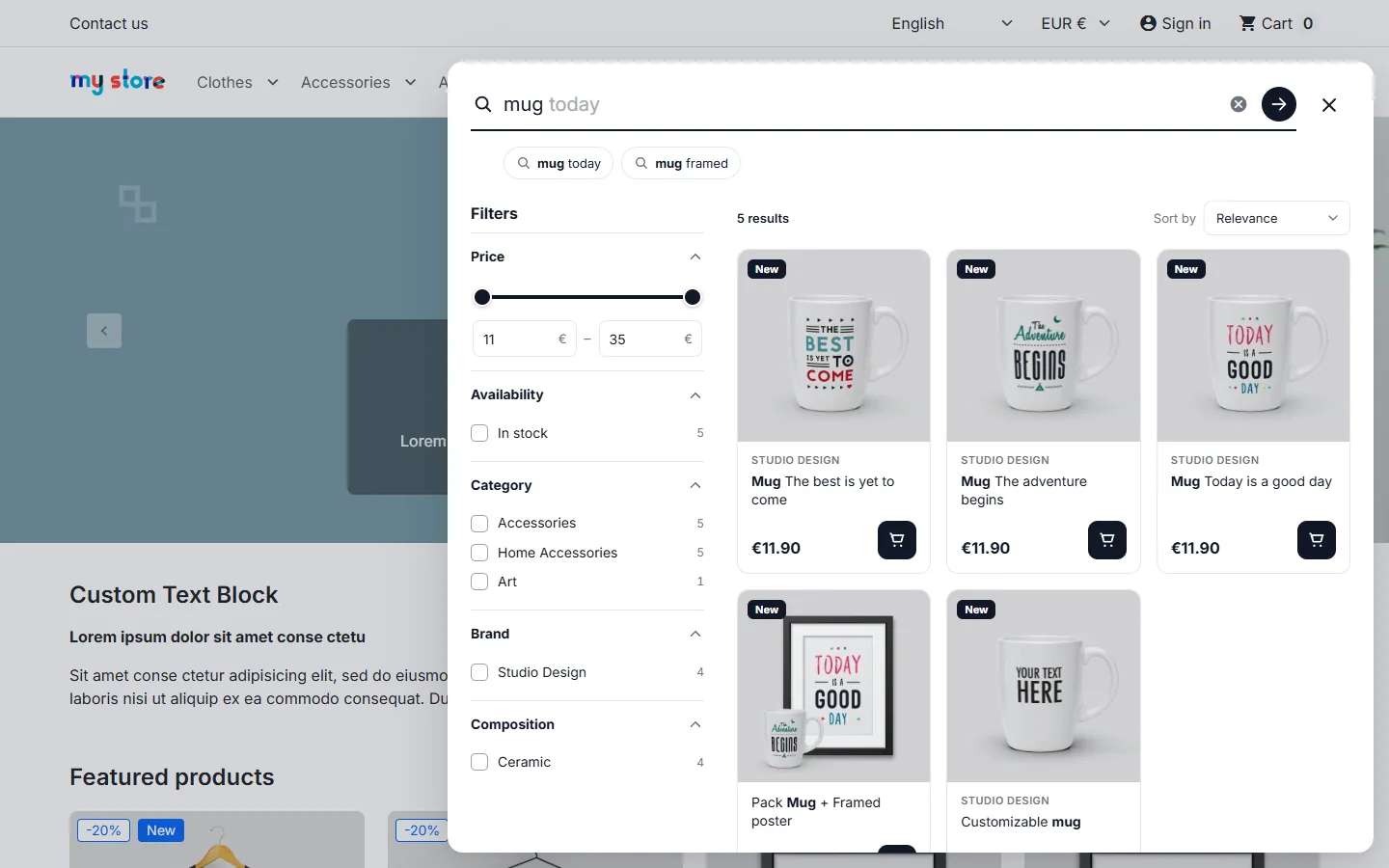
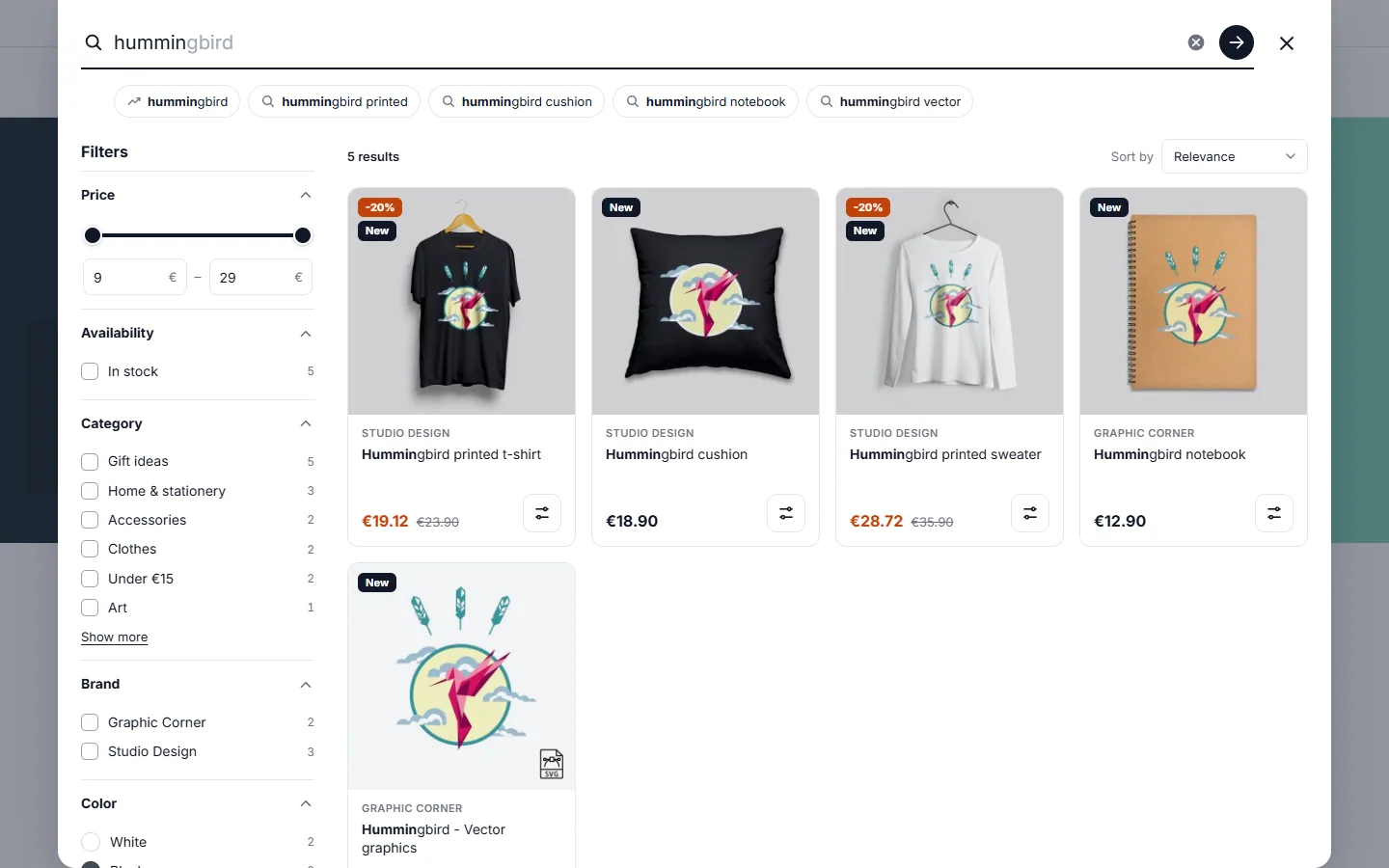
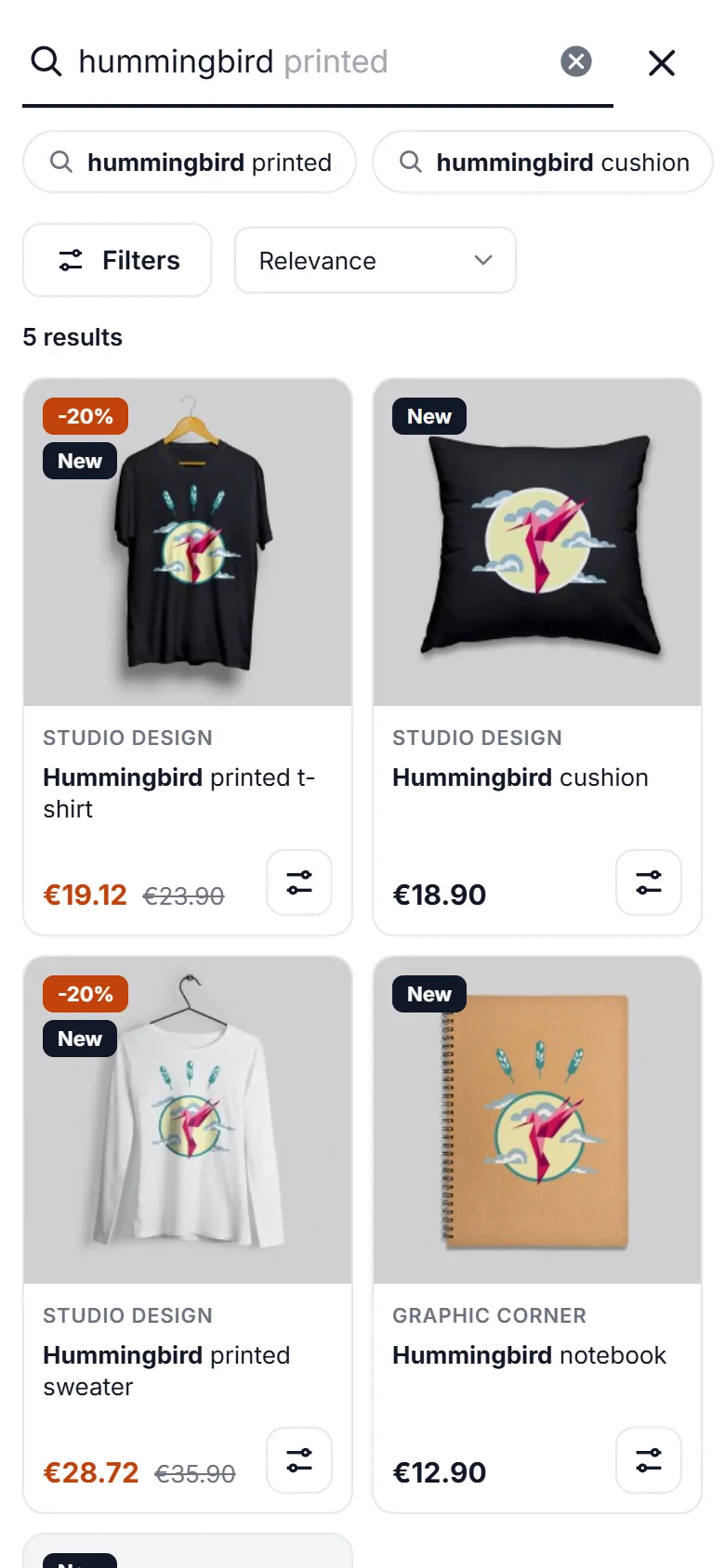
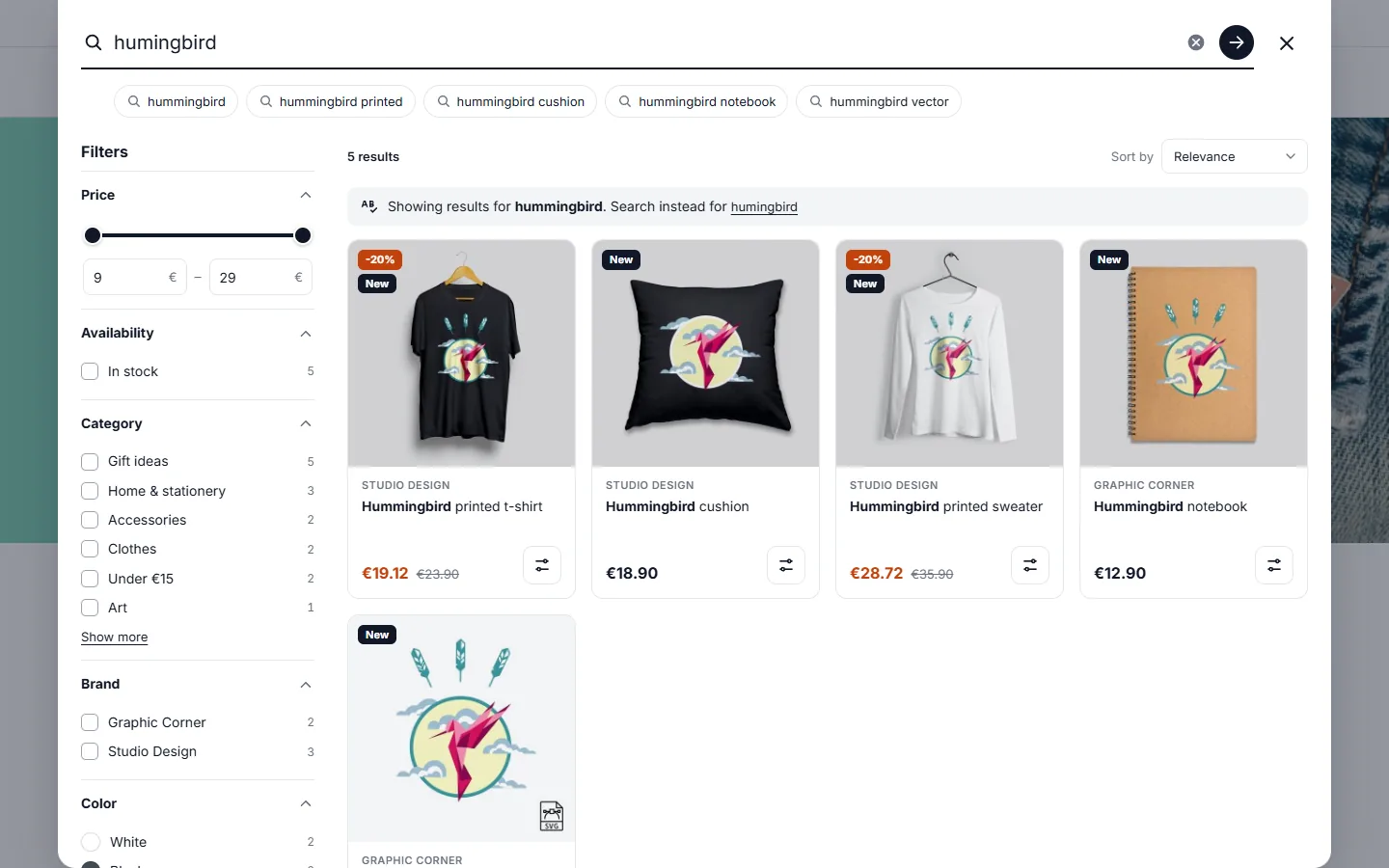
The panel shows inline completion (Tab or → to accept it), suggestion chips, matching categories and brands, the number of results and the product grid. Searched words are in bold. The keyboard moves through suggestions (arrows, Enter, Esc) and the number of results is announced to screen readers.
Add to cart
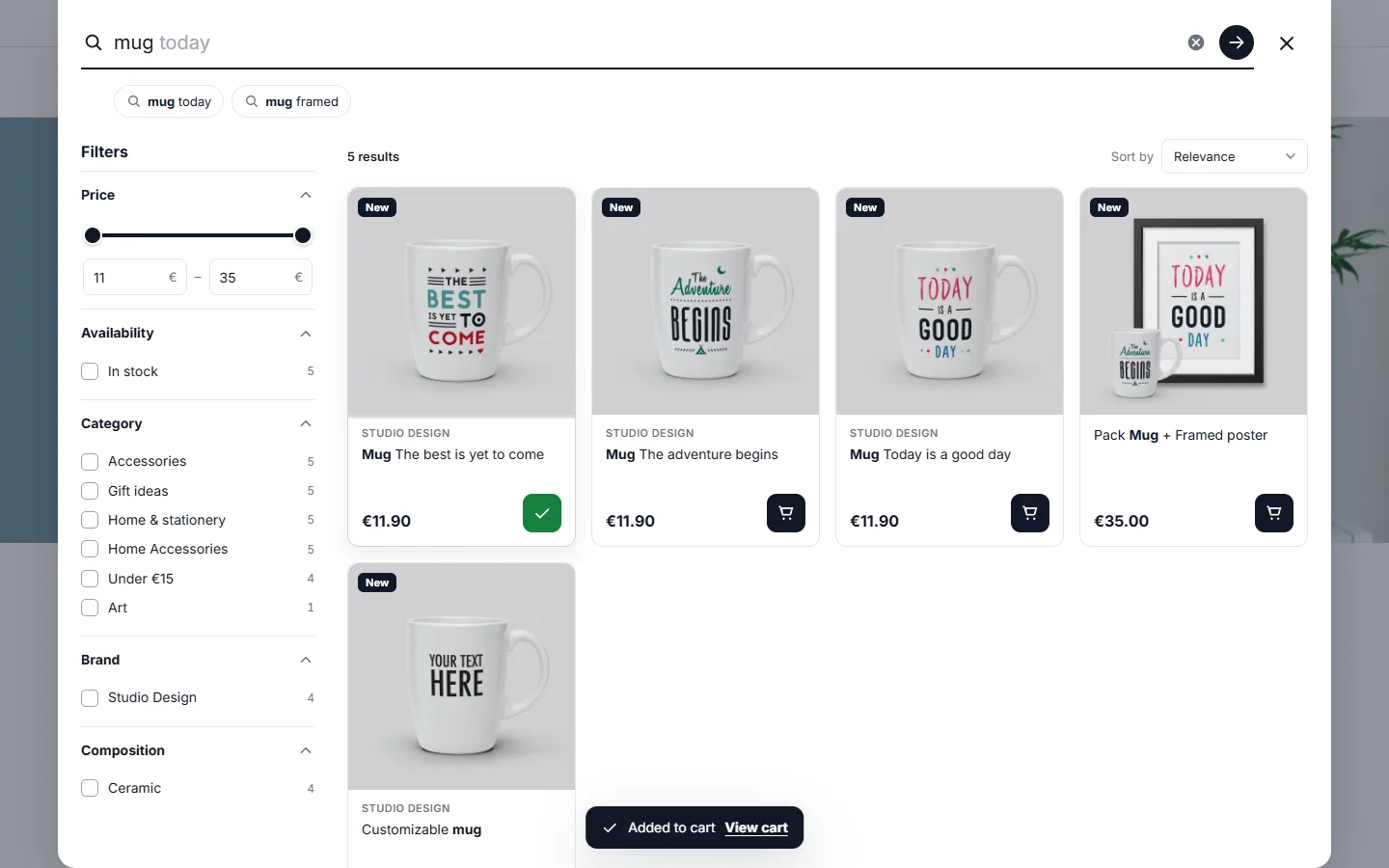
The cart button goes through the PrestaShop cart controller: stock, minimal quantities and cart rules are respected. A confirmation appears in the panel with a link to the cart, and the header cart is refreshed. Products with combinations show “Choose options”, which opens the product page.
Filters and sorting (optional)
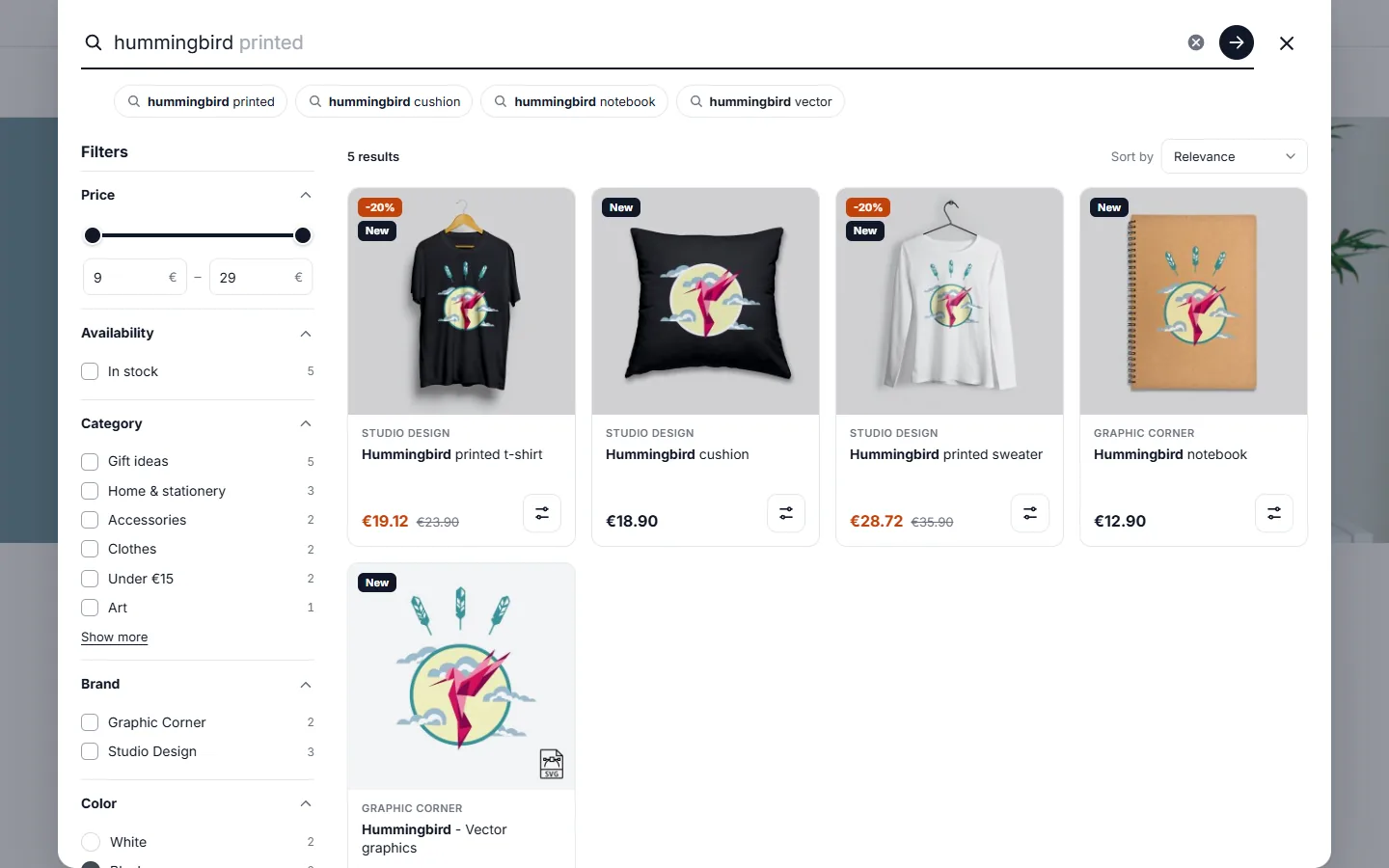
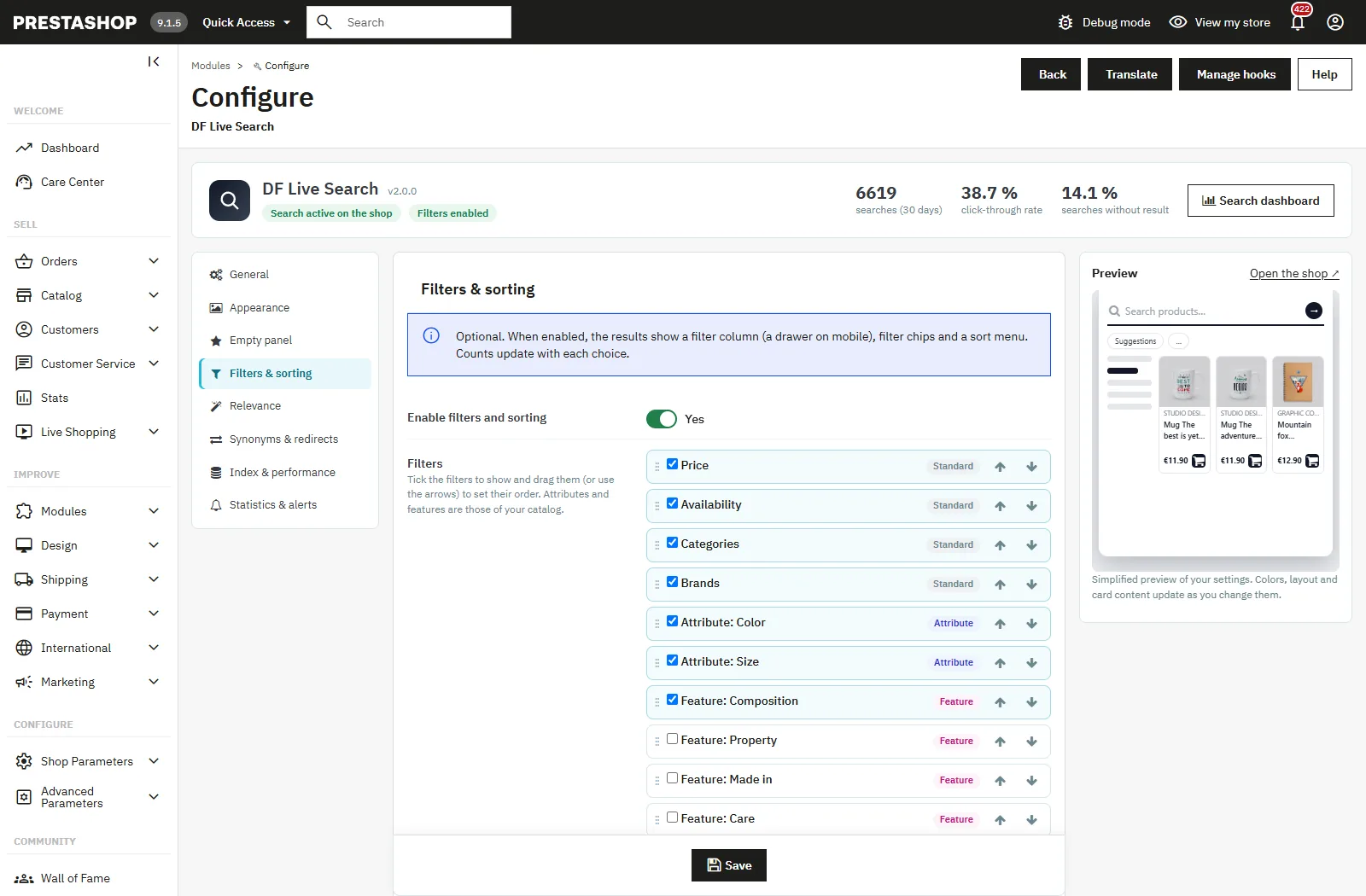
Filters are disabled by default. Enable them in the Filters & sorting tab, then tick the filters to show and drag them (or use the arrows) to set their order:
- Price: double slider and min/max fields, in the visitor’s currency and tax display.
- Availability: products in stock.
- Categories and brands.
- Attributes and features of your catalog, as you choose (swatches for colors).
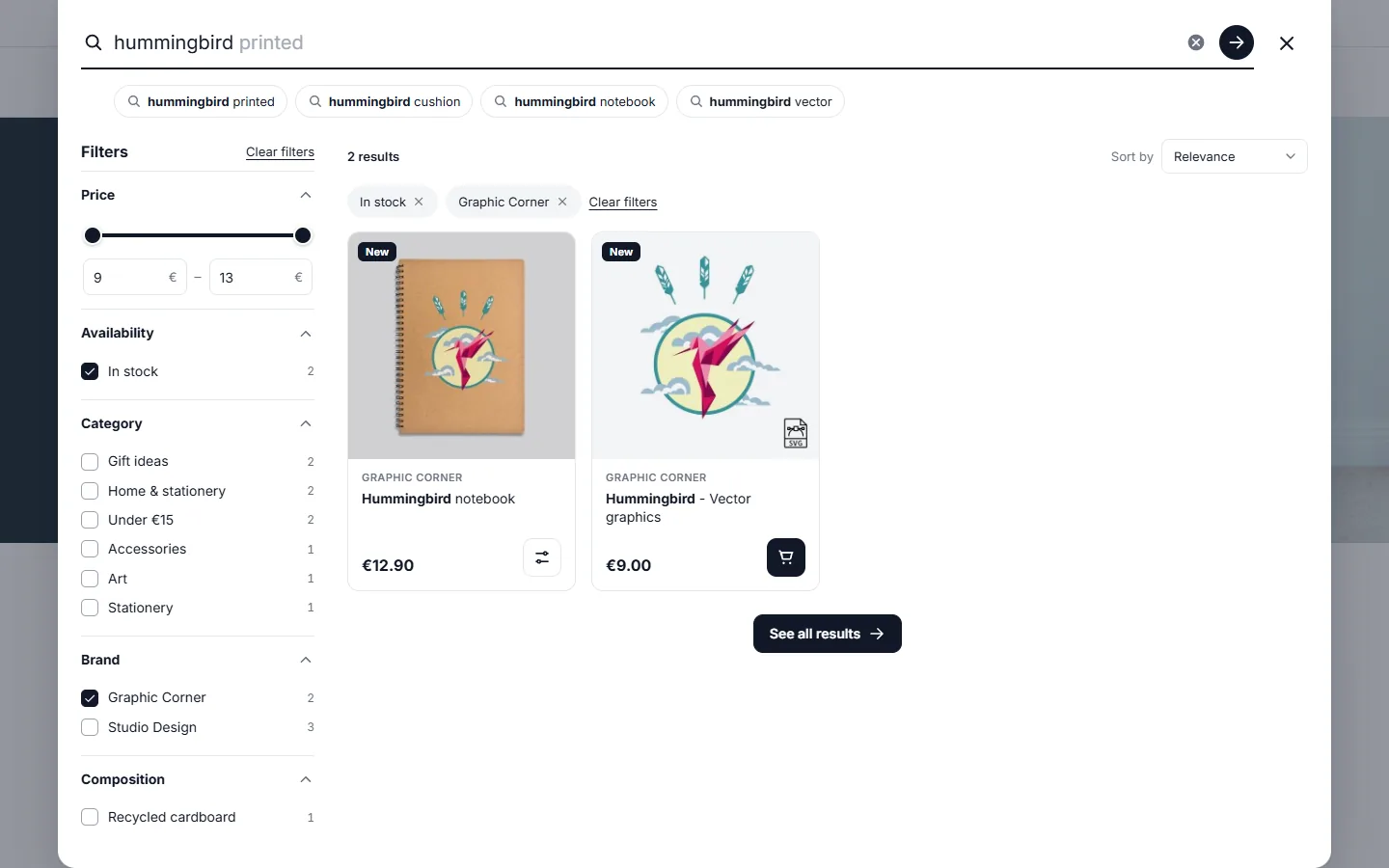
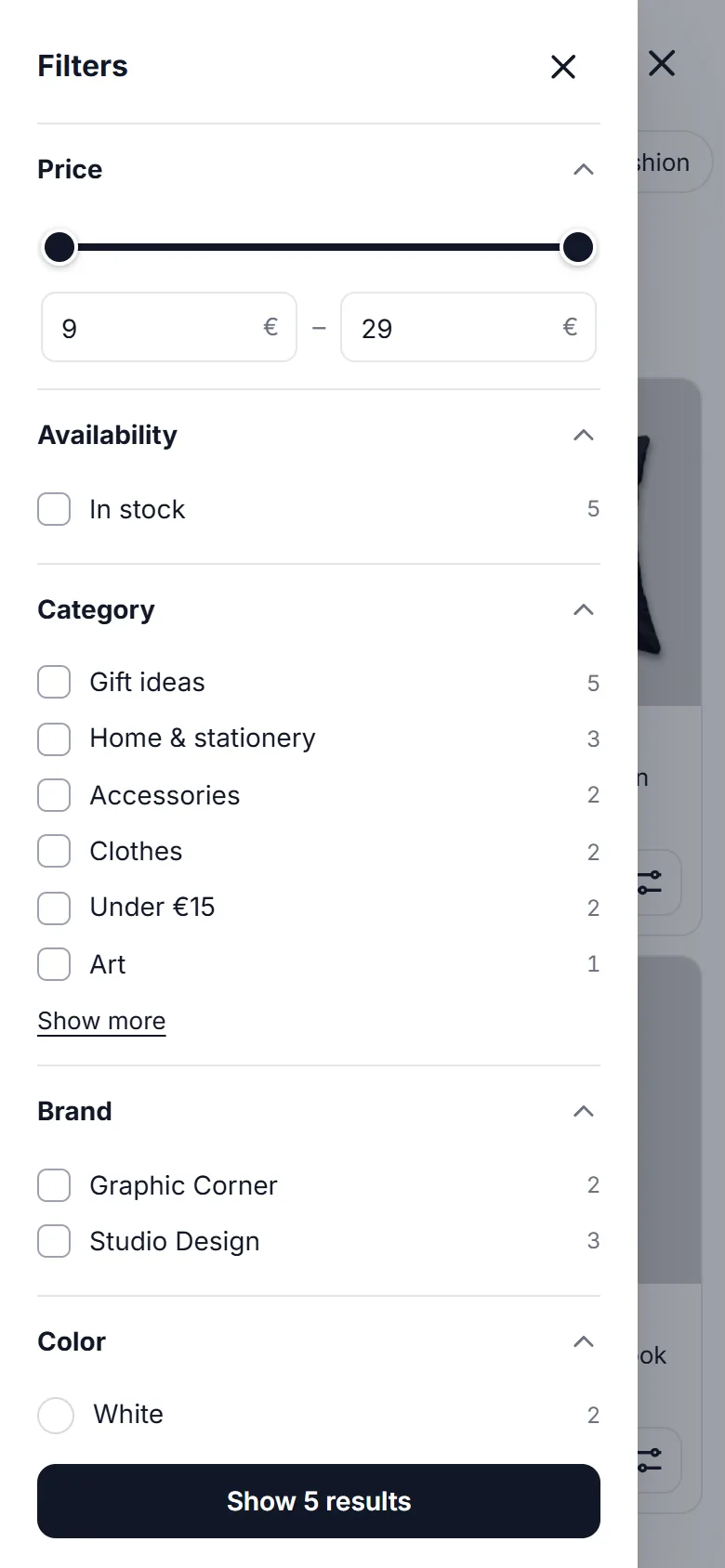
Counts update with each choice, and values of the same filter can be ticked together. Long lists get a search field and a “Show more” link. Active filters appear as chips above the results. The sort menu offers relevance, price low to high or high to low, newest, best sellers and name; choose the sort options in the same tab.
On mobile
On mobile, the panel opens full screen, the grid switches to two columns and filters open in a drawer with a “Show N results” button. Suggestions scroll horizontally under the field.
Relevance and typo tolerance
Always on: accents and case ignored, plurals in the 8 languages (“lamps” finds “lamp”), words in any order, hyphenated words (“t-shirt” = “tshirt”), as-you-type matching, product and combination references, EAN, UPC, MPN and supplier references. When the query is a combination reference, the result opens that exact variant.
The Relevance tab sets:
- Suggestions and inline completion, and their maximum number.
- Search in brands: “brand + product” works even when the brand is not in the product name.
- Typo tolerance and maximum typing errors per word (2 recommended; words of 4 letters or less accept one error). When a query finds nothing, the closest catalog words are tried.
- Tell visitors about corrections: “Showing results for… Search instead for…” with a link to the original spelling.
- Products in stock first and best sellers first, at comparable relevance.
Synonyms and redirects
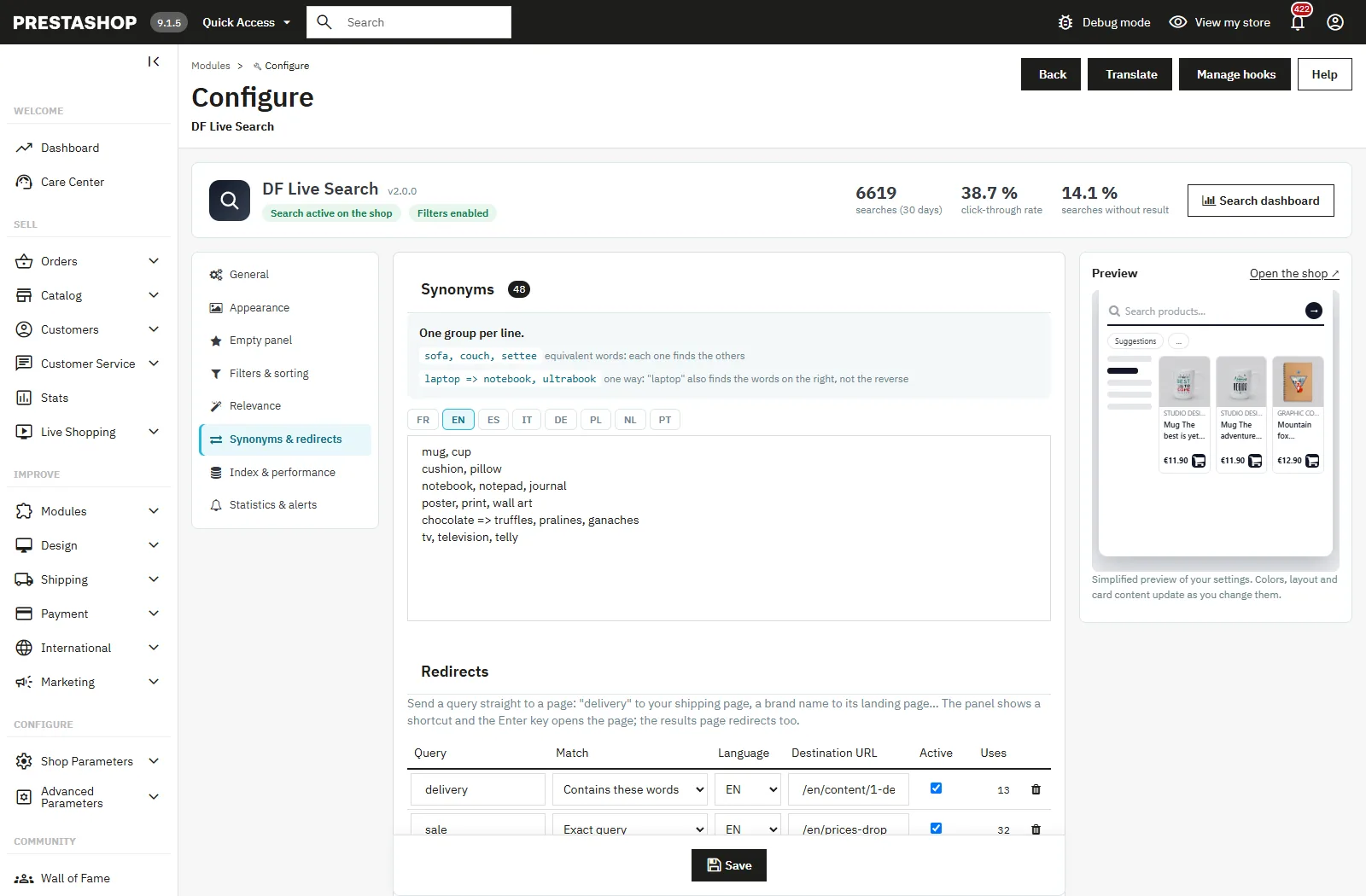
In the Synonyms & redirects tab, enter one group of synonyms per line and per language:
sofa, couch, settee
chocolate => truffles, pralines
A line with commas links equivalent words: each one finds the others. A line with => works one way: “chocolate” also finds the words on the right, not the reverse. Plurals are taken into account and a synonym only finds whole words.
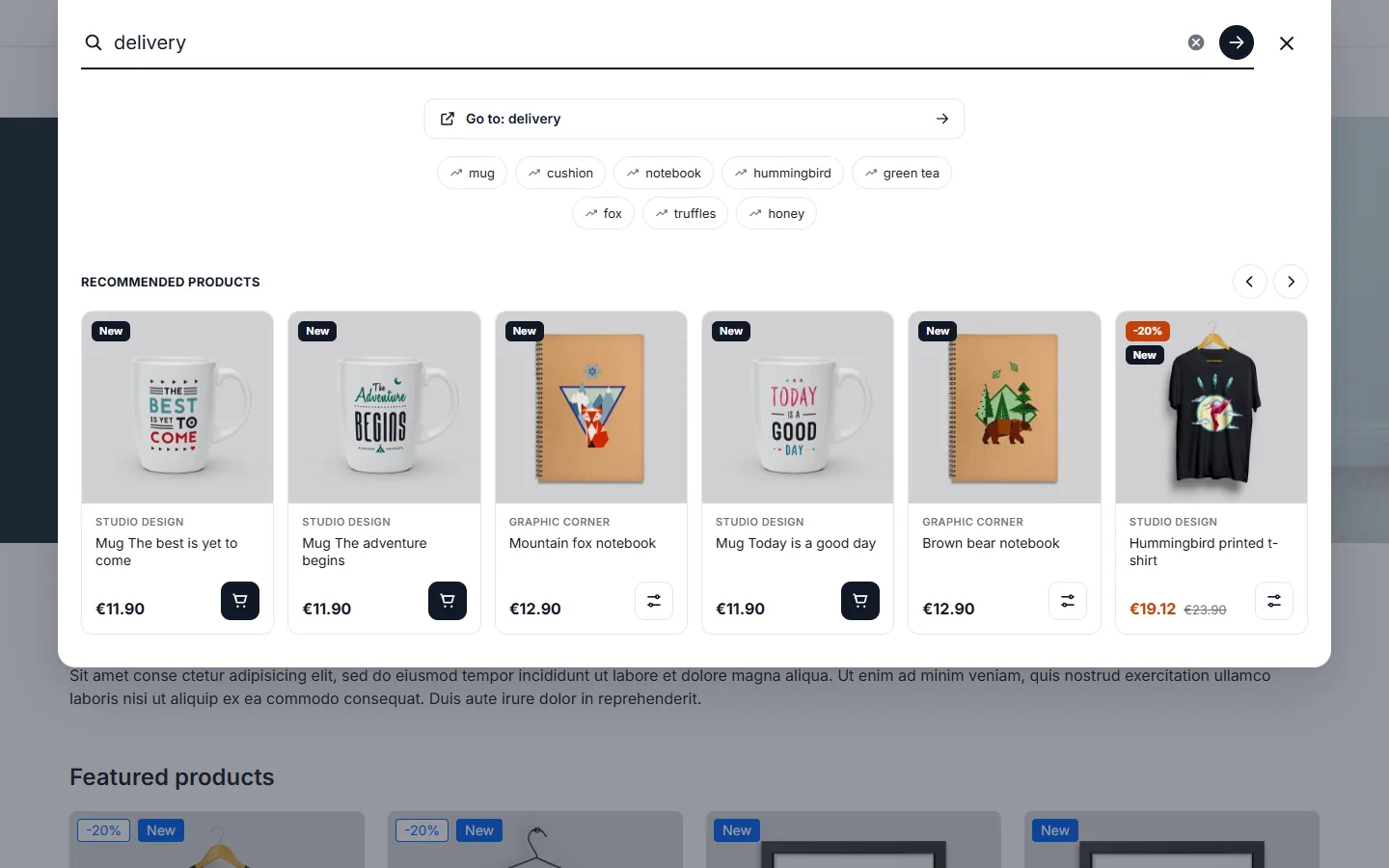
Redirects send a query straight to a page: “delivery” to your shipping page, a brand to its page… Choose “Exact query” or “Contains these words”, the language and the URL (full address or a path of your shop starting with /). The panel then shows a shortcut, the Enter key opens the page, and the results page redirects too. The number of uses of each redirect is shown.
Searches without result
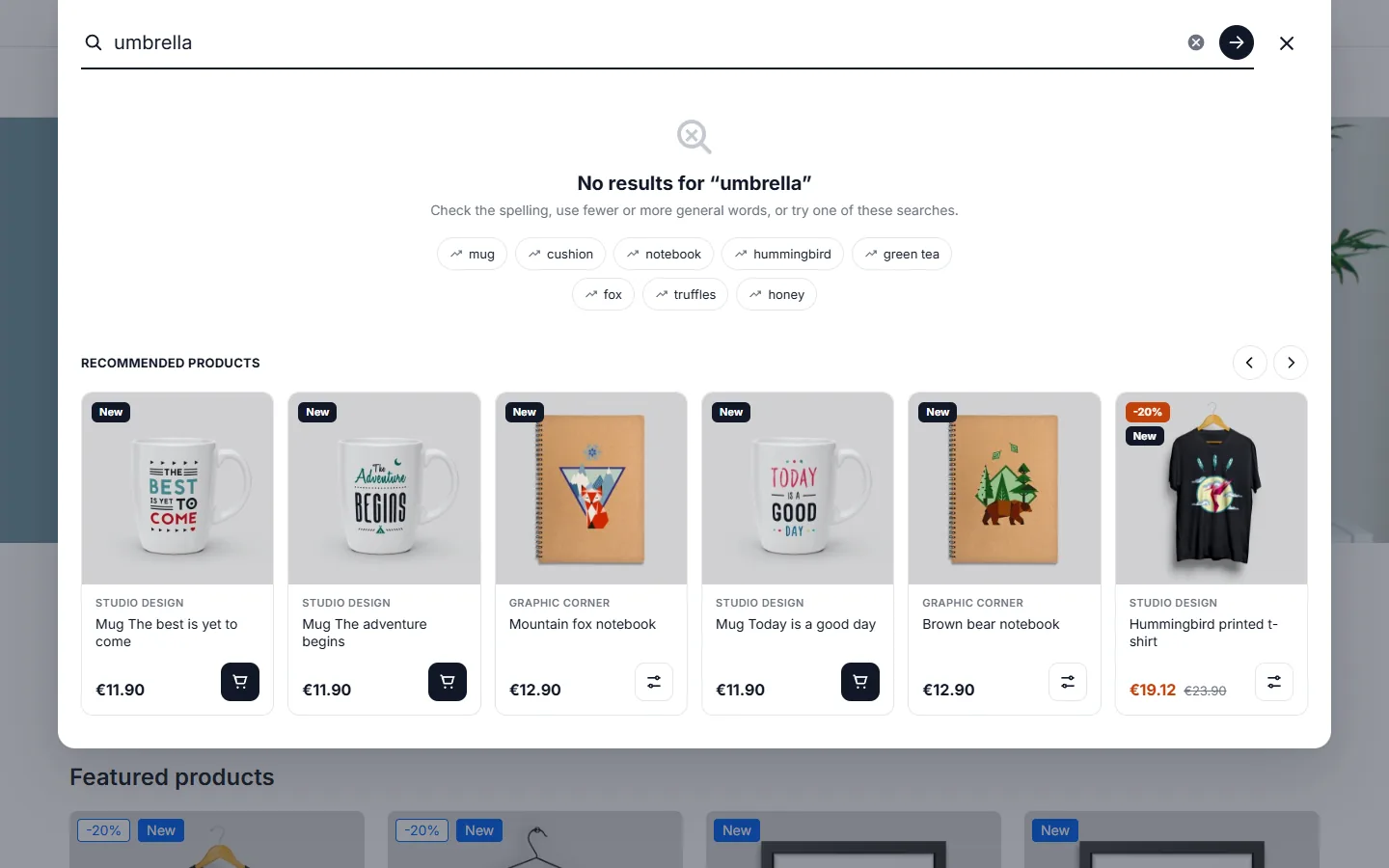
When nothing matches, the panel offers popular searches and recommended products instead of an empty page. When filters are active, a message invites the visitor to clear them. These queries are listed in the dashboard, with a button to create a synonym or a redirect in one click.
Smart search (optional)
Two optional layers improve the results beyond word matching. Both are off by default, in the Smart search tab.
Self-learning (no external service)
The module learns from your shop’s own search statistics:
- Clicks and orders: for a query, the products that several different visitors opened and bought rise in the results.
- Reformulations: when visitors who found nothing for a query succeed right after with another one, that reformulation is learned and the next visitors get its results (“Showing results for… Search instead for…”).
A signal counts only once a minimum number of different visitors gave it (3 by default), so nobody can push a product alone. The learning is updated every 6 hours, by the nightly command or with Update now. Learned reformulations are listed with the Make it a synonym and Ignore buttons.
Semantic search (hybrid ranking)
Semantic search understands the meaning of a query: “gift for a coffee lover” finds mugs, “something to write in” finds notebooks, even when these words are not in the product names. It uses an embeddings service compatible with the OpenAI API: OpenAI, Mistral AI or your own server (Ollama…), preset with one click.
- Enable the option, choose the provider, enter the API key (stored in your database, never shown on the shop) and save.
- Click Test the connection, then Generate the vectors. The tab shows the progress and an estimate of the volume to send. Afterwards, only new or changed products are sent again: with the button, the nightly command, or automatically when a product is saved.
The ranking is hybrid: the word score and the similarity are combined with an adjustable weight (40 % by default), and products less similar than the minimum similarity are not added. By default, the semantic search runs only when word matching finds few products; references and EAN codes always use word matching. If the service is slow or unavailable, the search answers with word matching after the maximum waiting time. On 10,000 products, the vector search itself takes about 15 ms.
When enabled, the text of your products (name, brand, categories, features, short description) and the queries typed by visitors are sent to the chosen service. No personal data is sent. Choose a provider compatible with your privacy policy, or your own server.
Merchandising
The Merchandising tab decides what visitors see for given queries. A rule applies to exact queries, to queries containing some words or to every search, in one language or all, and can be scheduled between two dates. Plurals and accents do not matter.
- Pinned at the top: products shown first, in your order, even if the search would not find them.
- Hidden: products never shown for these queries.
- Boost or bury: from -100 % to +100 % for a product, a category, a brand, products in stock or out of stock, new products or products on sale.
- Banner: a text, with an optional image and link, above the results.
Rules apply in the order of the list. The Ranking preview shows, for a query and a language, the products in the order visitors get them, and why: words, meaning, learning, pinned products, boosts and hidden products.
Index and performance
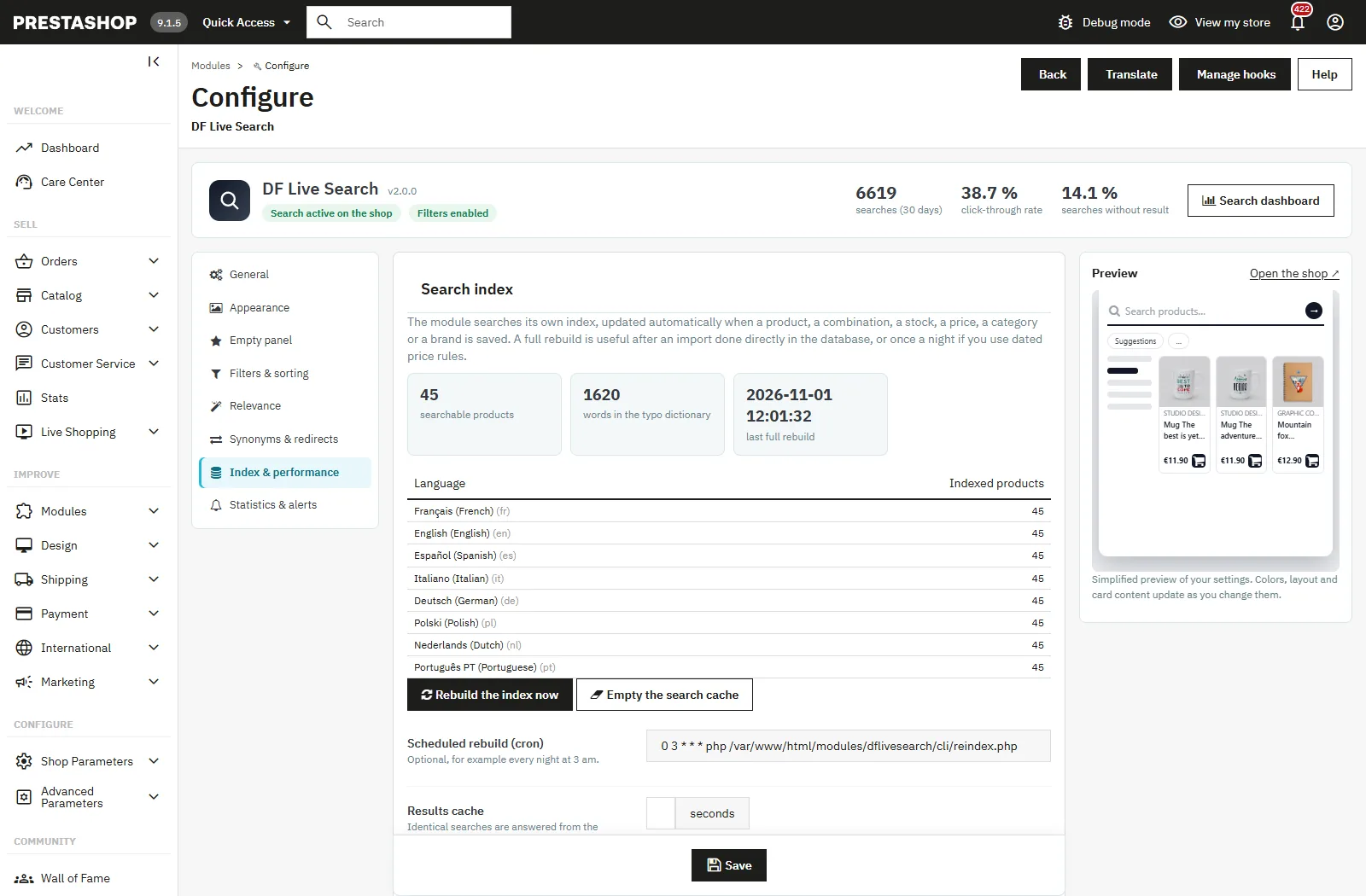
The module searches its own index (one row per product, shop and language), updated automatically when a product, a combination, a stock, a specific price, a category or a brand is saved. Only active products visible “everywhere” or “search only” are indexed, and categories restricted to some customer groups are respected.
- Rebuild the index: useful after an import done directly in the database.
- Scheduled rebuild: the cron command is shown ready to copy, for example
0 3 * * * php /path/to/shop/modules/dflivesearch/cli/reindex.php. Recommended every night if you use dated price rules. - Results cache: identical searches are answered from the cache (5 minutes by default, per language, currency and customer group). It is emptied automatically when the catalog changes.
No call is made when pages load: panel data is loaded when it opens. On our 5,000-product test catalog, a search answers in 57 to 80 ms (8 products) and in 41 to 45 ms from the cache, PrestaShop start-up time included.
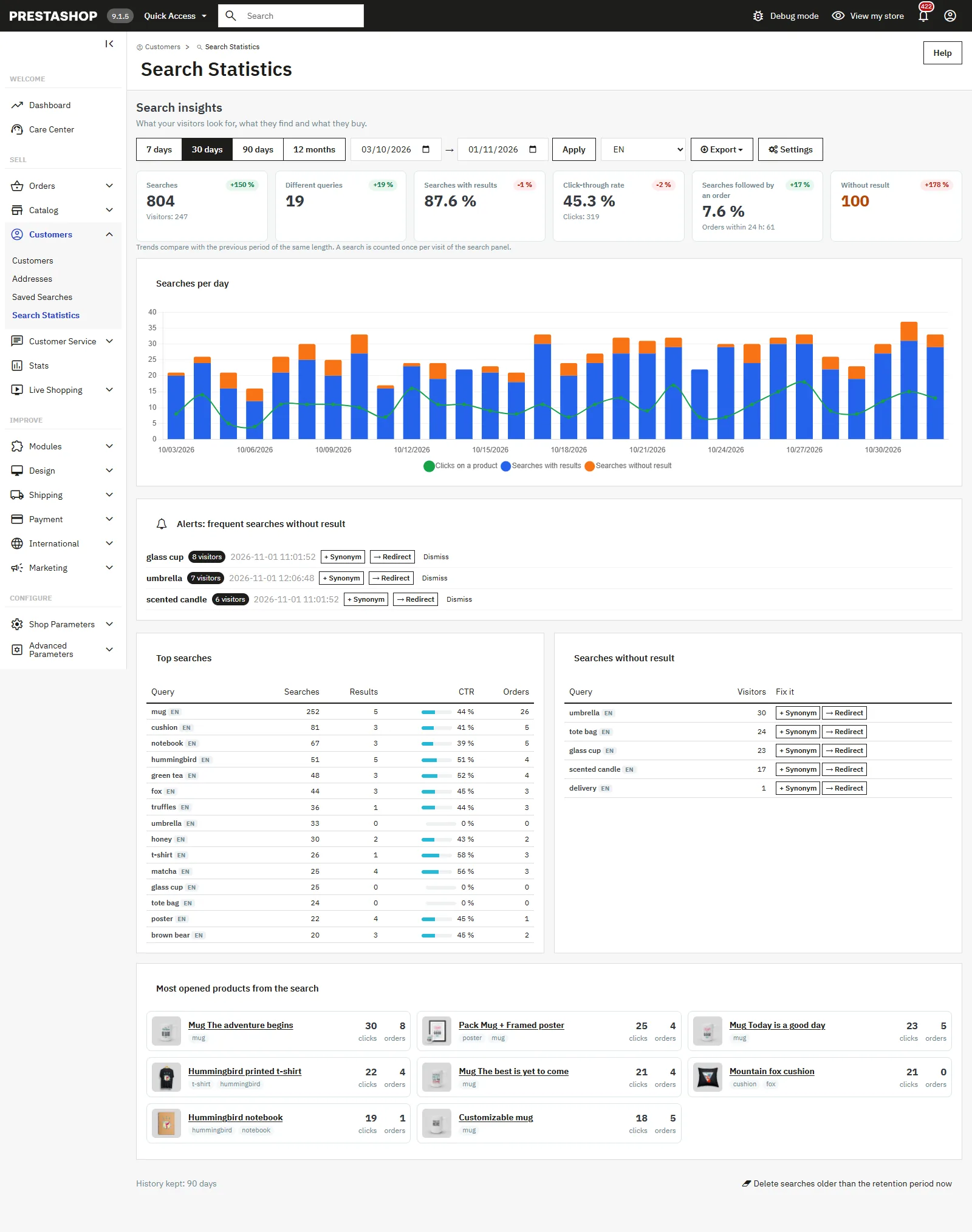
Search dashboard and alerts
The Catalog > Search insights menu (or Customers on a shop updated from 1.x) shows, for the chosen period and language:
- searches, different queries, share of searches with results, click-through rate, searches followed by an order within 24 hours, searches without result, with the trend against the previous period;
- a chart of searches per day;
- top searches with their click-through rate and orders;
- searches without result, with the + Synonym and → Redirect buttons;
- the products most opened from the search;
- CSV exports (top, without result, all searches).
An alert is created when the same query without result is searched by a number of different visitors you set (5 by default) within 7 days. It can be sent by e-mail (8 languages) to the address of your choice.
Privacy and security
- Visitor IP addresses are never stored: only a salted hash is used to count different visitors. Recent searches stay in the visitor’s browser.
- The recorded number of results is signed by the server: statistics cannot be forged from the browser.
- The search endpoint is limited to 120 searches per minute and per visitor.
- Any text typed by a visitor is escaped when displayed, in the panel, the back office and alert e-mails.
- The history is kept 90 days by default (adjustable), then deleted automatically.
Uninstallation
By default, uninstalling removes the module’s tables, settings, tab, hooks and cache. Enable Keep data when uninstalling (Statistics & alerts tab) to keep statistics, synonyms, redirects and settings for a later reinstallation.
FAQ and troubleshooting
Two search bars appear in the header
Choose Theme bar (the theme field opens the panel) or Module bar (the default PrestaShop bar is hidden) in the General tab.
A product is not found
Check that it is active, visible “everywhere” or “search only”, and that one of its categories is open to the visitor’s group. After a direct database import, rebuild the index (Index & performance tab).
The filtered price differs from the displayed price
The price filter and price sort use the indexed public price. Prices specific to a group or a customer are displayed correctly on the cards. If you use dated price rules, schedule a nightly index rebuild.
Popular searches stay empty
A query only appears after finding products for the minimum number of different visitors within 30 days. Lower this minimum or enter your own list (Empty panel tab).
The new design does not show after the update
Clear the PrestaShop cache. If your theme combines CSS and JS files (CCC), this regenerates the combined files.
The search shows “Too many searches in a short time”
The limit of 120 searches per minute protects your server from bots. A normal visitor never reaches it; check that no test tool or bot queries the endpoint in a loop.
How do I open the search from a button of my theme?
Add the data-dflivesearch-trigger attribute (or the dflivesearch-trigger class) to the button, or call window.dflivesearchOpen('query') in JavaScript. The Warehouse theme search icons are handled automatically.
Does the semantic search send my data to an external service?
Only if you enable it: product texts and visitors’ queries go to the provider you choose, never personal data. With your own server (Ollama), nothing leaves your infrastructure. Self-learning and merchandising use no external service.
How do I put a product first for a query?
In the Merchandising tab, add a rule with the query, pin the product and save. Check the result with the ranking preview.