
If you still compare your store’s GA4 numbers with the back-office orders, you know what comes next: between 20 and 35% of conversions are “missing”. They happened, they are in the PrestaShop back-office, but GA4 did not attribute them. Combined effect of iOS 17 (Mail Privacy Protection, Link Tracking Protection), Consent Mode v2, generalised third-party cookie blocking, and anti-tracking extensions installed by default for half the audience.
Server-side tracking is the standardised technical answer to this measurement gap. Correctly implemented, it typically restores 70 to 90% of lost conversions, hardens multi-touch attributions, and strengthens GDPR compliance. This article maps the 2026 architecture, the real cost of GTM Server-Side, and the implementation on PrestaShop.
Why client-side measurement is broken in 2026
Four convergent forces have degraded classic client-side GA4 measurement since 2023:
- iOS 17 Mail Privacy Protection and Link Tracking Protection (2023-2024): neutralise UTM parameters in Apple Mail and Messages, break email-to-conversion attribution for the iPhone ecosystem.
- Safari Intelligent Tracking Prevention: caps first-party cookie lifetime at 7 days. A Safari visitor returning after 8 days is a new visitor for GA4.
- Firefox Total Cookie Protection and uBlock Origin on Chrome: extensions and browsers that block requests to google-analytics.com and collect.googletagmanager.com.
- Consent Mode v2 mandatory in the EU since March 2024 (and de facto adopted in the UK for cross-border merchants): if the user refuses analytics cookies, GA4 receives only statistically modelled consentless pings. Useful, but noisy.
Result: according to multi-store audits in 2025-2026, the gap between back-office orders and GA4 orders is now:
- 10 to 20% on audiences mostly on Android Chrome.
- 25 to 40% on audiences mostly on iOS Safari.
- 30 to 50% on baskets sourced from Meta Ads and TikTok Ads campaigns (double effect: pixels blocked and UTMs neutralised).
What server-side tracking is — conceptual model
Classic client-side tracking works as follows: the visitor’s browser loads the GA4 or GTM snippet, sends a hit directly to google-analytics.com, and that hit is blocked by ITP, uBlock, etc. When the hit lands, it carries a fragile identifier (the _ga cookie with limited lifetime).
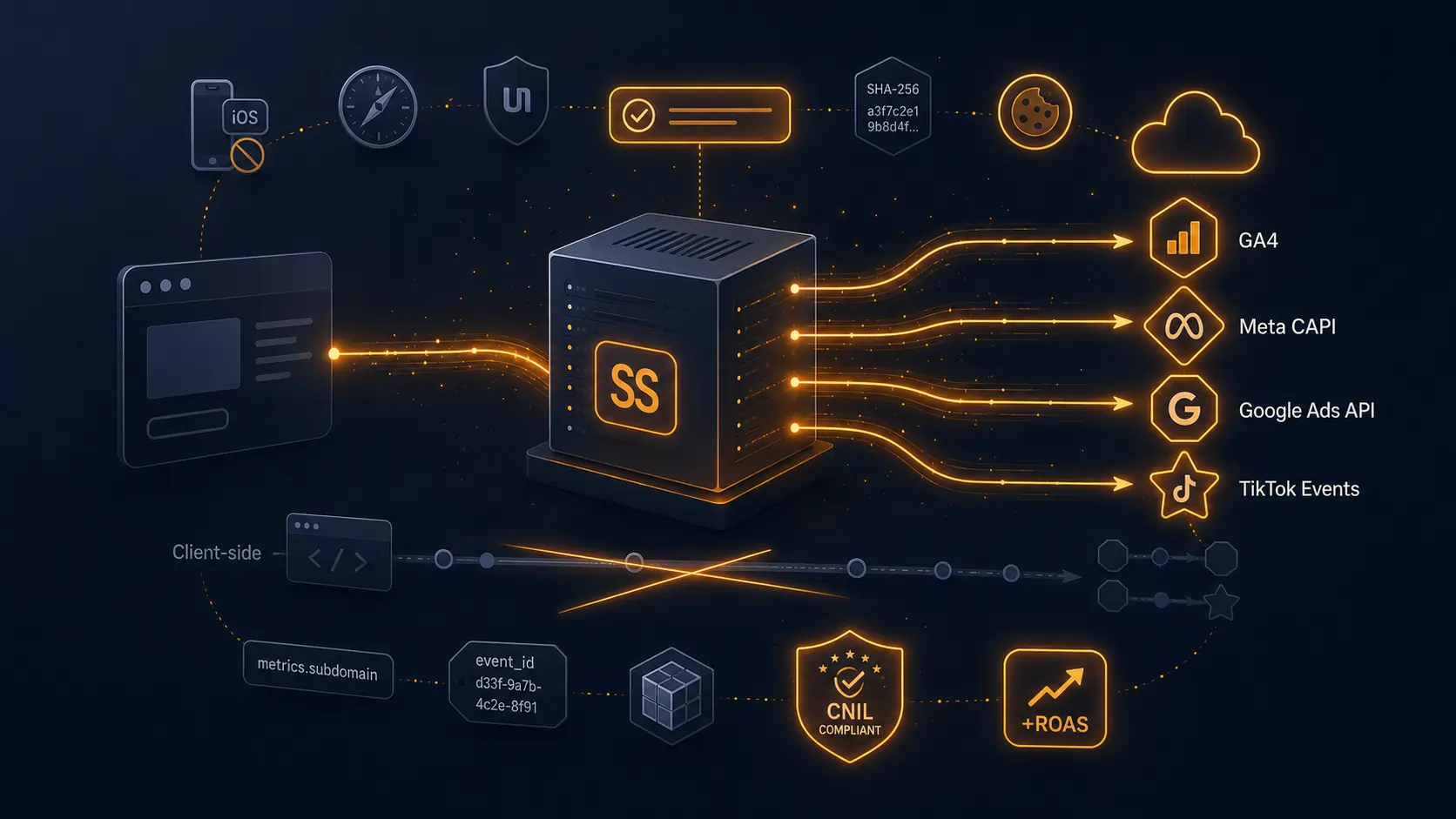
Server-side tracking flips the equation: the browser sends a hit to a merchant subdomain (for example metrics.shop.co.uk) that hosts a GTM Server-Side container. That container, on a merchant-controlled server, transforms and enriches the event, then forwards it server-to-server to GA4, Meta CAPI, Google Ads Conversion API, TikTok Events API. Advantages:
- The event is no longer blocked by anti-tracking extensions (the request goes to the merchant’s domain, not Google).
- First-party cookies persist longer (server-side, with a controlled lifetime).
- Data is enriched server-side (order number, margin, product category, stored acquisition source) before transmission.
- User consent is applied before transmission, simplifying Consent Mode v2 compliance.
- The same event can be routed to multiple destinations (GA4 + Meta + Google Ads + TikTok) without loading as many pixels client-side.
Typical architecture for a PrestaShop store in 2026
The stack that has standardised in 2026:
- Store side: standard GTM Web container, with enriched dataLayer on each critical event (view_item, add_to_cart, begin_checkout, add_payment_info, purchase). PrestaShop pushes these events via a tag manager module.
- Tracking subdomain (metrics.shop.co.uk or analytics.shop.co.uk): pointing to a dedicated server hosting the GTM Server-Side container. On App Engine (Google Cloud), AWS, Hetzner, or a dedicated server.
- GTM Server-Side container: receives the hits, enriches with server data (real order, margin, customer loyalty), routes to GA4 Measurement Protocol, Meta CAPI, Google Ads Conversion API, TikTok Events API, and possibly to an internal data warehouse (BigQuery, ClickHouse).
- First-party cookies managed server-side: controlled lifetime, client identifier reconciled server-side with the PrestaShop ID when the visitor authenticates.
Real cost of GTM Server-Side in 2026
Three cost lines to anticipate:
Hosting
- Google Cloud App Engine (default Google option): around £80 to £160 per month for average e-commerce SME traffic (100-200K visitors/month). Auto-scaling. More expensive at high volume, but zero maintenance.
- Hetzner VPS or AWS Lightsail with Docker and the official GTM SS image: £12 to £32 per month for equivalent volume. More maintenance, but 5x to 10x cheaper.
- AWS, Azure: comparable to GCP, with slightly higher bandwidth costs.
Initial implementation
For a standard PrestaShop store, count 8 to 20 days of work for:
- Audit of the current tag and event mapping.
- Setup of the tracking subdomain and SS container deployment.
- Migration of the GA4 client tag to server, event validation.
- Setup of additional destinations (Meta CAPI, Google Ads Conversion API).
- Side-by-side A/B tests to validate data consistency.
- Documentation and marketing team training.
Ongoing maintenance
1 to 2 days per quarter to follow GTM SS evolution, update tag templates, manage new destinations. Low but non-zero.
Implementation on PrestaShop 8 and 9
Store-side, the work consists of cleanly pushing standard GA4 events into the dataLayer. PrestaShop has no official module for this, but several third-party solutions cover the need.
At DataFirefly, the dfgtagmanager module (v1.1.0+) handles the full GA4 dataLayer for PrestaShop 8: view_item, add_to_cart, remove_from_cart, view_cart, begin_checkout, add_shipping_info, add_payment_info, purchase, plus consent_update events (Consent Mode v2) and user_data with SHA-256 hash for Enhanced Conversions. Output directly compatible with a GTM Web container that forwards to a GTM Server-Side container.
Traps to anticipate
1. The tracking subdomain must be consistent
metrics.shop.co.uk must be a subdomain of the main domain, otherwise first-party cookies won’t work properly and the SS benefit collapses. Don’t use a separate domain (such as shop-metrics.com).
2. Consent Mode v2 compliance must be applied server-side
Receiving the event server-side does not waive consent. If the user refused marketing cookies, the GTM SS container must drop the hit before forwarding it to Meta CAPI or Google Ads. Classic beginner mistake that creates a worse compliance violation than client-side tracking did.
3. Added latency must stay under control
A slow GTM SS container (hosted far away, undersized) adds latency to hits. On asynchronous events (purchase), it’s invisible. On critical-path events (rare in e-commerce), it must be monitored.
4. Conversion deduplication is essential
If the same purchase event is sent twice (once client-side, once server-side), GA4 or Meta CAPI will count it twice. Either track only server-side, or send a unique event_id shared across both sides to enable Google and Meta to deduplicate.
5. Multi-destination routing must be designed
Not every event goes to every destination. add_to_cart goes to GA4 and Meta CAPI. purchase goes to GA4, Meta CAPI, Google Ads, TikTok, and ideally to an internal data warehouse. The mapping must be documented.
Typical ROI from migration
On projects completed in the last 12 months, observed gains break down as follows:
- Recovery of measurement: 70 to 90% of “lost” conversions from client-side tracking are recovered server-side. For a store at £70K/month revenue, that means £10K to £21K/month of “visible” revenue back in GA4. No change to real revenue, but a faithful view that changes marketing arbitrations.
- Meta Ads campaign performance: +15 to +35% ROAS observed after Meta CAPI server-side deployment, by improvement of Meta’s algorithm (which learns better from more complete conversions).
- Google Ads campaign performance: +10 to +25% ROAS with Enhanced Conversions and Google Ads Conversion API server-side. Similar effect to Meta.
- Strengthened GDPR compliance: consent applied before transmission, flow audit possible, clear traceability. A strong argument in case of ICO inquiry.
On a mid-market PrestaShop store, the total deployment cost (implementation + annual hosting) is typically amortised in 2 to 6 months by the ROAS gain on paid campaigns alone — without even counting the improved quality of marketing decision-making.
Conclusion: measurement is no longer optional in 2026
Investing in content, UX, SEO and AEO without being able to measure conversion properly is flying blind. In 2026, classic client-side GA4 tracking has become insufficient for a serious store — not through technical laziness, but because the browser ecosystem has fundamentally changed.
Server-side tracking is not a fad. It is the reference architecture to which every store above a certain revenue and acquisition complexity threshold is migrating. It is also, in 2026, a necessary foundation for relevant marketing arbitrations and for lasting GDPR compliance.
If you have not migrated yet, now is the moment — before the next iOS, Chrome, or ICO/EDPB ruling tightens the screws and makes client-side tracking even more partial than it is today.



1 comment