
A return is a moment of truth. The customer has already been disappointed by the product, and the way you handle their request decides whether they order from you again or leave for good. Yet in PrestaShop, returns rest on a minimal form on the customer side and manual handling on the merchant side.
What the native system does
PrestaShop offers a merchandise return function, enabled in the order settings. From their history, the customer can select the items to return and type an explanation.
Three limits appear immediately.
The return is only possible on orders whose status allows it, and the window is set globally, with no distinction by product category. No structured reason is offered: the customer writes whatever they want in a free field, which makes any analysis impossible. And customer-side tracking stops at submission: they have no idea where their case stands.
The five elements of a usable portal
1. Access without an account. Some of your customers ordered as guests. A personal link sent in the confirmation email, or identification by order number and email, spares them an account creation at the worst possible moment.
2. Structured reasons. A closed list, with a free field alongside. Six to eight reasons are enough: does not match the description, wrong size, faulty product, picking error, damaged in transit, changed my mind, received twice.
That list is not just administrative. It is your main source of information on the flaws in your product pages, and it costs nothing to collect.
3. A visible status. Request received, accepted, parcel received, checked, refunded. Every change triggers a notification. That is what removes most of the load on customer service.
4. The return label. Generated from the portal, it saves the customer from working out how to send it back. Whether the cost falls on them or on you, a label ready to print removes a major friction.
5. The choice of outcome. Refund, exchange, or credit note. Offering exchange and credit before refund preserves revenue, provided you do not hide the refund option, which remains a right.
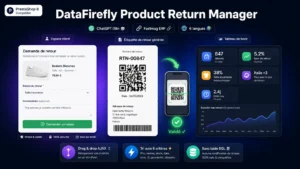 DataFirefly Product Return Manager — Product returns with QR scan, analytics and ChatGPT translation for PrestaShop 8Complete PrestaShop 8 product return management: QR scan, PDF label, 13-axis analytics, ChatGPT translation, Fastmag hook, admin manual return, guest return. Original price was: €129.00.€89.00Current price is: €89.00.
The withdrawal right framework
Your portal has to respect the legal floor, whatever your commercial terms.
The customer has fourteen days from receipt to withdraw, without giving a reason. They then have fourteen days to send the product back. The refund has to be made within fourteen days of the withdrawal, and it includes the standard delivery costs originally paid.
You can defer the refund until the product is received or until proof of dispatch is provided, whichever comes first.
Two points often misapplied. Return shipping costs stay with the customer if you informed them before the purchase, but the outbound delivery costs have to be refunded, at the standard option rate. And a reason cannot be required: your list of reasons has to remain optional on withdrawals.
What is not mandatory, and what sells
The distinction is worth drawing. Beyond the fourteen legal days, everything you grant is commercial: thirty-day returns, free returns, free exchange.
Those elements have a measurable value at purchase. Free returns announced on the product page raise conversion, particularly in categories where uncertainty is high. They also raise the return rate, and the equation has to be worked out category by category.
The marker: on products with high uncertainty about size or appearance, the conversion gain generally exceeds the cost of the additional returns. On technical products bought by reference, it does not.
The time saved
This is the main internal argument, and it can be quantified. A return request handled by email means three to five exchanges on average: the request, your reply with the procedure, the customer’s question about the address, the chase about the refund.
A self-service portal brings that to zero exchanges in most cases, and concentrates human time on the genuinely contentious cases.
On a shop handling fifty returns a month, the saving is counted in working days per quarter.
Using the data
Three analyses, once structured reasons have been collected for a few months.
The return rate per product, which identifies the pages to fix. A product whose dominant reason is “does not match the description” has a content problem, not a quality one.
The return rate per reason, which directs your actions: a spike on “damaged in transit” is about packaging, not the product.
The average handling time, from request to refund, which is the best indicator of the perceived quality of your after-sales service.
The Product Return Manager module for PrestaShop sets up this portal on PrestaShop 8 and 9: self-service request with structured reasons, status tracking notified to the customer, label generation and return analysis by product and by reason.