
On many stores, brand pages exist, are reachable from a menu, and receive no search traffic at all. Yet they are one of the few remaining deposits of high-intent queries: someone who types a brand name followed by a generic word already knows what they want.
The reason for this failure is structural, and it can be fixed.
Why the native brand page does not rank
Four causes stack up, each sufficient on its own.
No content. The native page shows a logo, an often empty description, and a product grid. Against competing pages that present the brand, its history and its range, it has nothing to offer.
A generic title. The page title is frequently reduced to the brand name alone, with no complement. Yet nobody types just a brand name in order to buy: real queries take the form of name plus category, or name plus qualifier.
No inbound linking. Product pages mention the brand without linking to its page. The page exists but nothing points to it, which pushes it to the periphery of the site.
Excessive depth. On many themes, the brand list is relegated to the footer, three or four clicks from the home page.
The minimum content of a page that ranks
Count on 400 to 700 words, with clear structure. Below that, the page remains a product grid with an introductory paragraph, which is not enough.
Four blocks form a solid base.
- The brand’s positioning. What it makes, since when, what sets it apart. Three or four factual sentences, not a pasted press release.
- The product ranges. A presentation of the product families, each linking to the corresponding category filtered on the brand. This block creates the downward linking.
- A buying guide. The block that adds the most. Which model for which use, how to read the references, what the suffixes mean. This is what a visitor typing a brand name is actually looking for.
- A short FAQ. Warranty, spare parts availability, compatibility, after-sales service. Three to five questions are enough.
An important point: this content must be unique. Copying the presentation supplied by the manufacturer puts your page in competition with dozens of resellers who did the same thing, and with the brand’s official site.
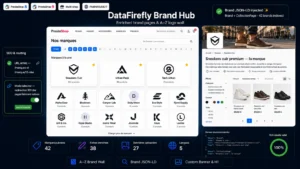 Brand Pages SEO — A–Z Brand WallYour brands deserve better than a manufacturer list€79.00
Title and URL
The title must contain the brand plus a qualifier matching the real query. “Brand X” alone is too short; “Brand X: full tool range, prices and availability” targets what people actually type.
For the URL: a short, stable structure, avoiding parameters. A brand page only reachable through a filter applied to a category is not a brand page, it is a filtered view, and it will not rank.
Linking, in both directions
This is the most profitable lever and the simplest to put in place.
From product pages. Every product page that mentions a brand should link to its page. On a catalog of three thousand products spread across forty brands, that averages seventy-five inbound links per brand page, obtained with no editorial effort.
From a brand directory. A page listing all brands in alphabetical order, reachable from the main menu, cuts the depth to two clicks. It also catches internal searches for brand names along the way.
From categories. A “brands present in this category” block creates cross-linking useful to the visitor and to the crawler alike.
The case of brands with a small catalog
A brand page with two products is a problem: little content, little value for the visitor, and a risk of the page being judged low quality.
Three possible treatments depending on the case. If the brand has real search potential, develop the content even with few products: the buying guide and the FAQ do not require a large catalog. If the brand has no recognition at all, exclude the page from indexing rather than leaving it in limbo. And if you have thirty brands with one or two products each, group them into a shared thematic page rather than creating thirty weak pages.
The cannibalisation risk
A point to watch when a brand nearly overlaps a category. If you have a “Drills” category and a “Brand X” page whose catalog is 90% drills, both pages target similar queries and compete with each other.
The tie-break rule: the category targets the generic query, the brand page targets the query containing the name. Their titles, opening paragraphs and buying guides must reflect that difference. If you notice Google alternating between the two pages on the same query, one of them needs to be repositioned.
Measuring
Track three things in Search Console, filtered on brand page URLs. The number of distinct queries generating impressions, which shows whether the page is understood as a brand page or as a mere list. The average position on queries containing the brand name. And the click-through rate, which reveals whether your title matches what people are looking for.
The SEO Brand Pages and A to Z Brand Wall module handles this structure on PrestaShop 8 and 9: enriched brand pages with structured content and dedicated metadata, an A to Z directory with instant search, and automatic linking from product pages to their brand’s page.