
A monthly box is neither a product nor a subscription in the usual sense: it is a product that changes every month, sold in waves, with a cut-off date after which it is too late to join the current shipment.
That wave mechanic is what sets a box apart from a classic subscription, and it is where the configuration difficulties lie.
The box product, and what it stands for
First decision: what exactly are you selling?
The box of the month is not a stable product whose contents are known. The customer buys a promise: a theme, a price range, a number of items. The actual contents are revealed on receipt, and that is often the main selling point.
Consequence for the data model: the product sold is the subscription to the box, not the September box. That one is a preparation wave, invisible to the customer at the moment of purchase.
Three attributes are enough to describe the product sold: the formula, the frequency, and the commitment period if there is one.
Waves, and the cut-off date
This is the heart of the model and the source of most mistakes.
All the boxes of a given month leave together. That imposes a cut-off date: beyond it, a new signup no longer joins the current wave but the next one.
That date is calculated backwards from dispatch. Count the assembly time, the quality control and the handover to the carrier. On a medium-sized box, the cut-off sits one to two weeks before dispatch.
Two points to handle explicitly.
Displaying the cut-off. The customer must know before buying which box they will receive. A countdown along the lines of “sign up before the 18th to receive the September box” removes the ambiguity and creates a legitimate urgency.
Behaviour after the cut-off. A customer who signs up on the 19th receives the October box. Should they pay immediately or on the date of the next wave? Charging at signup with deferred dispatch is simpler to manage, and it must be announced unambiguously.
 Recurring & Scheduled Orders — Automatic Reordering for PrestaShop 8 & 9Recurring and scheduled orders: the customer picks a frequency and receives a ready-to-pay cart link before every due date.€109.00
Stock per wave
A major difference from a classic product: your stock is not a number of boxes, it is a number of places available on the current wave.
That number is set by your purchasing. If you ordered 400 units of the month’s flagship item, you cannot serve 450 boxes.
Three management rules.
The place counter must decrease at signup and reset at each new wave, with its own capacity.
Renewals take priority over new signups. An existing subscriber must be served before a place is sold to a newcomer. That means reserving the capacity matching your active subscribers before opening the rest to sale.
A waiting list when the wave is full. Rather than showing an unavailable product, offer signup for the next wave. That is what boxes building scarcity do, and it avoids losing a request.
The contents of the wave
An organisational point with technical consequences.
You must know, for each wave, which products make it up. Two reasons: warehouse preparation, and traceability in the event of a recall or a complaint.
That implies an entity distinct from the product sold: the wave, with its dispatch date, its capacity, and the list of its components with quantities.
Two secondary uses justify that effort on their own. Communication after dispatch: revealing the contents by email at the time of delivery is a high point of the relationship. And the customer history: a subscriber must be able to look up what they received in previous months, which also helps avoid duplicates.
Formula variants
Most boxes offer several formulas, and they combine badly if they are not designed together.
Three axes of variation, to be kept in check.
Size: discovery box, full box. It multiplies the waves to prepare.
Frequency: monthly, every two months. Careful: a two-monthly box does not align naturally with monthly waves and requires defining which waves it falls on.
Commitment period: no commitment, three months, a year. It is the most profitable axis, with a sliding scale of prices, and the least costly to manage.
One piece of advice for starting out: begin with a single size and three commitment periods. You will add sizes when your volume justifies it.
What breaks in production
Four situations to plan for before meeting them.
An address change mid-wave. A subscriber who moves between the charge and the dispatch must be able to change their address. Set a deadline, aligned with the start of preparation.
Cancellation after the charge. The customer paid for the current wave, they receive it, and the subscription stops afterwards. Any other rule produces disputes.
A failed payment mid-wave. If the charge fails three days before the cut-off, should the subscriber be served? The prudent rule: a place reserved during the retry period, released if the payment does not go through before the cut-off.
The gift subscription. Someone gives three months to another person. It is a frequent case around the holidays, and it means separating the payer from the recipient, which is not native.
The metrics of a box
Three measures specific to this model, beyond the classic subscription indicators.
The fill rate per wave, places sold against capacity. It drives your purchasing for the following month.
The cancellation rate after the first box. This is the most revealing figure: a subscriber who leaves after receiving a single box signals a gap between the promise and the contents.
The content cost per box, compared with the selling price and your target margin. On this model, the temptation to overload the box to impress is strong, and it is paid for after three months.
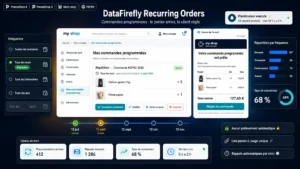
The Recurring Orders module for PrestaShop handles this mechanic on PrestaShop 8 and 9: orders generated automatically on the due date, wave management with cut-off date and capacity, priority of renewals over new places, and address changes by the customer up until preparation.