
Our best WooCommerce plugins to manage your prices and margins
Four plugins to reprice, automate and measure: pricing becomes a process, not a forgotten setting.
Most WooCommerce prices date back to product creation. Costs have moved since. Managing prices means repricing in bulk, replacing exceptions with rules and measuring real margin per order.
Sound familiar?
Prices frozen since product creation
Purchase costs, shipping and energy have moved. Prices have not. The gap comes out of your margin.
Manual repricing
Product by product, in the admin. Across 500 SKUs nobody has the time, so nobody does it.
Blind discounts
The same promo for the loyal customer and the coupon hunter. One of them did not need it.
Revenue without margin
WooCommerce shows revenue, never profit. You can sell more and earn less without seeing it.
Our selection, ranked
Every module below is built, maintained and supported by our team. The ranking reflects what we would install first on a client store.
-
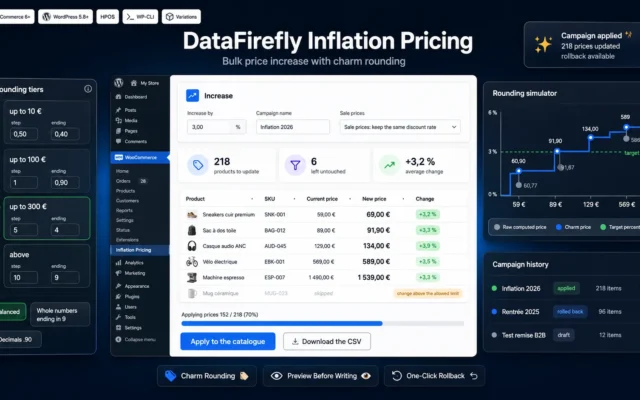
Increase or decrease across the whole catalog in one pass, with psychological rounding and a preview before applying.
Raise every WooCommerce price by a percentage to cover inflation while keeping readable prices such as 59, 89 or 569. Full preview before anything…
€59.00 View the module -
Dynamic Pricing for WooCommerce — Price Rules
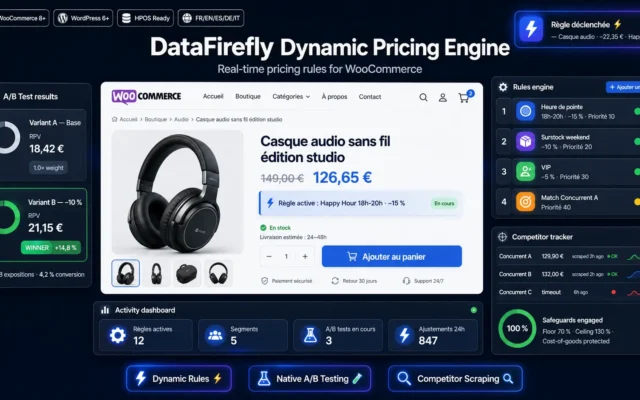
Pricing rulesSegments, quantities, time windows: prices adjust by rule instead of being edited page by page.
Dynamic pricing engine for WooCommerce: adjust your prices in real time based on hour, stock, customer segment, or competitor price. Built-in safeguards, full log,…
€69.00 View the module -
Real Profit & Margin Dashboard for WooCommerce
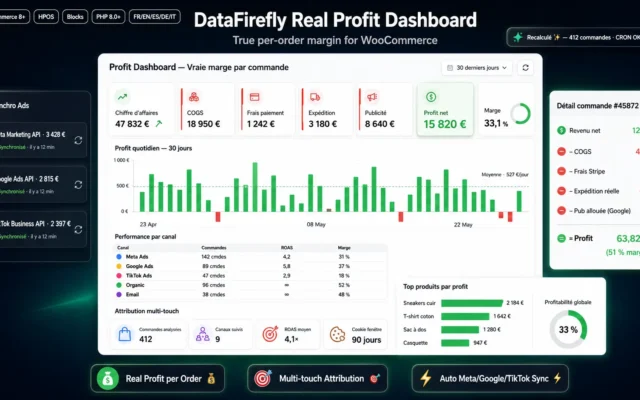
Margin, not revenueNet profit per order, all costs deducted. The only number that tells whether the pricing strategy works.
The only WooCommerce dashboard that computes your real profit order by order: product COGS, Stripe/PayPal/Mollie fees read natively, real shipping, and ad spend from…
€89.00 View the module -
Predictive LTV & Churn — Predicted LTV and Automatic Customer Segmentation for WooCommerce
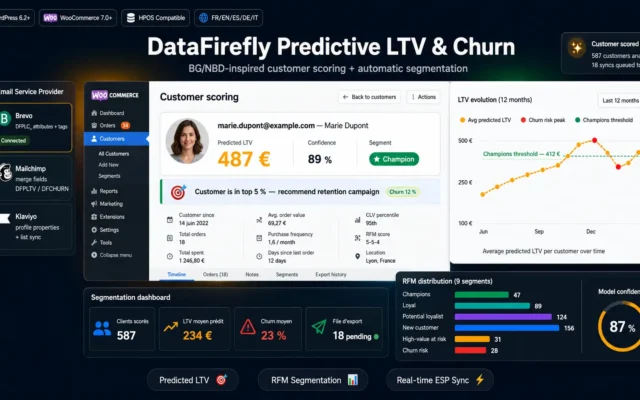
The right customer for the right effortPredictive LTV and churn risk: the discount targets the customer whose behavior can still change.
Score the predicted LTV of every customer from their very first order, automatically segment your base into 9 business segments (Champions, Churn risk, High-value…
€59.00 View the module
Side-by-side comparison
| Module | Best for | Price | Rating | Link |
|---|---|---|---|---|
| Bulk Price Increase for WooCommerce (Inflation & Charm Pricing) | Bulk repricing | €59.00 | — | |
| Dynamic Pricing for WooCommerce — Price Rules | Pricing rules | €69.00 | — | |
| Real Profit & Margin Dashboard for WooCommerce | Margin, not revenue | €89.00 | — | |
| Predictive LTV & Churn — Predicted LTV and Automatic Customer Segmentation for WooCommerce | The right customer for the right effort | €59.00 | — |
A price is not a setting, it is a process
Most WooCommerce prices date back to the day the product was created. Since then, purchase costs, shipping and energy have moved. The gap between those two dates comes straight out of your margin, and nobody sees it.
Reprice without hurting conversion
A 2 to 4 % increase with psychological rounding stays below the attention threshold of most buyers. What gets noticed is a broken price like 21.47. Bulk repricing handles the whole catalog in one pass, with a preview before anything is applied. Pricing rules then take over: segments, quantities, time windows.
And measure margin, not revenue
WooCommerce shows revenue, never profit. You can sell more and earn less without noticing. The number that drives a pricing strategy is net margin per order, all costs deducted.
How to choose
Measure before you move
Without real margin per order, repricing is guesswork. Install the profit dashboard first: it shows which products make money and which lose it once every cost is deducted. It is the map before the journey.
Reprice in one pass, not in one year
Bulk repricing brings the catalog back in line with current costs: one percentage, psychological rounding, a preview, one application. Twelve months of manual edits fit into an afternoon.
Then replace exceptions with rules
A hand-edited price is debt: you will have to come back to it. A rule per segment, quantity or period works continuously and adapts when the context changes.
And reserve discounts for those they can change
A discount given to a customer who was going to buy anyway is lost margin. LTV prediction and churn risk point to the customers whose behavior can still shift. That is where the effort pays.
What you gain
Repricing in one pass
All or part of the catalog, by percentage or amount, with a preview before anything is applied.
Rounding that protects conversion
19.90 instead of 19.73. A clean increase goes unnoticed, a broken price stands out.
Rules instead of exceptions
Prices by segment, quantity or period. The rule runs on its own, nobody edits product pages.
Real margin per order
Purchase cost, payment fees, shipping, advertising: net profit per order, not gross revenue.
Know who deserves an effort
LTV prediction separates the customer who will return from the one who is leaving. The discount goes where it changes something.
From install to results
-
Measure current margin
Per product and per order, all costs deducted. You cannot manage what you cannot see.
-
Reprice in bulk
One pass, psychological rounding, a preview. Not twelve months of edits.
-
Automate with rules
Segments, quantities, periods. The rule works, not you.
-
Target the discounts
LTV prediction says who the effort benefits. Everyone else pays the listed price.
“We had not touched our prices in two years, our suppliers had. Bulk repricing with rounding recovered 4 points of margin, and nobody noticed anything on the conversion side.”
Frequently asked questions
Does a price increase drive customers away?
Far less than expected when it is clean. A 2 to 4 % increase with psychological rounding stays below the attention threshold of most buyers. What stands out is a broken price like 21.47, not a 19.90 that becomes 20.90.
Where should I start?
With measurement. Without real margin per order, every pricing decision is a hypothesis. The profit dashboard comes first, bulk repricing second, rules last.
What is the difference between bulk repricing and pricing rules?
The first is an event: the catalog is brought back in line with current costs, in one pass. The second is a permanent regime: segments, quantities, time windows. One corrects the past, the other manages what comes next.
Should I stop running promotions?
No, you should stop running untargeted promotions. A discount to a customer who was going to buy is margin given away. LTV prediction points to those whose behavior can still change: that is who the discount is for.
Does the profit dashboard replace my accounting?
No. It answers a different question: how much does this order earn, costs deducted, today. Accounting validates after the fact, the dashboard manages day to day.
Not sure which one fits your store?
Tell us your context — we answer with a straight recommendation, not a sales pitch.