

Collecting reviews is an organisational problem. Collecting reviews whose authenticity holds up under an inspection is a legal problem. The two are handled separately, and the second is the one that really exposes a store.
The French consumer protection authority has run several inspection campaigns on online reviews, with high anomaly rates. The failures found are not exotic: they are practices many merchants consider normal.
What counts as a fake review under the law
The definition is broader than “an invented review”. Consumer law targets misleading commercial practices, and both case law and inspections recognise four distinct forms.
- The fabricated review. Written by the merchant, by a relative, or bought from a provider. The most obvious form and the most heavily sanctioned.
- Filtering out negative reviews. Publishing the favourable ones and setting the others aside. This is a fake review by omission: the displayed rating does not reflect actual feedback.
- Undeclared consideration. Offering a voucher in exchange for a review is not forbidden, but failing to state it publicly is.
- The unverified claim. Writing “verified reviews” or “reviews from customers who purchased” without a verification mechanism. The claim itself becomes misleading.
Sanctions fall under misleading commercial practices: an administrative fine, and in serious cases a penalty of up to two years’ imprisonment and 300,000 euros, an amount that can be raised to a percentage of turnover.
The European Digital Services Act has also strengthened transparency obligations on content moderation, which includes reviews.
The three mandatory pieces of information
The point most often missing, and the simplest to fix. Any store publishing reviews must state three things, accessible from the pages that display them.
- Whether reviews are checked, and if so, how. A store that verifies nothing has to write that, which is perfectly lawful.
- The publication date of each review, and the date of the experience if it differs.
- The ranking criteria for reviews. If you display the highest-rated first, say so.
A dedicated fifteen-line page settles these three obligations. Its absence is the most frequently recorded failure, and the easiest to observe.
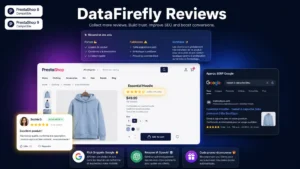 DataFirefly Verified Reviews — PrestaShop 8 and 9 customer reviews with rich snippets and AI summaryVerified reviews, photos, rich snippets, AI summary and reward discount — no subscription.€89.00
The NF Z74-501 standard, and what it brings
This French standard, which has an international version under the reference ISO 20488, governs the handling of consumer reviews. It is voluntary: not following it is not an offence.
It imposes a method in three parts. Collection must be traceable, with identification of the author and proof of the consumption experience. Moderation must rest on objective criteria, written down and applied uniformly, with a record kept of rejections. And publication must include every retained review, without selection on the rating, in an announced order.
Its real value is not the label but the discipline it imposes. A store applying these three principles is almost automatically compliant with the law, because the legal obligations are a subset of them.
Defensible moderation
You have the right to reject reviews. You must be able to explain why.
Write your criteria before you start, and stick to them. A usable list fits in five points: insulting or discriminatory content, off-topic content or content about a different product, third-party personal data, manifestly false or verifiably wrong content, suspicion of unfair competition.
Anything not on that list does not justify a rejection. In particular, neither a low rating, nor criticism of the delivery time, nor poorly worded dissatisfaction.
For every rejection, keep the date, the reason and the identity of the moderator. Without that record, your moderation is indefensible, however honest it may have been.
The link with the order, the best proof
Technically, the most solid arrangement is to allow a review to be submitted only from a single-use personal link, sent after delivery, and attached to the order line concerned.
Three consequences. The “verified review” claim becomes accurate and demonstrable. Reviews concern products actually received, which improves their content. And volume drops compared with an open form, which is the price of credibility.
Keep the link between the review and the order, without displaying it publicly. It is that link that answers an inspection, not the label shown on the page.
Reviews solicited in exchange for a benefit
If you offer a voucher, loyalty points or entry into a draw, three rules apply.
The benefit must be announced publicly, on the page that presents the reviews. It cannot be conditional on a minimum rating or on favourable content. And it must be granted whatever the content of the review submitted, including a very negative one.
An acceptable wording: “Every published review earns you 2 euros off your next order, whatever the rating given.”
What Google expects on top
For star display in search results, two rules are added to the legal obligations. Reviews must concern the specific product and not the store. And they must be visible on the page carrying the markup: marking up an aggregate rating no visitor can read exposes you to a manual action.
The Verified Reviews module for PrestaShop provides this framework on PrestaShop 8 and 9: submission via a personal link attached to the order, a moderation queue with reasons and traceability of rejections, publication without filtering on the rating, and structured data markup.