


Everything you'd want to know before you install.
A detailed look at how Google Search Console for PrestaShop — Position Tracking works, why we built it the way we did, and the thinking behind the features above.
§ 01
Why GSC Connect?
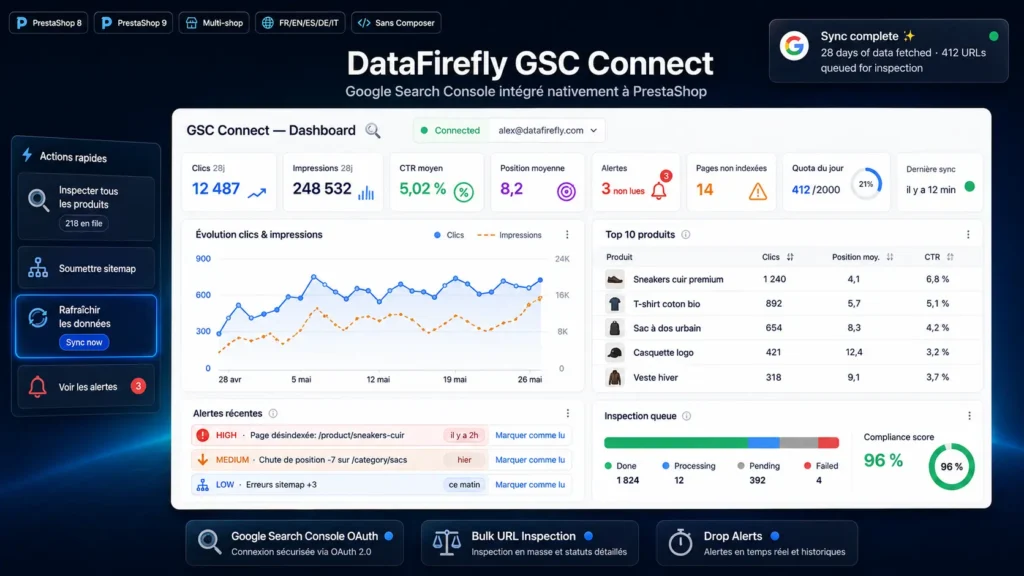
Google Search Console is the essential tool to track your PrestaShop store's SEO. But opening Google's interface, juggling tabs, exporting CSVs by hand, cross-referencing positions with your product references, monitoring drops one by one… is a daily time sink and a risk of missing something. GSC Connect brings all your Search Console data directly into the PrestaShop back office, cross-referenced with your product and category catalog, with automatic alerts when something goes wrong.
§ 02
One-click OAuth connection
Setup boils down to creating a Google Cloud project, copying your Client ID and Client Secret into the module configuration, and clicking Connect to Google. You confirm the permissions, the module receives the refresh token, encrypts and stores it locally. Access token refresh is automatic. No further manual intervention.
§ 03
Sitemaps: submission and tracking
The module automatically detects your candidate sitemaps: the root sitemap.xml, patterns generated by PrestaShop modules such as gsitemap. You submit them to Search Console in one click, the module then tracks for you the number of URLs submitted, indexed, the errors, and the last download date by Googlebot. If Google reports errors, you get an automatic alert.
§ 04
Bulk URL inspection
Google's Inspection API caps calls at 2000 per day. GSC Connect handles this quota for you via a queue. You enqueue all your active products or categories in one click, and the cron processes the queue over several days while respecting the limit. For each URL, the module records Google's verdict: indexed or not, coverage state, robots.txt, indexability, rich results detected, AMP, mobile-friendly. Any non-indexed page triggers a HIGH alert with the reason returned by Google.
§ 05
Clicks and position reports
The dashboard groups 8 KPIs: clicks and impressions over 28 days, average CTR, average position, number of unread alerts, number of non-indexed pages, today's quota consumption, last sync. A 28-day trend chart is rendered with Chart.js bundled locally (no CDN dependency). The detailed reports tabs give you the top of your products and categories by clicks, with average position and CTR, with a configurable lookback from 7 to 90 days, client-side sorting and CSV export.
§ 06
Drop and deindexation alerts
Three alert families are handled: position drops on already well-ranked pages, significant click drops in percentage, and deindexation. Thresholds are fully configurable. The comparison runs on a rolling 7-day window against the previous 7 days, with a 2-day offset to respect Search Console's data freshness latency. The 24h deduplication prevents receiving the same alert five times. Alerts can be sent by email as an HTML digest grouped by severity.
§ 07
Shared-hosting cron
The module exposes a token-protected cron endpoint, triggerable from your host's cron. Tasks are filterable: sync (fetches new Search Console data), inspect (processes the inspection queue), sitemaps (refreshes status), drops (computes drops), notify (sends emails), prune (purges old data). No Redis, BullMQ worker or dedicated PHP-FPM needed. Works on o2switch, OVH shared, and any standard Linux hosting.
§ 08
Clean architecture
PSR-4 code under the DataFirefly/GscConnect namespace, custom autoloader with no Composer, native cURL Google API calls with SSL verification, 8 dedicated tables prefixed dfgsc_, anti-listing index.php files in every directory, cookie-based CSRF state token on the OAuth flow, hash_equals validation on the cron token, systematic output escaping in templates.





There are no reviews yet.