
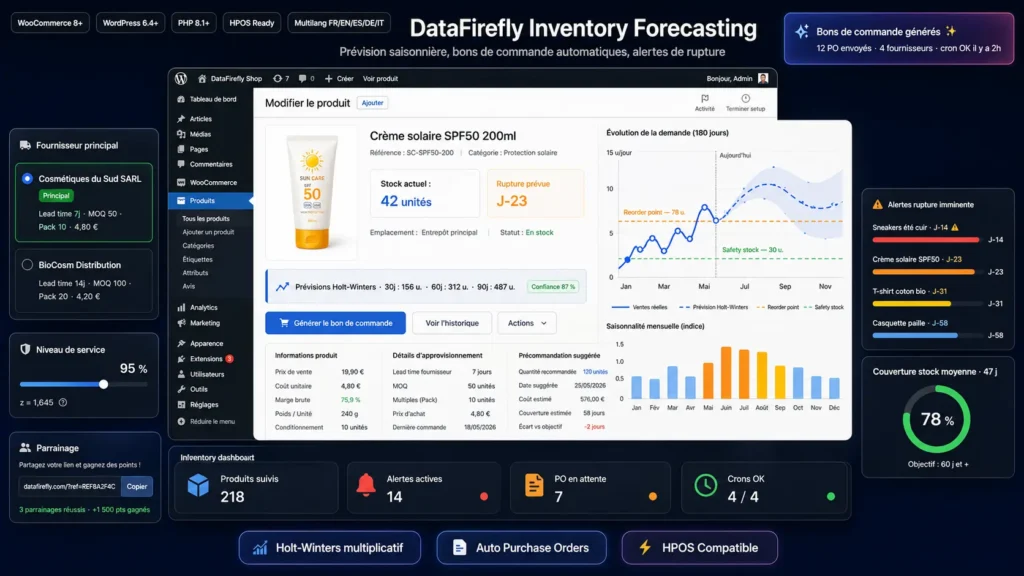
Everything you'd want to know before you install.
A detailed look at how Inventory Forecasting & Reordering for WooCommerce works, why we built it the way we did, and the thinking behind the features above.
§ 01
Why a self-hosted alternative to Veeqo, Cin7 or Lokad?
SaaS inventory management solutions typically charge per user, per SKU and per site. For a catalogue of a few hundred references, the monthly bill quickly exceeds one thousand euros, not counting onboarding fees and capped APIs. Inventory Forecasting installs on your own WordPress all the forecasting intelligence you need: seasonal statistics, safety stock, purchase order generation, stockout alerts. No subscription, no per-SKU fee, no data leak to a third party, no API call quota.
§ 02
Real statistical modelling, not a rolling average
Under the hood, the algorithm decomposes your sales into two components: the trend, estimated by linear regression on a seven-day moving average, and the seasonality, computed as a multiplicative monthly index bounded between 0.3 and 3.0 to avoid outlier values. This approach, derived from the multiplicative Holt-Winters model, yields stable forecasts even on catalogues with strong seasonal variability: Christmas cosmetics, back-to-school supplies, beach products, white goods on sale.
§ 03
Supplier purchase orders generated and sent in one click
Every product can be linked to multiple suppliers with their own purchase price, supplier SKU, lead time, minimum order quantity and pack size. When replenishment needs cross a threshold, the module automatically groups lines by primary supplier, generates a native PDF (no Dompdf, no TCPDF) and emails it to the supplier contact. The draft, sent, partially received and received statuses follow the goods all the way to your receiving dock.
§ 04
Four daily cron tasks, zero intervention
The plugin automatically schedules four WP-Cron tasks: sales history rebuild at 2 a.m., forecast computation at 2:30 a.m., stockout alert detection at 3 a.m., and automatic purchase order generation at 4 a.m. (the latter is optional and disabled by default). You can also trigger any operation manually from the dashboard, in one click, to validate a parameter change.
§ 05
REST API and WordPress hooks for extensibility
All sensitive operations are exposed through REST under the dfif slash v1 namespace and protected by manage_woocommerce capability and wp_rest nonce. For deeper integrations, the main steps (forecast computation, purchase order creation, alert detection) emit WordPress hooks you can intercept with add_action to trigger Slack, a custom ERP, a CSV export or any third-party pipeline.

There are no reviews yet.