
Everything you'd want to know before you install.
A detailed look at how AI Semantic Audit — Vector clustering for PrestaShop 8 & 9 works, why we built it the way we did, and the thinking behind the features above.
§ 01
Why audit your store's semantic coherence
Google no longer just reads keywords. Since BERT, MUM and the Search Generative Experiences, the engine evaluates the overall thematic relevance of your site. A store that mainly sells automotive accessories but contains a few pages about interior decoration sends a contradictory signal. The result: Google struggles to know which topics to rank you for, and your overall authority decreases. The semantic audit identifies these 'thematic leaks' so you can delete, move or regroup them.
§ 02
How vector clustering works
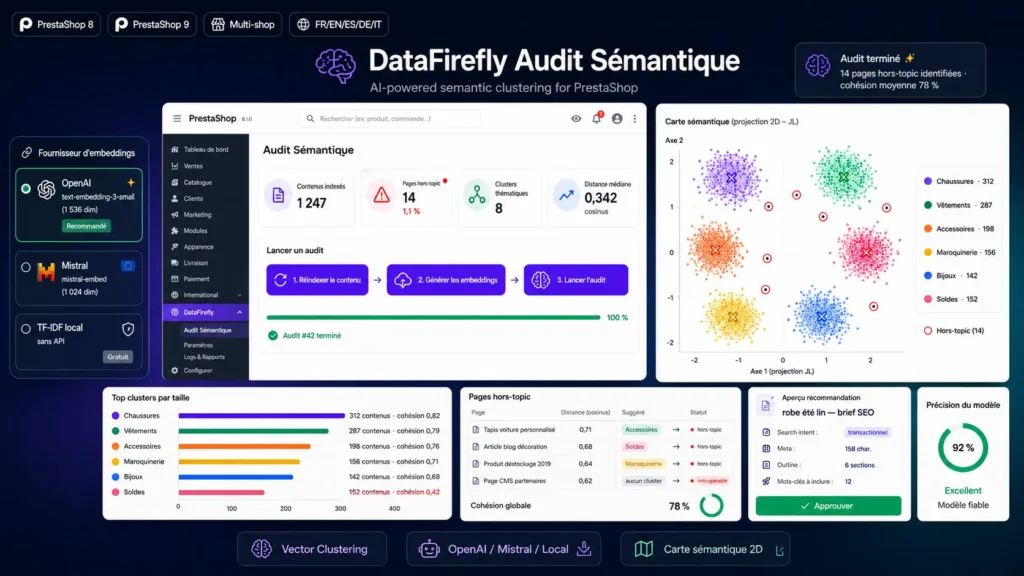
Each piece of content in your store is transformed into a vector of hundreds or thousands of dimensions, where each dimension captures an abstract semantic aspect. Two pieces of content on the same topic will have close vectors, two pieces on different topics will be far apart. The k-means algorithm groups these vectors into thematic clusters without human intervention — you discover the real structure of your catalog as a modern search engine perceives it.
§ 03
Three providers for three budgets
OpenAI offers the best quality with text-embedding-3-small (1,536 dimensions, ~€0.02 per 1,000 products). Mistral provides a European alternative hosted in France with mistral-embed (1,024 dimensions, similar pricing). Local TF-IDF mode runs entirely on your server with no API calls, using classic statistical NLP principles — ideal to get started with no commitment or recurring budget.
§ 04
The audit report in practice
After each audit, the module produces five complementary views: a dashboard with key KPIs (off-topic rate, median distance, cluster count), a 2D semantic map to visualize the catalog structure, a detailed cluster list with their representative terms and cohesion scores, a table of off-topic pages with move suggestions and estimated gain, and a table of 'hopeless' pages as noindex or deletion candidates.
§ 05
Automation and continuous workflow
The module registers hooks on the creation, modification and deletion of products, categories and CMS pages. As soon as content changes, it is flagged for re-embedding at the next run. A signed cron URL triggers the indexing → embeddings → audit pipeline in headless mode, for automated weekly or monthly verification. The full audit history is preserved to measure the evolution of your semantic coherence over time.




There are no reviews yet.